
The API Contract
Why a Strong GraphQL/REST Strategy Is Your Best Dev Tool
In my years of overseeing product development, I’ve found that speed and stability are often treated as competing goals.
When the backend team iterates on the data structure while the frontend team waits for schema finalization, velocity disappears — and instability takes over.
The solution I’ve seen work best doesn’t lie in writing faster code. It lies in documentation: the API contract.
The API contract is the formal agreement — the single source of truth — between the data provider (backend) and the data consumer (frontend, mobile app, or external partner).
Defining this contract upfront is the most critical step you can take to eliminate the “waiting game” and enable real parallel development.
The Silent Killer: Tight Coupling
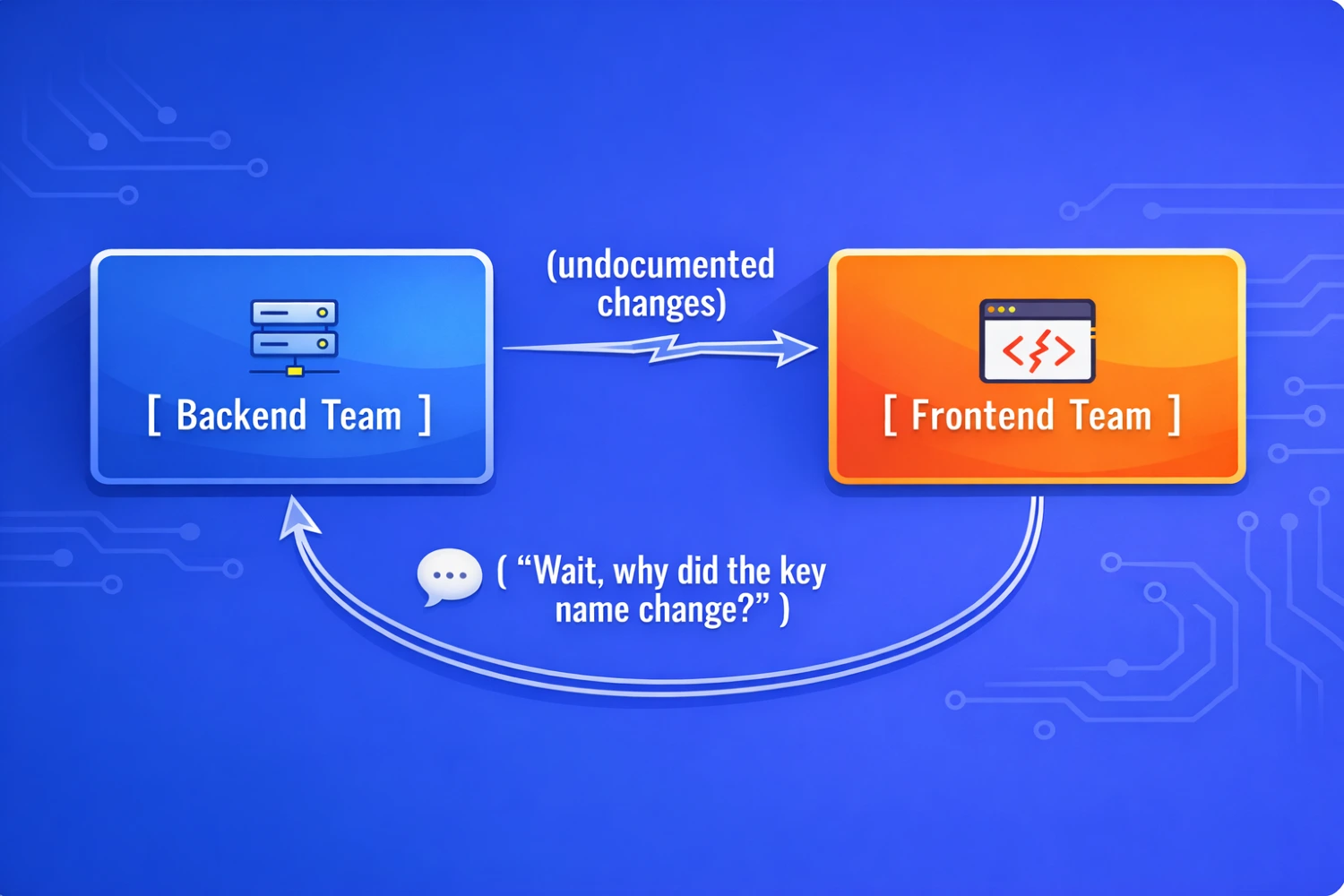
Many teams fall into the trap of developing frontend and backend sequentially — or worse, simultaneously without a clear blueprint.
A common scenario looks like this:
The backend engineer builds features in isolation. The frontend engineer designs the UI based on assumptions about what the data might look like.
This leads to tight coupling.
Tight Coupling Workflow
In a coupled environment, several problems emerge.
Backend Changes Break the Frontend
If a backend engineer renames a field (for example, changing userid to accountid), the frontend application immediately breaks.
The frontend developer must manually track and adjust every dependent reference.
In practice, this usually surfaces during urgent hotfixes — when teams discover their environments are out of sync.
Sequential Dependencies
The frontend cannot meaningfully begin work until:
- The database schema is finalized
- All API endpoints are implemented
- The backend is deployed
This creates a waterfall-like dependency chain where one team constantly waits for the other.
Velocity slows. Friction increases.
Brittle Testing
Integration tests rely on system stability.
Without a firm contract, APIs shift beneath the tests. The result:
- False failures
- Broken pipelines
- Eroded trust in CI/CD
Over time, teams start ignoring failing tests — which defeats the purpose of having them.
The Contract: Enabling Parallel Development
A strong API contract creates a stable, documented boundary between teams. This boundary enables true parallel development instead of fragile coordination.
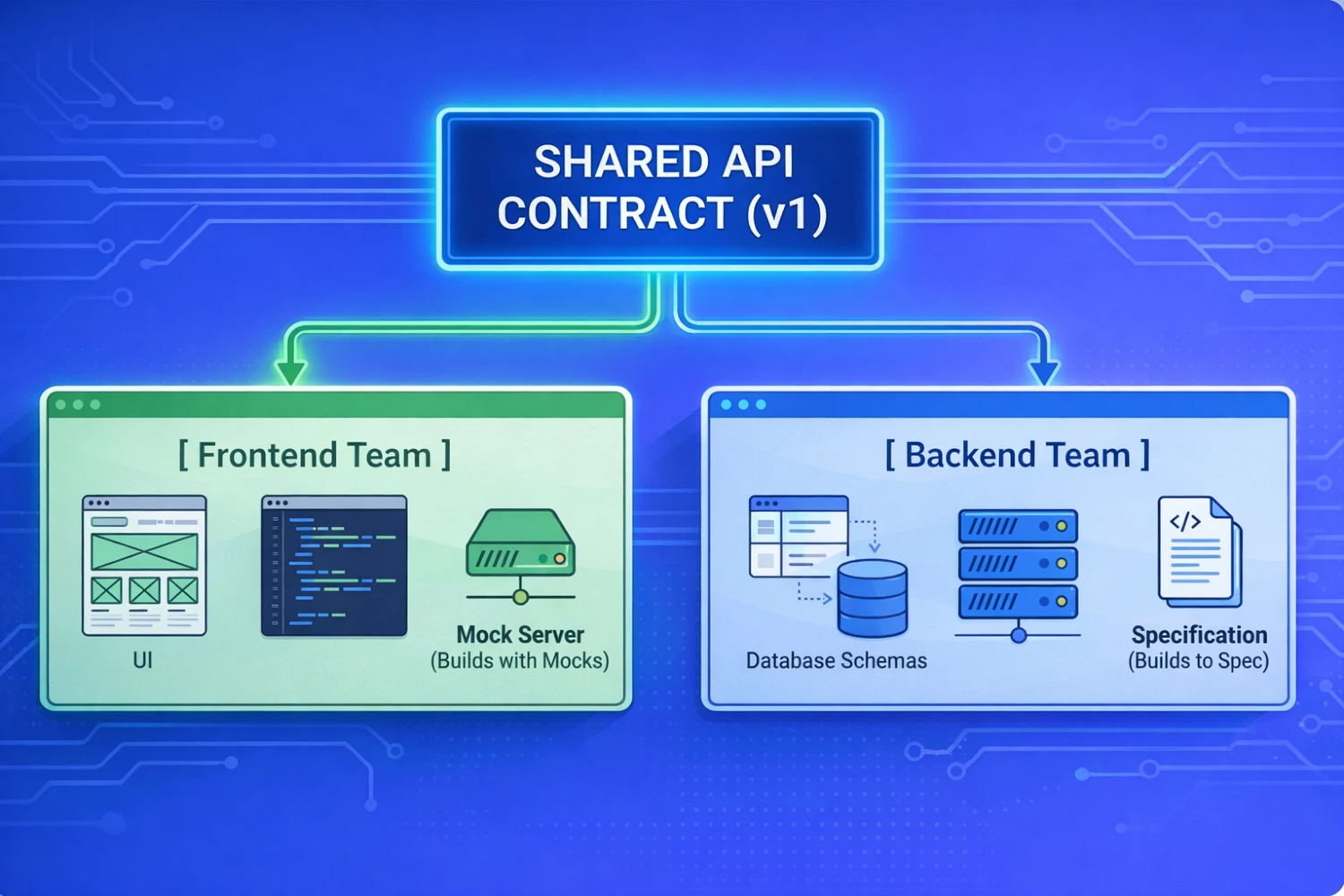
Decoupled Workflow
Here is how I recommend approaching decoupling.
1. Contract First
Before writing any code, define:
- What data will be requested
- How it will be structured
- What validation rules apply
This contract is versioned and agreed upon by engineering leads.
It becomes the foundation for all implementation.
2. Frontend Mocks the Data
With the contract defined, the frontend team can generate mock data that conforms exactly to the agreed structure.
They can build:
- UI components
- State management
- Display logic
All without a working backend endpoint.
3. Backend Implements to Spec
The backend team implements endpoints according to the contract.
They remain free to choose:
- Database
- Language
- Internal architecture
As long as the output matches the agreed interface.
4. Integration
Integration becomes a simple replacement:
Mock data → Live API
Because the contract was respected, integration proceeds with minimal friction.
The Value of Versioning
One of the most important habits I advocate for is API versioning.
Example:
/api/v1/users
/api/v2/users
Teams often struggle when they attempt to “fix” an API in place. Changing a live endpoint without versioning is a recipe for production incidents.
Versioning enables graceful transitions.
When a breaking change occurs:
Graceful Transition
Deploy /v2 alongside /v1.
No Firefighting
The frontend team can migrate on their own schedule — without outages or pressure.
Clear Sunset Path
Once migration is complete, /v1 can be safely deprecated and removed.
REST vs. GraphQL: Two Paths to Contract Enforcement
Both REST and GraphQL benefit from a contract-first approach. They simply enforce the contract differently.
REST and OpenAPI (Swagger)
For RESTful APIs, the contract is typically defined using OpenAPI (formerly Swagger).
Contract Definition
The OpenAPI specification (YAML or JSON) defines:
- Endpoints
- Paths
- Methods (GET, POST, PUT, etc.)
- Request parameters
- Response schemas
- Error codes
Enforcement
OpenAPI can generate:
- Server-side code stubs
- Client-side SDKs
- Documentation
It ensures implementation adheres strictly to the defined structure.
For enterprise teams, this structured documentation is as important as the code itself.
GraphQL and the Schema Definition Language (SDL)
GraphQL is inherently contract-driven.
The contract is not optional — it is part of the architecture.
Contract Definition
The Schema Definition Language (SDL) defines:
- Types
- Fields
- Relationships
It explicitly defines what the API can do.
Enforcement
The GraphQL server validates every request against the schema.
If the frontend requests a field that does not exist, the query fails immediately.
This type-safety acts as a runtime contract and enables:
- Predictable data structures
- Strong developer tooling
- Auto-completion
- Early failure instead of silent bugs
Conclusion
Choosing a strong API contract strategy — whether through OpenAPI for REST or the inherent schema of GraphQL — is not a luxury.
It is a core engineering discipline.
I always advise teams:
Do not start coding until you have agreed on the interface.
By establishing a stable, verifiable boundary early, you transform development from a coupled, sequential waiting game into a parallel, collaborative system.
The result:
- Faster feature velocity
- Less debugging
- Fewer production incidents
- An architecture that scales without painful refactoring
Feb 3, 2026

Drives the technical vision at Ramotion, uniting engineering excellence with design innovation to deliver scalable, secure, and user-focused digital solutions.