
Research is a crucial component of user experience design. From learning more about the users and market to iterating and improving designs, almost all phases of design require extensive research. However, Business-to-Business (B2B) research differs from Business-to-Consumer (B2C) research.
B2B user research focuses on enterprise environments, involving multi-role users, extended buying cycles, and complex decision-making processes that influence how products are evaluated and adopted. These elements require that B2B research focus on understanding the functionality of organizations, rather than isolated interactions between individual users.
Designers working in B2B environments need to understand the motivations, constraints, and business context of organizations’ day-to-day work. Researchers need to go beyond the surface-level user behavior and align their work with the goals, objectives, and values of concerned organizations.
Whether design and research teams conduct studies internally or work alongside a UX design consulting firm, the goals of B2B research include uncovering insights that enable the development of more intuitive, resilient, and enterprise-ready products.
In this article, we define what B2B user research means, along with a practical framework for effective research. We also discuss the differences between B2B and B2B research. Additionally, we share some important technical aspects that can help in conducting quality B2B research.
Join us as we explore this crucial topic for enterprises and businesses.
B2B User Roles
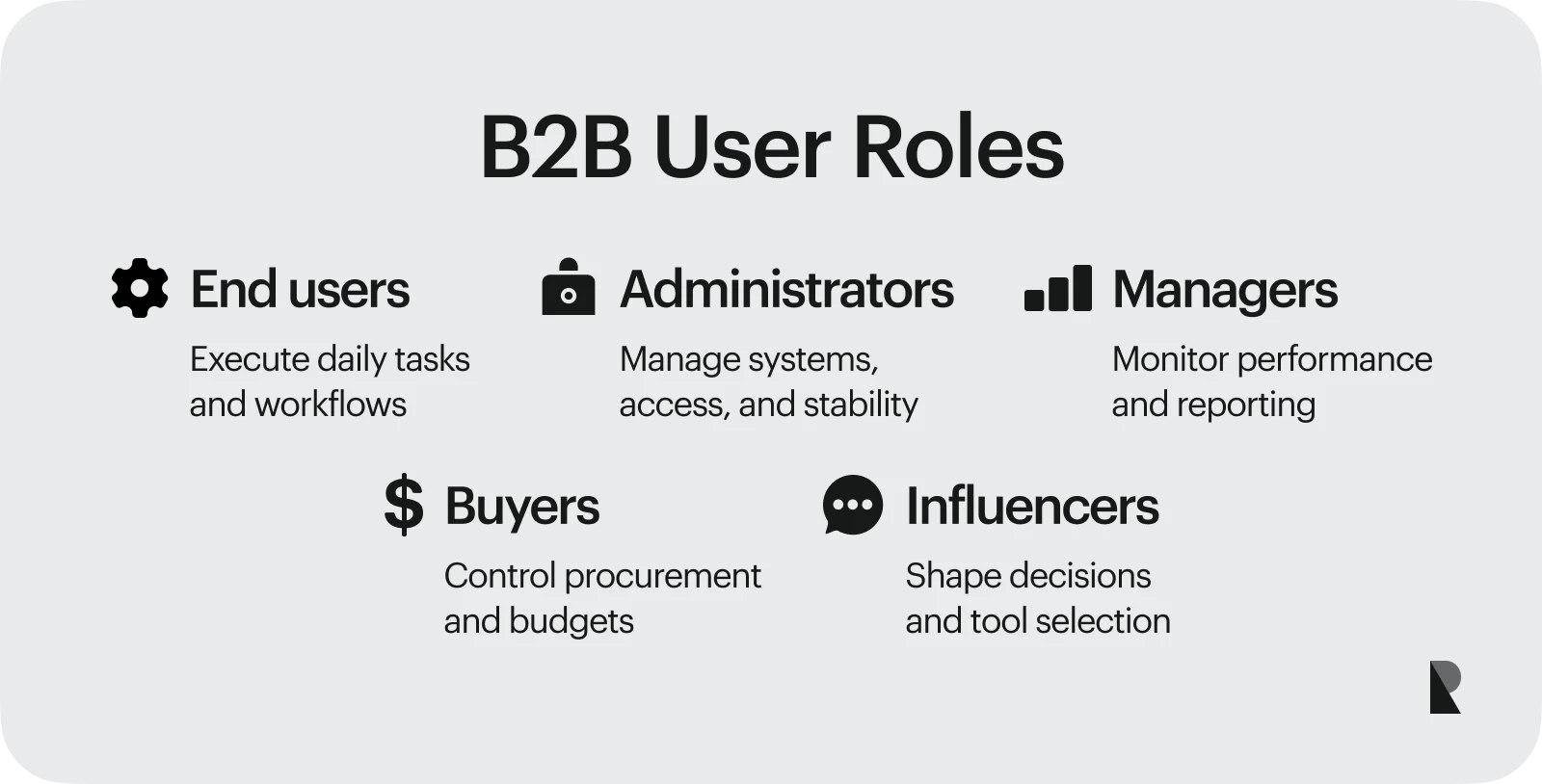
In business-to-business environments, it is essential to consider a diverse set of users rather than a single persona. Typically, user roles in a B2B environment include end users who perform daily tasks and interact with systems, administrators who maintain and manage systems, managers who monitor performance, buyers who handle procurement, and influencers who shape tool selection behind the scenes. Each role has its own expectations, constraints, and success metrics.
To effectively design a product or service, researchers must identify, understand, and map every role’s responsibilities, pain points, and decision authority. While end-users care about the workflow, administrators prioritize stability and control. Similarly, managers focus on reporting, and buyers prioritize cost. Understanding these roles and responsibilities is critical for meaningful B2B insights.
How to Research B2B Users?
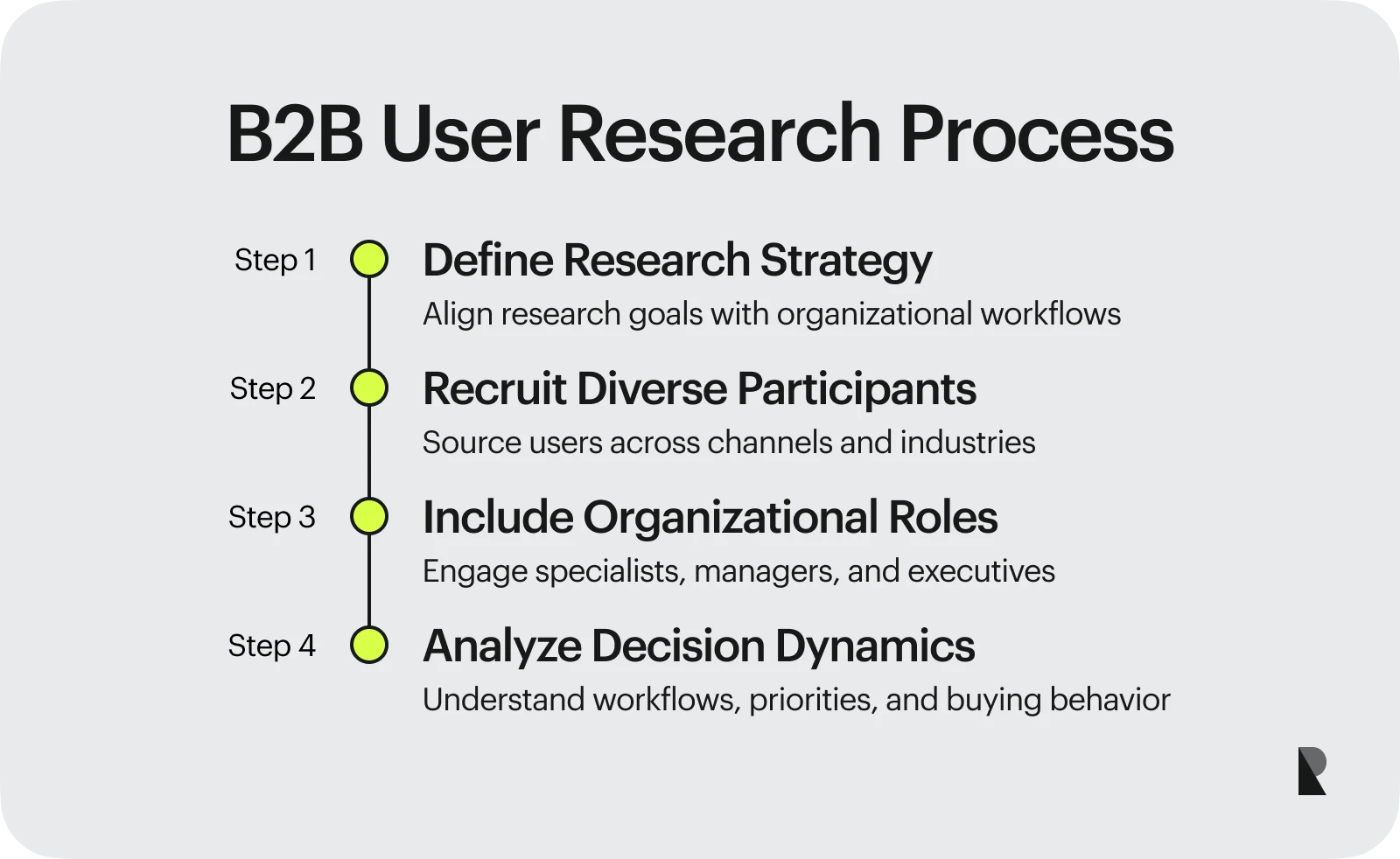
Researching B2B users is a process requiring specific strategies and approaches. This process should reflect the complex decision-making and the layered workflows involved. This goes beyond conducting generic interviews, where teams need a targeted plan to align with organizational roles and outcomes.
Researchers need to recruit the respondents from multiple channels, such as customer relationship management (CRM) tools, LinkedIn, industry groups, and professional panels. A mix of these sources would ensure that researchers can cover a wide range of audience groups.
It is also important to consider the hierarchy within organizations when conducting B2B user research. Effective studies include specialists who execute tasks, managers who oversee processes, and executives who shape priorities. This diverse perspective reveals how decisions are made and how products must adapt to serve all users.
B2B vs B2C Research Differences
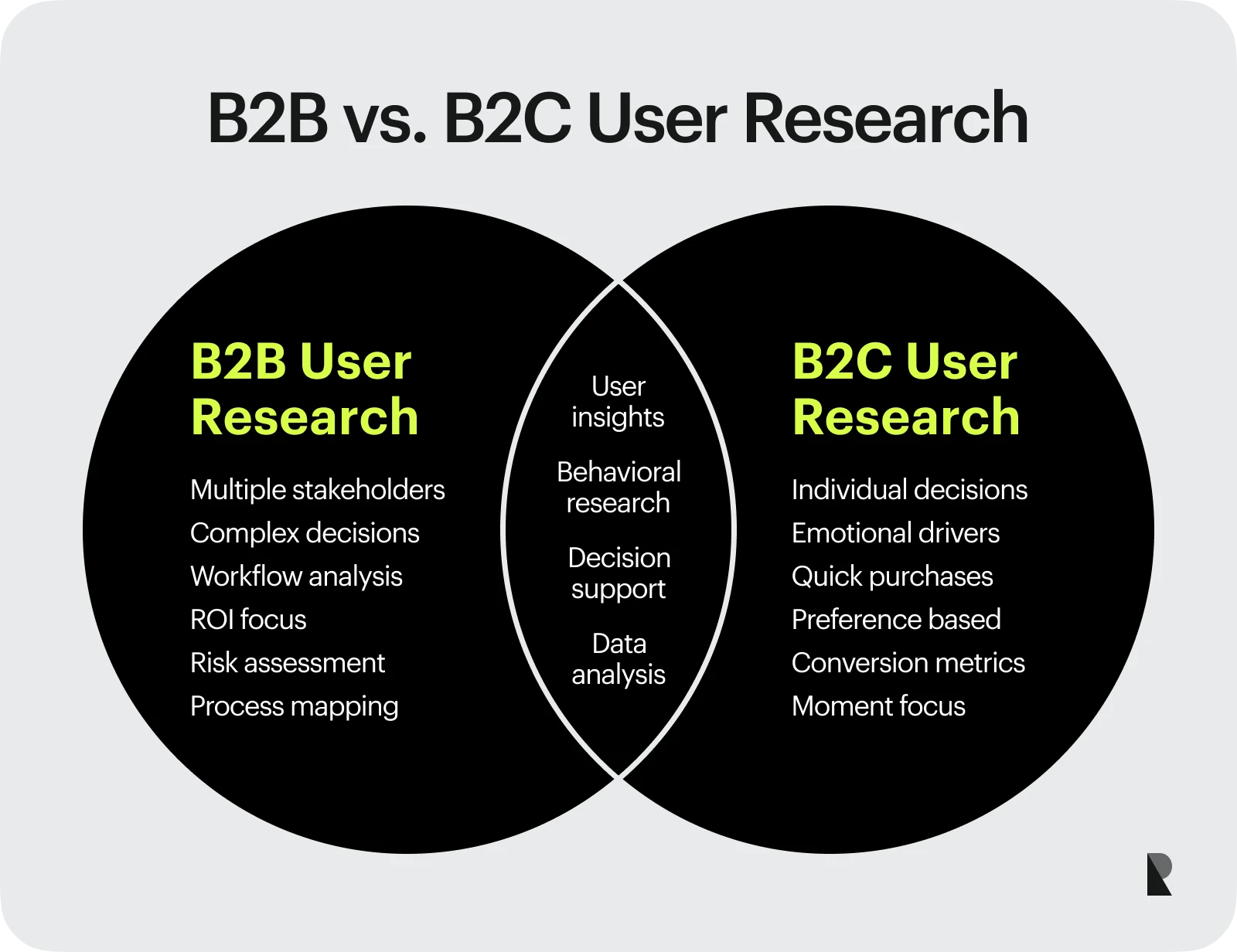
There are significant differences between B2B and B2C research. In business-to-business environments, researchers must consider multi-stakeholder decisions, complex approval processes, and shared accountability. Unlike B2C settings, decisions in B2B contexts are rarely made by a single individual, thus distinguishing how insights are gathered and analyzed.
Additionally, B2C research focuses on personal motivation and quick purchases, while B2B work prioritizes business decisions, such as risk and ROI. B2B research maps end-to-end workflows, rather than studying one-off purchases. It is essential to understand how information flows, who approves it, and where breakdowns occur.
B2B vs B2C Research Differences
| Aspect | B2B Research | B2C Research |
|---|---|---|
| Decision making | Multi-stakeholder, role-dependent | Individual, fast, and personal |
| Motivations | ROI, risk, workflow fit | Convenience, emotion, and preference |
| Research focus | End-to-end processes | Single moments or interactions |
| Success metrics | Efficiency, compliance, and team adoption | Satisfaction, conversion, and ease |
| Stakeholder roles | Users, admins, managers, buyers, etc. | Primarily, the individual consumer |
Supporting the Full Buying Journey
When a product team researches the B2B buying journey, it is crucial to focus on every stage of the B2B funnel. This means keeping a close eye on every stage, including discovery, evaluation, procurement, implementation, and renewal. Each phase of the journey involves different users, priorities, and pain points, thus highlighting key insights.
Discovery and evaluation stages help identify how teams compare solutions and assess risk. Procurement reveals organizational constraints. Implementation highlights onboarding and workflow impact, while renewal helps understand long-term value and user satisfaction.
It is also important to consider friction at every stage. By mapping friction across all phases, designers and researchers identify where users struggle, where expectations break down, and where better support or interventions can streamline the entire B2B buying journey.
Multi-Stakeholder Buyer Processes
In B2B environments, user research must closely consider how multiple departments interact with a product or service. It is essential to consider the roles of various teams, including operations, finance, IT, and security. When multiple stakeholders are involved in the decision-making process, their perspectives help to understand the product from different lenses, ranging from performance to cost.
Mapping all of these significant interactions is important not only to reveal their own priorities and business values, but also to identify the conflicting goals and misaligned requirements. Once these tensions emerge, teams can design solutions that satisfy shared priorities and mitigate friction throughout the entire organization.
Fixing User-Hostile Corporate Workflows
One important aspect of B2B research is that it uncovers internal processes that can cause friction, slow down the work, or lead to administrative concerns. These issues can arise due to legacy tools, outdated approval processes, or outdated policies.
With the help of thorough research, design teams can identify significant blockers and pinpoint where the pain points originate. This evidence helps product teams and stakeholders identify solutions that streamline workflows, reduce cognitive load, and provide users with a more efficient and satisfying experience.
Resolving these issues, which often become an inherent part of an organization’s ecosystem, is a complicated process. It requires simplifying steps, updating tools, and designing new user journeys. B2B research can drive these changes and help create intuitive workflows.
Effective B2B Research Methods
When conducting B2B user research, product design teams must rely on several key methods to gather and analyze data. Such research requires a mix of qualitative and quantitative methods to generate meaningful insights across complex organizations.
Many companies conduct such research internally, while others collaborate with top UX/UI design agencies to reach the right participants and interpret findings with enterprise context in mind. In either case, combining methods creates a clearer picture of real behaviors and constraints.
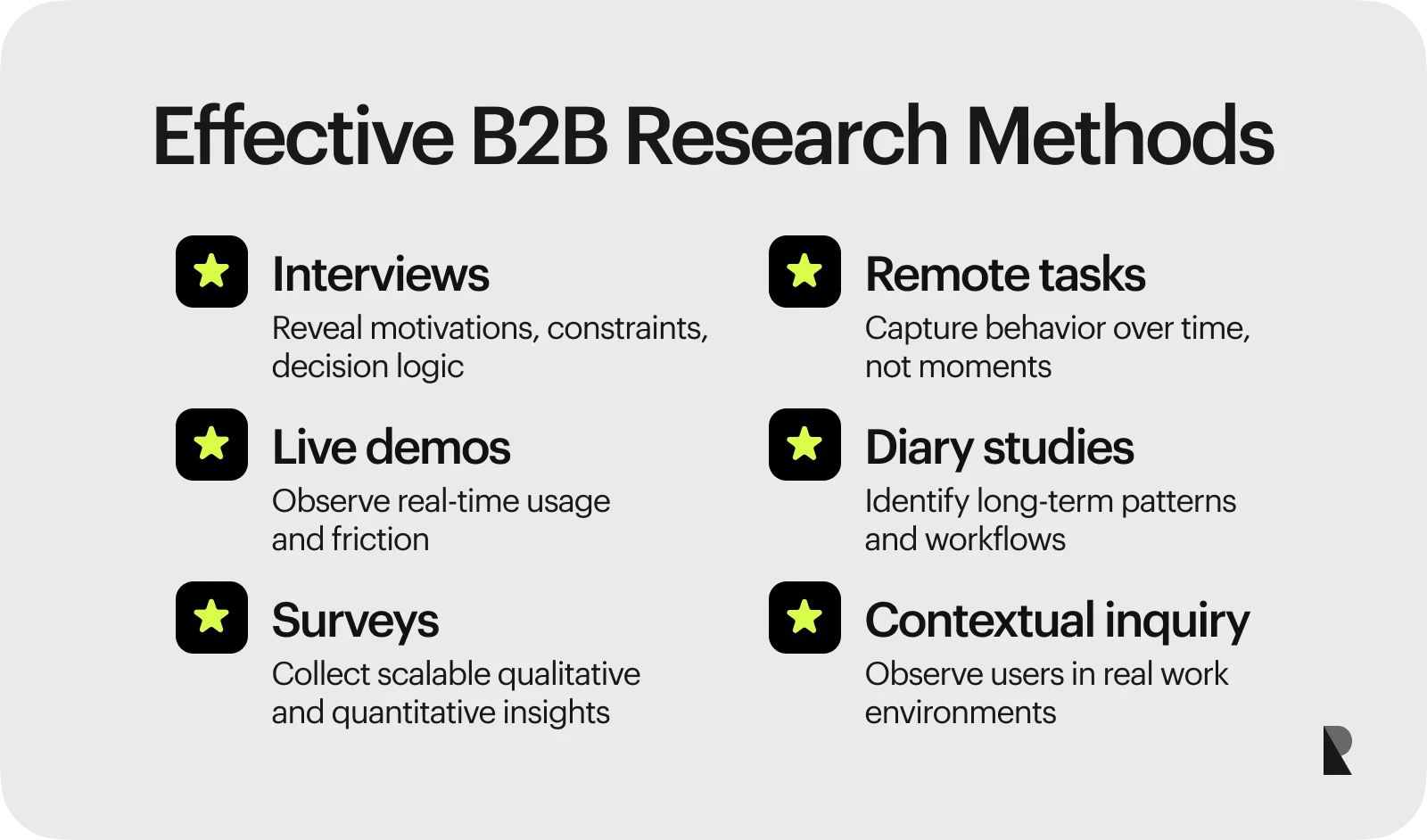
The following are some important methods to consider in B2B user research.
Synchronous research: interviews and live demos
Interviews are one of the most powerful ways to understand motivations, constraints, and pain points in B2B environments. When researchers speak with users, they gather valuable insights into the decision chains, workflows, and working situations.
During the interviews, live demos can also be helpful in capturing real-time reactions. Interviews, combined with live demos, help observe how participants respond to features, ask questions, or struggle during their interactions.
Asynchronous research: surveys and remote tasks
Asynchronous methods, such as surveys, are also helpful in gathering both qualitative and quantitative insights. Surveys enable researchers to understand the perceptions and motivations of large populations and different audience groups. For B2B contexts, surveys are particularly useful in gathering measurable evidence to guide decisions.
Another asynchronous approach requires the use of longitudinal studies, such as diaries and remote tasks. These methods help reveal long-term patterns, rather than focusing on a single moment or a microinteraction. Long-term studies help produce insights that are impossible to capture in short sessions.
Contextual inquiry in real workspaces
Contextual inquiry is another tested approach that enables researchers to observe users in their natural environments. Such field studies enable them to observe how B2B users interact with products and services in their physical workplaces, such as offices and production floors, as well as in digital spaces, including CRMs and support queues.
With the help of contextual inquiry, researchers can document workflows, user interactions, and communication patterns to uncover insights that go beyond abstract conversations. Such an immersive research method reveals how products succeed – or fail – within real-world contexts.
Tips for B2B Exploratory Research
Exploratory B2B research requires a structured approach to discovery, particularly when the problem space is unclear. Early research approaches should focus on testing and refining hypotheses, which can then lead to narrowing the scope and defining the research space.
With the help of iterative loops, researchers and product designers can validate assumptions, observe real user behaviors, and reveal insights that matter to both users and the business environment.
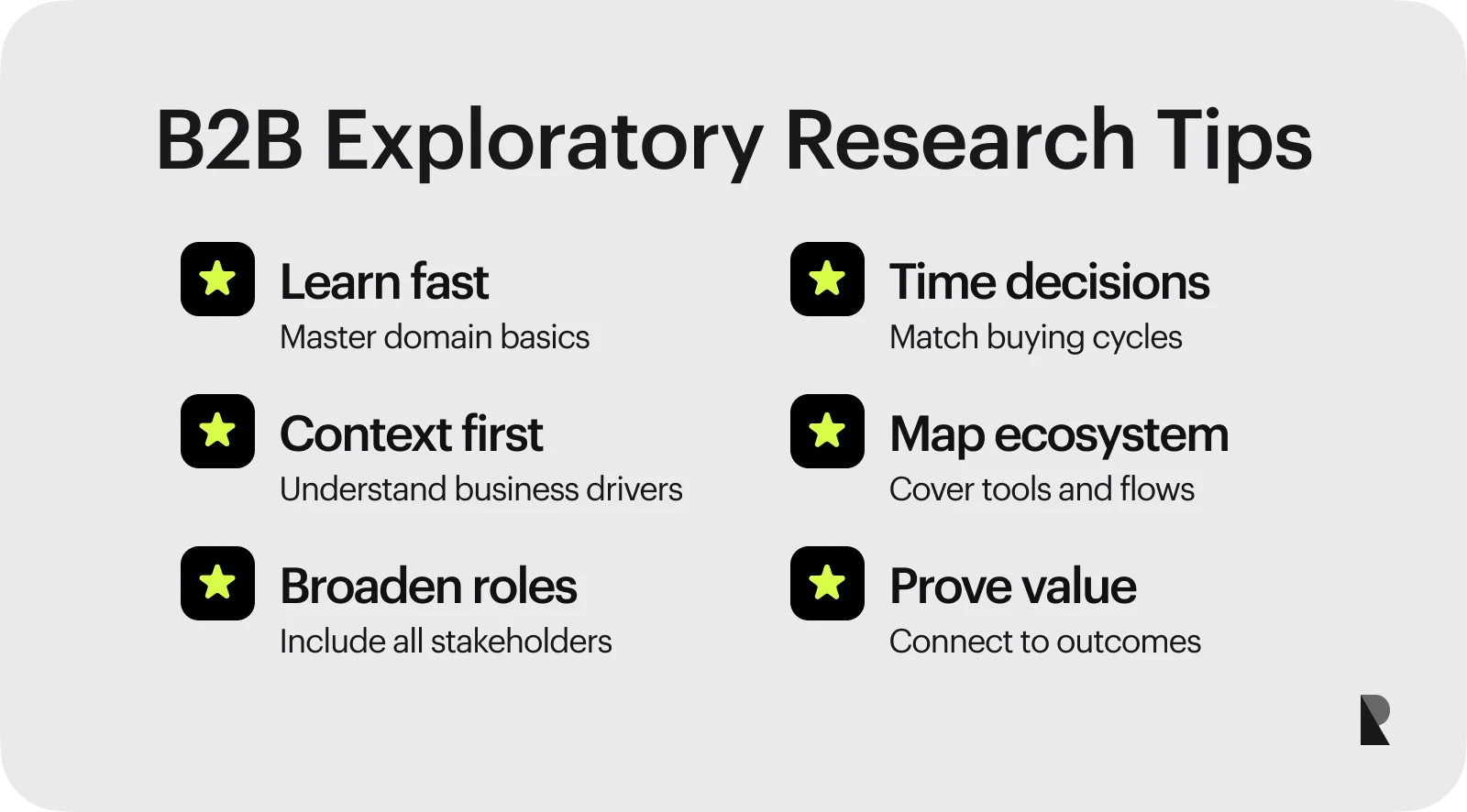
The following are some helpful tips for conducting B2B exploratory research.
Learn the industry fast
Strong exploratory research always begins with understanding the industry’s trends, terminology, and workflows. After building these foundations, researchers can not only ask better questions and interpret the findings accurately.
It is essential to develop this shared understanding, as mirroring the language of respondents builds trust and encourages openness, making users more willing to share deeper insights.
Account for business context
Just as with any UX design challenge, it is crucial to understand the entire business context and ecosystem. Effective exploratory work maps all the processes and phases, such as approvals, handoffs, policies, and impacts, that define design requirements.
When researchers align these insights with real-world contexts and scenarios, they can not only create better designs but also continually improve them over time, resulting in increased user satisfaction.
Include diverse stakeholders
B2B research can only be successful if a diverse range of users and stakeholders is taken into consideration. Since B2B environments rely on multiple user roles, such as managers, executives, support teams, and others.
Each group has its own needs and pain points. Researchers can compare their perspectives to surface gaps and reveal structural issues that influence adoption and long-term success.
Align with decision cycles
Exploratory research has the most impact when it aligns with the organization’s natural workflow and values. It is essential to consider resources, budget, calendars, and policies to maximize the benefits of B2B user research.
Aligning work with these milestones ensures that insights reach decision-makers when they are most effective, thereby increasing the likelihood of better outcomes.
Explore the full ecosystem
B2B tools do not function in isolation. Therefore, researchers must always map every system, integration, and dependency that shapes how users complete their tasks and interact with design solutions.
An ecosystem-level view uncovers pain points and constraints that can otherwise go unnoticed. Such an in-depth understanding is crucial for designing solutions that accurately match real-world systems.
Tie findings to business impact
For exploratory B2B research to have an impact, it is essential to tie the findings to and present them in a way that aligns with the business goals. Researchers should frame these findings in terms that leadership understands, such as efficiency gains, ROI, and scalability.
Researchers must translate observations into measurable business values to help teams make informed decisions. With the help of these findings, designers and researchers can prioritize improvements strategically and ensure that insights are turned into actionable steps.
Recruiting the Right B2B Participants
B2B user research starts with effective recruitment of participants. It is essential for researchers to establish rigorous selection criteria based on the role, expertise, and decision-making authority of target users. This clarity can help in gathering a representative sample of users, which can then lead to useful insights. Designers and researchers should also validate that potential participants truly match the target personas.
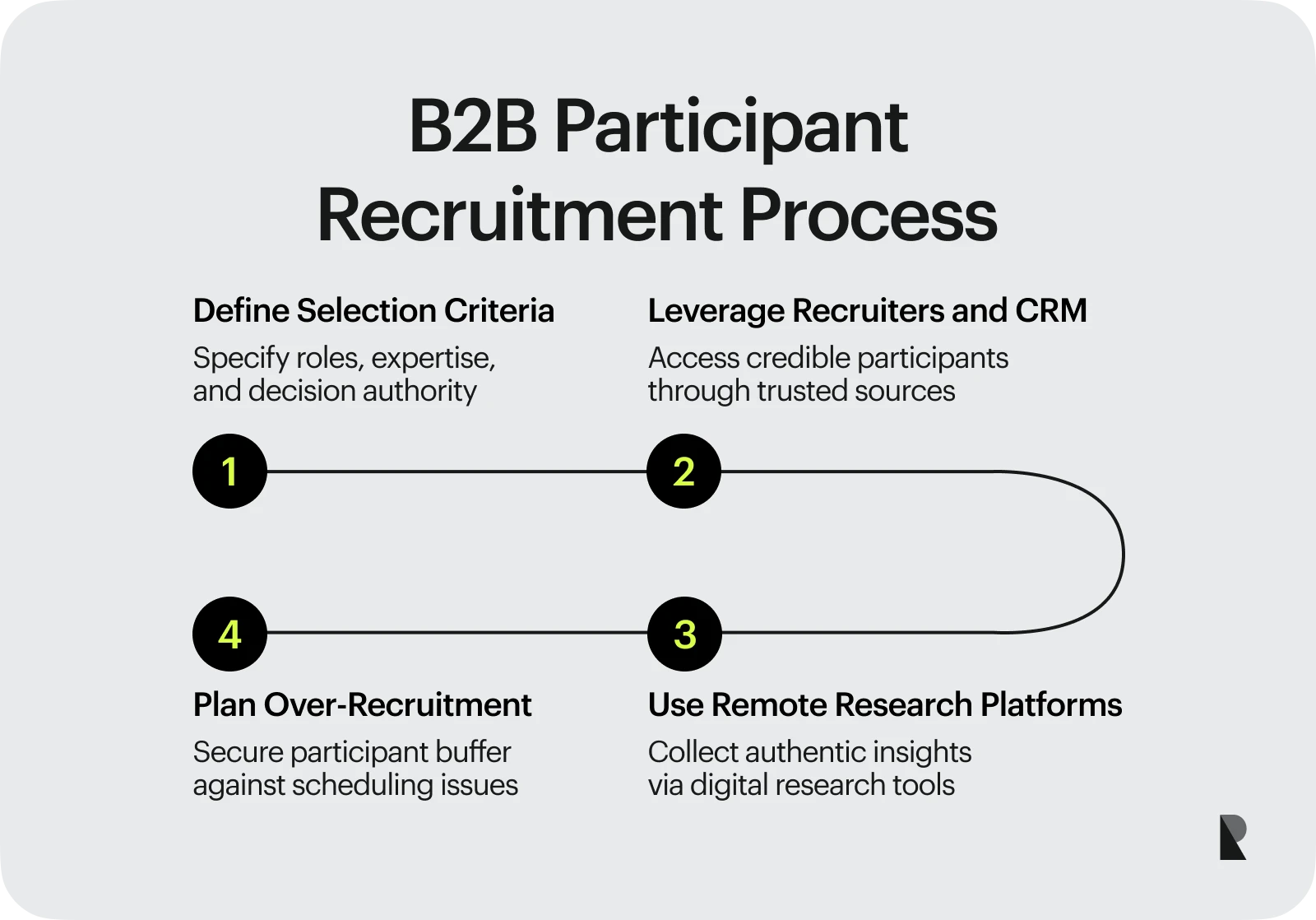
Use professional recruiters and CRM data
Researchers should partner with specialized B2B recruiters to ensure access to difficult-to-reach roles and find credible users. CRM lists can also help add precision by providing context-aware contacts already familiar with the problem space.
Use remote insight platforms
Platforms like Indeemo and Dscout are examples of tools that can help streamline remote qualitative work by enabling video diaries, screen recordings, and quick feedback. These tools enable researchers to capture authentic behaviors from research participants, thereby enhancing data richness.
Apply AI for transcription and analysis
AI tools, such as Otter.ai, Fireflies.ai, and TurboScribe, are helpful in several ways. One such way is to automate transcription, coding, and analysis. These features reduce manual labor, ensure efficient analysis, and free researchers to focus on interpreting insights instead of processing raw data from users.
Plan for over-recruitment
Research in B2B environments can be challenging, as schedules are often unpredictable. Therefore, teams must over-recruit to offset cancellations and delays. Gathering participants as a buffer ensures that the study is not compromised by any disruptions.
Boosting B2B Respondent Engagement
When it comes to conducting B2B user research, engaging professionals requires streamlined and respectful interactions. Researchers need to focus on reducing friction by clarifying expectations early and making participation feel purposeful.
What are some ways to boost B2B respondent engagement?
Some ways to boost B2B respondent engagement are as follows.
- Be transparent about goals
- Offer meaningful incentives
- Gamify engagement
The following are some important ways to boost B2B respondent engagement.
Be transparent about goals
Before any activity, researchers should clearly share their objectives, expectations, and the outcomes they hope to achieve. A transparent attitude helps build trust and enables users to understand their role and purpose in research, thus increasing their willingness to participate actively.
Offer meaningful incentives
Participants are always more inclined to work with researchers who offer good incentives. Research teams should strive to align incentives with participants’ expectations and the value of their time. Competitive compensation signals respect and encourages users, especially for managers and domain experts.
Gamify engagement
It is also important to incorporate interactive tasks and rely on light gamification to make participation more enjoyable. These elements reduce fatigue, keep users engaged, and often lead to more thoughtful and richer contributions.
Designing and Running Effective B2B Research
A successful research project begins with a clear plan that defines objectives, specific hypotheses, realistic scenarios, and clear metrics, along with a structured analysis workflow that guides decisions from kickoff to synthesis.
Communicate the “Why”
Explain the purpose behind each activity so participants understand how their input will shape the research project. When people understand the value of their contribution, they provide more thoughtful insights and share context that might not otherwise surface.
Give participants ownership
Invite participants to take ownership of their involvement in the research process. Encourage them to critique scenarios, suggest alternatives, and participate in generating ideas. Treating participants as collaborators, rather than just test subjects, strengthens the project and yields more relevant findings.
Treat low engagement as insight
Low participation is generally considered a bad aspect of research projects. However, it is rarely random. Researchers should document non-responsiveness, delays, or incomplete tasks, as these can provide valuable insights.
Tools and Technology for Better Insights
With advancements in technology, B2B research is also getting better. Modern research benefits from specialized tools that streamline data collection and analysis, reducing effort while improving the quality of insights.
Mobile ethnography and video diaries
Mobile ethnography tools enable observation of day-to-day behavior. With the help of modern tools, participants can record short videos that reveal real contexts, interruptions, and workflows. This method provides a rich example of how users actually work, offering details that traditional interviews often miss.
Digital platforms for scalable insights
Modern, large-scale research platforms support rapid recruiting, structured analytics, and remote participation. These tools allow teams to reach diverse users and run studies asynchronously. With the help of digital platforms, even complicated research projects can be completed effectively and efficiently.
Conclusion
B2B research is not a one-time fix or an ad-hoc solution. It is a continuous and strategic practice that adds value to product growth and helps meet real organizational needs. With changing user roles and workflows, research and discovery ensure that teams stay aligned and focused throughout the process.
As tools and platforms evolve, insights must also change to keep pace with them. Regular iteration helps teams adapt confidently and build products that remain valuable, robust, and relevant in complex enterprise environments.
Dec 8, 2025

Creates insightful, strategy-driven content that translates complex design and branding concepts into accessible knowledge, supporting Ramotion’s mission to elevate digital experiences.