
B2B portal development is rapidly transforming the enterprise software landscape. According to statistics, the B2B e-commerce market is projected to grow to $47,772.6 billion by 2030, with an estimated annual growth rate of 11.8% from 2021 to 2030. Additionally, Gartner states that by 2025, 80% of all B2B sales will be held online.
With this significant shift toward online operations, we've seen growing demand for custom B2B portal development from organizations seeking to streamline operations and enhance collaboration. B2B web portal development has become essential for enterprises looking to maintain competitive advantages in increasingly digital marketplaces.
Whether you're considering working with a web app development company or exploring B2B portal software options, this technical guide will provide the foundation you need. As enterprise architects, understanding the security considerations and technical requirements for B2B portal development services is crucial for delivering solutions.
What Is a B2B Portal?
A B2B portal represents a secure online platform that connects businesses with their partners, suppliers, and customers through a centralized digital hub. For executive teams planning to partner on a build that must scale across accounts, regions, and roles, this shortlist of top companies for scalable web app development offers a practical way to benchmark delivery capability and architectural discipline. This specialized interface enables a range of self-service capabilities and streamlines complex business-to-business transactions that traditional systems cannot match.
Essentially, these portals function as sophisticated digital ecosystems where businesses purchase, sell, and exchange goods and services while managing crucial relationships.
Modern B2B portal software extends far beyond basic transaction processing, integrating vital management tools, customer relationship management systems, data analytics, and comprehensive self-service features.
The core purpose of custom B2B portal development involves creating a single point of access where business customers can:
- Browse personalized product catalogs with contract-specific pricing
- Place and track orders autonomously without administrative assistance
- Access invoices, credit notes, and complete payment histories
- Communicate directly with account managers or support teams
- Download important documents and track deliveries in real-time
Unlike disconnected spreadsheets or email-based ordering systems, B2B portal development services establish centralized processes that enable faster transactions and clearer communication across entire supply chains.
Furthermore, these platforms play a pivotal role in digitizing traditional business operations, ensuring seamless connections between suppliers, manufacturers, wholesalers, and various stakeholders.
The technical foundation supporting B2B portal development relies on cutting-edge technologies. Cloud computing provides the infrastructure, while integration with Enterprise Resource Planning (ERP) systems ensures the portal reflects accurate "source of truth" data for contract pricing, inventory levels, and credit terms.
For enterprise architects working with a B2B portal development company, understanding that these systems prioritize complexity management proves crucial. Unlike B2C platforms that focus primarily on convenience, B2B portals must handle intricate workflows, role-based permissions, negotiated pricing structures, and comprehensive ERP integrations.
Types of B2B Portals
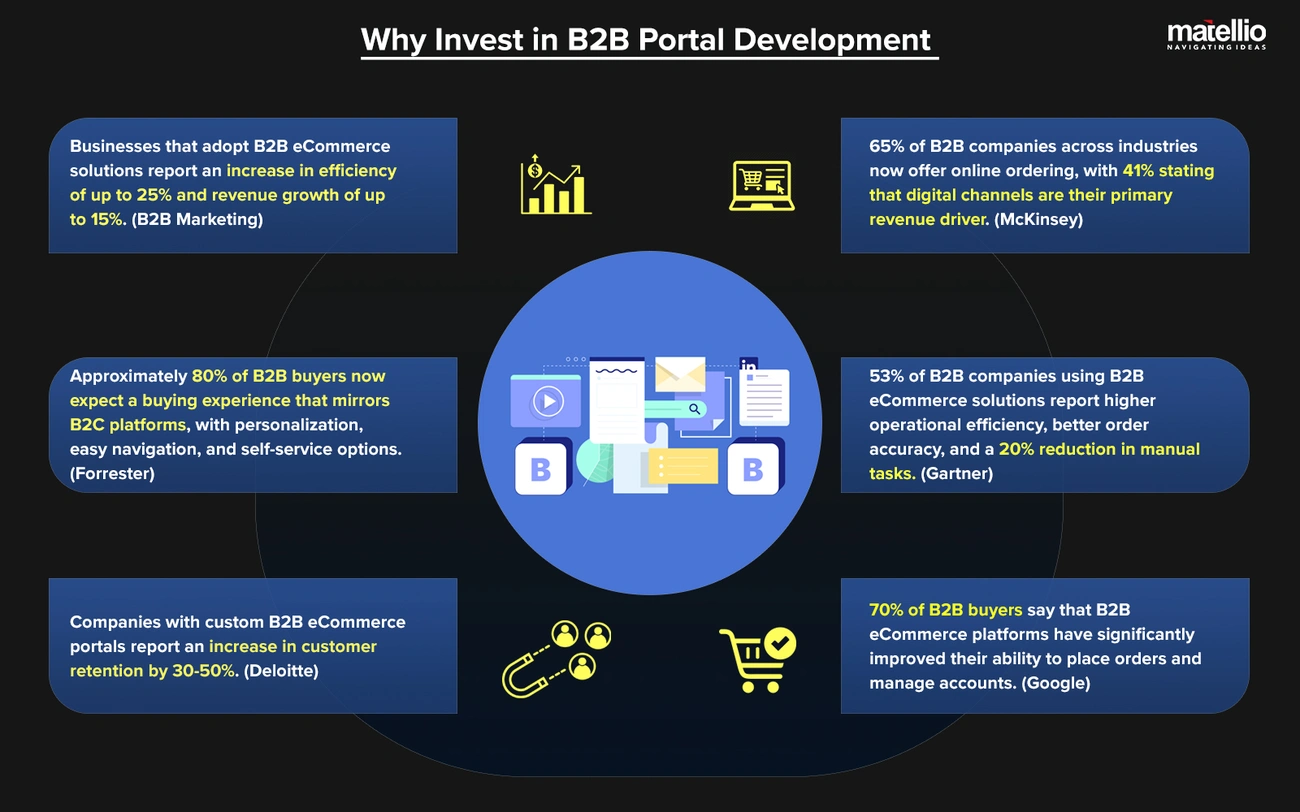
Infographic detailing key benefits and statistics (Image Source)
Modern enterprises leverage specialized portals to address specific business needs. Each serves distinct functions in B2B portal development while sharing the common goal of enhancing digital business operations.
Supplier portals
Supplier portals streamline vendor management by consolidating all supplier transactions and requests in a single, secure location. These platforms enable businesses to efficiently communicate with suppliers who can submit necessary documents, send personalized price lists, and manage purchases.
A well-designed supplier portal typically includes tools for order placement, inventory management, and performance-tracking analytics dashboards.
B2B E-commerce portals
B2B e-commerce portals facilitate online transactions with customized catalogs, pricing structures, and bulk ordering capabilities. These platforms help manufacturers, wholesalers, and distributors showcase products and process orders efficiently. In fact, 80% of B2B organizations are actively seeking ways to integrate their e-commerce technology with cloud-based systems to eliminate siloed operations.
Customer portals
Customer portals function as one-stop shops where business clients can independently manage their accounts. A survey of nearly 100 manufacturers found that 66% plan to invest in customer portals in 2024.
These self-service platforms enable customers to track orders, review invoices, make payments, and assess existing contracts 24/7. Moreover, they provide real-time visibility into product stock levels, order status, and shipping details.
Partner portals
Partner portals strengthen business relationships by connecting companies with distributors, resellers, and other stakeholders. These platforms contain role-based access control, secure document management, and collaboration tools.
Research shows that brands offering self-service solutions often outperform those that don't, with 80% of high-performing businesses providing self-service capabilities, compared to just 56% in low-performing businesses.
ERP portals
ERP portals ensure seamless communication between commerce solutions and Enterprise Resource Planning systems. Through API-based integration, these portals facilitate real-time synchronization of crucial data, including inventory levels, pricing, and customer information.
Consequently, businesses achieve streamlined operations through automated processes like order management, invoicing, and fulfillment.
Custom web portals
Custom web portals address unique business requirements that standard solutions cannot fulfill. These tailored platforms can include specialized workflows, industry-specific features, or unique integration requirements.
A B2B portal development company can create these solutions by analyzing specific business needs and implementing targeted functionality, thereby providing maximum value through personalized user experiences.
Benefits of Implementing a B2B Portal
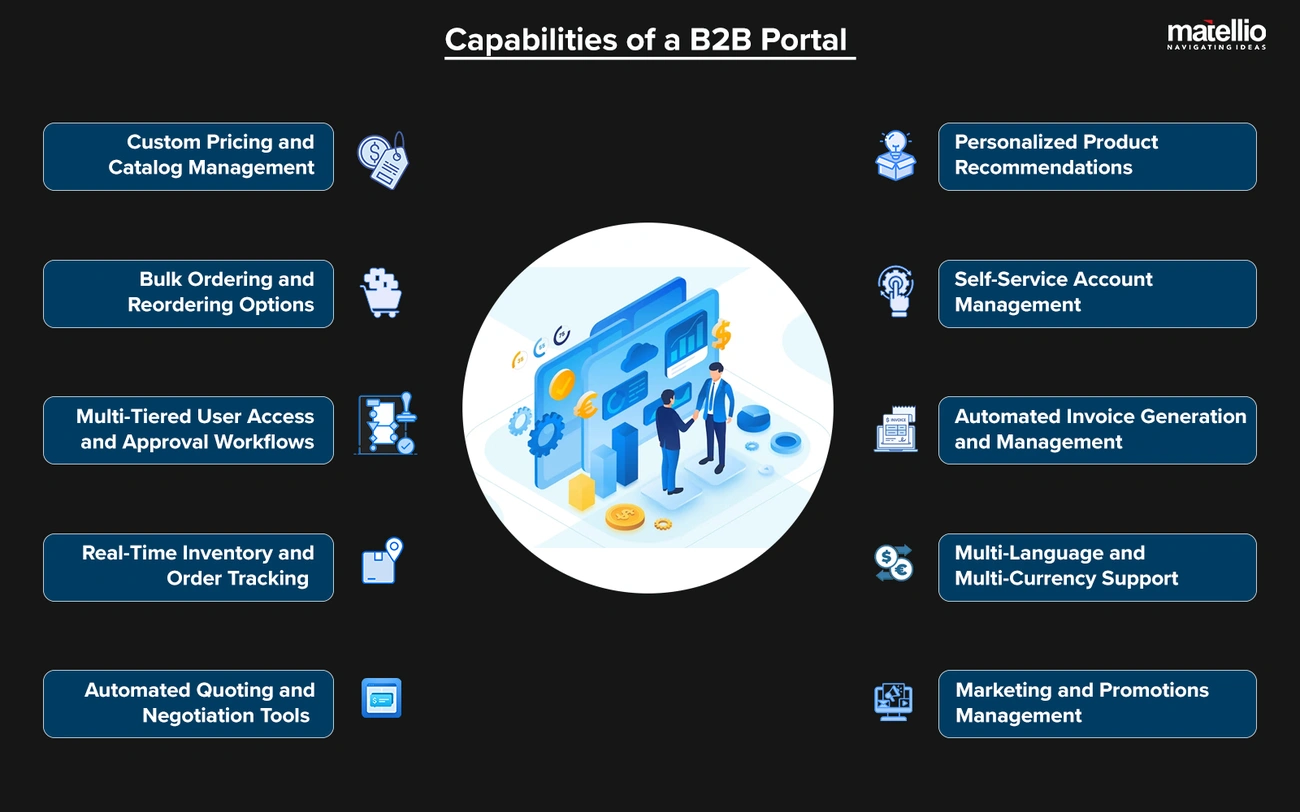
Infographic listing key capabilities of a B2B portal (Image Source)
Implementing a robust B2B portal delivers measurable advantages across multiple business dimensions. As organizations face increased digital demands, these platforms have become essential infrastructure rather than optional enhancements.
Streamlined operations & automation
First of all, B2B portal development significantly reduces operational overhead by automating routine tasks. Studies reveal that order processing speeds up by 45% with integrated systems, while accounting errors drop by 40% through automation.
When buyers manage orders independently, sales teams can concentrate on strategic activities rather than administrative tasks.
Improved collaboration & communication
Custom B2B portal development enhances collaboration through centralized communication tools that eliminate delays and miscommunication. These platforms enable seamless document sharing, project management, and real-time updates between stakeholders.
Notably, B2B portal development services create digital collaborative workspaces where teams can interact effectively despite geographic separation. This capability proves especially valuable for global operations, where traditional business-hour limitations disappear.
Self-service efficiency
Self-service capabilities represent a cornerstone benefit of modern B2B portal development:
- 68% of buyers report saving between 30-60 minutes per purchase when using self-service portals, with 21% saving over 2 hours
- 90% of portal users interact with sales representatives fewer than 7 times, compared to 52% of non-users who require 8+ interactions
- Customer service costs can be reduced by up to 30% through self-service implementation
Better customer experience
Subsequently, improved customer experiences directly impact business results. Currently, more than 8 in 10 customers globally expect organizations to provide online self-service support portals. A superior digital experience influences supplier choice for 40% of B2B buyers.
Therefore, companies that invest in high-quality B2B portal development partnerships often see higher customer satisfaction scores, resulting in lower churn rates and stronger sales performance.
Data accuracy & real-time visibility
As a result of portal implementation, businesses gain unprecedented data accuracy and visibility. Real-time insights into inventory levels, order status, and delivery tracking enable proactive decision-making.
When enterprises provide immediate access to this information, support teams can transition from reactive troubleshooting to strategic problem-solving. This transparency builds trust, as 95% of B2B buyers believe self-service portals improve purchasing efficiency.
Essential Elements of a Good B2B Portal
Creating an effective business portal involves several critical components that enable secure and efficient operations. When examining successful B2B portal development initiatives, four essential elements consistently stand out.
Role-based access control
Security foundation begins with properly implemented role-based access control (RBAC). This system answers the fundamental question: "Can this user perform this specific action?"
A robust B2B portal software solution must include customizable permission structures that define precisely what users can view, modify, and execute within the system. Typically, a well-designed RBAC framework includes:
- Clearly defined permission sets tailored to specific job functions
- Hierarchical role structures (such as
Owner → Admin → Member) - Granular controls that can be adjusted as organizational needs evolve
Real-time data sync
Continuous data synchronization ensures that changes made in one system immediately reflect across all connected platforms. This capability proves crucial for B2B portal development services that integrate with ERP systems, creating a "single source of truth" for all stakeholders. Proper synchronization:
- Pulls critical ERP data into the portal (inventory, pricing, customer information)
- Pushes portal activities back to core systems (orders, payments, support requests)
- Minimizes latency issues that could otherwise lead to errors or duplicated work
Intuitive UI/UX
Behind every successful custom B2B portal development project lies thoughtful interface design. Although B2B applications serve professionals handling complex processes, users still expect the same design quality found in consumer products. Effective B2B interfaces balance simplicity with functionality by:
- Accommodating multiple user types, from executives to daily operators
- Prioritizing clean, purpose-driven layouts over flashy visual elements
- Ensuring consistent navigation patterns across all portal sections
Reliable support & maintenance
Even the most well-designed B2B portal development company offerings require ongoing attention. Comprehensive support structures include self-service resources alongside traditional assistance channels. Successful portals incorporate:
- Knowledge bases and FAQs addressing common scenarios
- Community forums where users can share experiences and solutions
- Performance metrics that continuously evaluate portal effectiveness
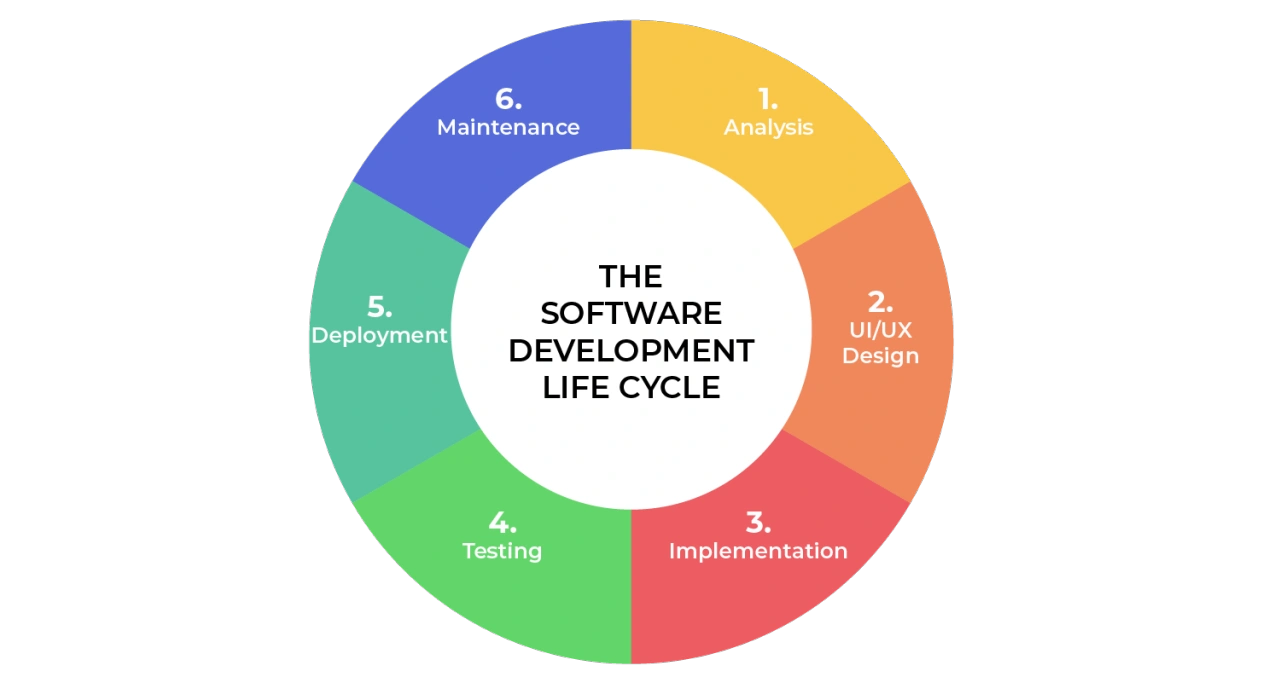
Circular diagram of the Software Development Life Cycle (Image Source)
Developing a secure B2B portal requires a systematic approach with well-defined phases. The following six-step process ensures the successful implementation of enterprise-grade portals.
Step 1: Requirement analysis
Firstly, a comprehensive assessment of business needs forms the foundation of any successful B2B portal development. This initial phase involves defining general and specific goals, identifying key problems the portal should solve, and mapping out operational requirements.
Business analysts and project managers typically outline essential features, integrations, and scalability needs during this stage. Prior to writing any code, teams conduct market research and competitor analysis to ensure the portal delivers unique value.
Step 2: UI/UX design
Following the requirements gathering phase, the design phase transforms abstract information into realistic mockups. This hands-on prototyping delivers an intuitive user experience tailored to B2B environments.
Throughout this process, designers focus on convenient navigation, interface layouts, and responsive designs that work across all devices. Accordingly, user flow optimization ensures smooth navigation for different roles (administrators, suppliers, buyers) while maintaining consistent design patterns.
Step 3: Development
During development, front-end and back-end coding bring the portal to life. Developers create user-facing components using modern frameworks while simultaneously building backend systems to handle business logic, data processing, and security.
This phase often employs iterative development cycles lasting 2-4 weeks, depending on project scope.
Step 4: Integration
At this point, the portal is connected to critical business systems, including ERP, CRM, logistics APIs, and payment gateways. These integrations establish seamless data flow between the portal and existing enterprise applications.
Properly configured connections guarantee real-time data accuracy and eliminate manual work by enabling automatic synchronization of inventory levels, pricing, and customer information.
Step 5: Testing
Before deployment, comprehensive quality assurance evaluates functionality, security, and performance. Testing typically includes compatibility checks across devices and browsers, as well as functional verification.
Validation test cases cover security audits and user acceptance testing. Many projects use automation frameworks such as Selenium or Cypress to streamline testing while ensuring thorough coverage.
Step 6: Deployment & maintenance
Finally, after passing validation, the portal is deployed to cloud environments such as AWS, Azure, or Google Cloud. Post-launch activities include performance monitoring, troubleshooting, and continuous feature enhancement.
The maintenance process involves tracking uptime, load performance, and making regular updates to keep the system secure and efficient. Proper support structures include knowledge bases alongside traditional assistance channels for ongoing user assistance.
Technologies for B2B Portal Development
Technology stack (Image Source)
Selecting the right technology stack is fundamental to creating secure and scalable B2B portals. Each technological component plays a unique role in delivering high-performance solutions that meet complex business requirements.
Frontend technologies
Initially, the frontend development process requires frameworks that enable responsive, interactive user interfaces. React.js has emerged as popular for developing dynamic interfaces with fast load times. Meanwhile, Angular provides an ideal environment for complex applications requiring real-time data binding.
Vue.js offers a lightweight alternative that balances flexibility with quick rendering for b2b portal software solutions. These frameworks enable component-based architectures that isolate functionality and accelerate development cycles.
Backend technologies
The server-side foundation typically relies on robust frameworks that handle multiple requests simultaneously. Node.js excels at processing concurrent requests, making it suitable for high-traffic B2B portal development services.
Alongside this, Django (Python) delivers security and scalability for data-heavy applications, whereas PHP (Laravel) enables the development of secure, adaptable business applications. Custom B2B portal development often leverages these technologies to build APIs and business logic layers.
Databases
Data storage decisions equally impact portal performance. MySQL provides reliability for structured data and transactional processing. PostgreSQL handles high-volume data analysis effectively.
In essence, MongoDB offers scalable NoSQL storage, while Redis serves as an in-memory data store for caching and session management in B2B portal development projects.
Cloud platforms
Presently, cloud solutions prevent local server limitations by offering scalability and security. Services like AWS automatically scale to handle traffic surges without performance degradation. These platforms provide the infrastructure necessary for custom B2B portal development that can evolve with changing business requirements.
Security practices
Most importantly, OAuth 2.0 ensures secure authentication across platforms. SSL encryption protects data during transmission, and two-factor authentication adds another verification layer. Given these points, robust security measures form the backbone of trustworthy B2B web portal development.
B2B Portal Development Costs
The financial investment in B2B portal solutions varies widely based on several key factors. Understanding these costs helps organizations plan budgets effectively and avoid unexpected expenses.
Estimated cost by phase
B2B portal development typically follows a tiered pricing structure across implementation phases:
- Discovery & Analysis: 5,000-15,000
- Design: 10,000-30,000
- Development: 30,000-150,000
- Integration: 15,000-50,000
- Testing: 8,000-25,000
- Deployment & Training: 5,000-20,000
Factors affecting total budget
Several variables influence custom B2B portal development costs:
- Complexity & Scale: The number of features, user roles, and workflow complexity directly impact development hours.
- Integration Requirements: Integrating with existing ERP/CRM systems can account for 20-30% of total project costs.
- Customization Level: Off-the-shelf solutions with minimal adaptation cost less than fully customized portals.
- Technology Stack: Using newer technologies may increase initial costs but often delivers better long-term value.
- Geographic Location: A B2B portal development company in North America or Western Europe typically charges 2-3 times as much as its Asian counterparts.
Conclusion
B2B portals have established themselves as critical infrastructure for modern enterprises seeking to gain a competitive advantage in increasingly digital markets. Throughout this guide, we've examined the fundamental aspects of secure B2B portal development that enterprise architects must consider when implementing these powerful business solutions.
The diverse array of portal types, including supplier, e-commerce, customer, partner, ERP, and custom portals, demonstrates the versatility of these platforms in addressing specific business needs. Each type serves distinct functions while sharing the common goal of enhancing digital business operations and streamlining complex processes.
Implementing a B2B portal delivers significant measurable benefits. Businesses experience streamlined operations through automation, enhanced collaboration via centralized communication tools, and remarkable efficiency gains from self-service capabilities.
Additionally, organizations gain better customer experiences, which directly impact business results, alongside improved data accuracy and real-time visibility across operations.
Successful B2B portal implementation relies on several essential elements. Role-based access control forms the security foundation, while real-time data synchronization creates a single source of truth across systems.
Intuitive user interfaces balance simplicity with functionality, and reliable support structures ensure ongoing effectiveness through proper maintenance.
The systematic six-step development process, including requirement analysis, UI/UX design, development, integration, testing, and deployment, provides a roadmap for creating enterprise-grade portals. This methodical approach ensures thorough consideration of business needs, user experience, security requirements, and system integrations.
Technology selection remains fundamental to creating secure, scalable B2B portals. From frontend frameworks like React and Angular to robust backend technologies, database solutions, and cloud platforms, each component plays a unique role in delivering high-performance solutions that meet complex business requirements.
Jan 16, 2026

Creates insightful, strategy-driven content that translates complex design and branding concepts into accessible knowledge, supporting Ramotion’s mission to elevate digital experiences.