
Quality is part of the brand
Users don’t separate code from design. They judge the experience based on how quickly a page loads, how stable it feels, and how consistently it behaves. That is the brand in action. Reliability is the new form of trust. The strongest collaborations with branding companies start by aligning on what “trust” means operationally—shared standards, measurable experience quality, and fewer surprises after launch. It isn’t declared in campaigns, it’s felt with every interaction. Brands that manage quality systematically look mature. They don’t promise. They deliver.
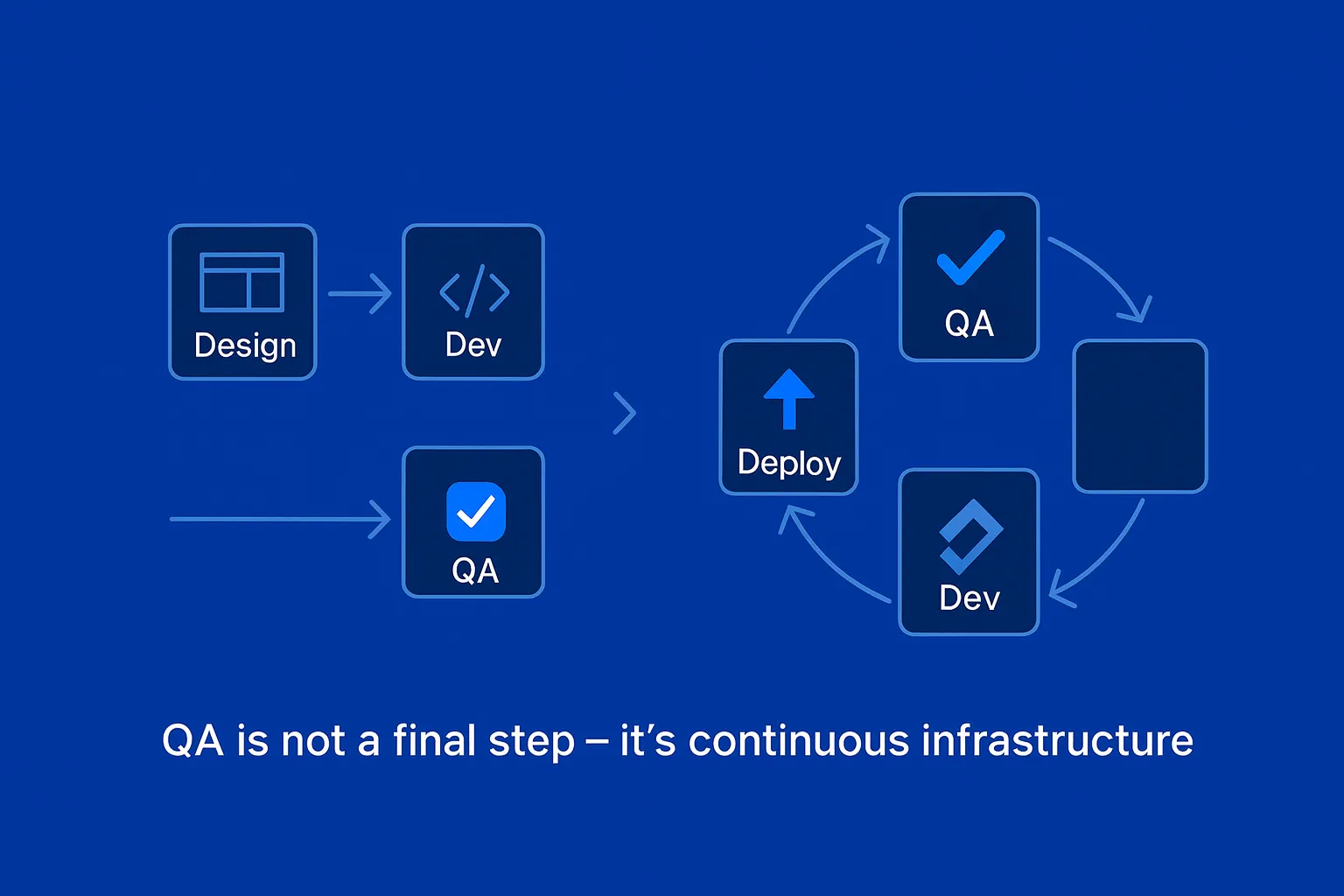
QA as continuous infrastructure
In many teams, QA is still “the last check before release.” In mature ones, it’s part of the product’s foundation. Every campaign, content update, or integration adds risk. Unified QA standards make that risk manageable.
QA as infrastructure
Standards define a shared language between design, engineering, and content:
- Visual parameters: grids, typography, spacing, and color.
- Accessibility: Contrast, alt text, ARIA labels, and keyboard navigation.
- Performance: Core Web Vitals, Lighthouse scores, Time to Interactive.
- Behavior: DOM stability, responsiveness, animations.
These checks run automatically inside the pipeline.
Every pull request triggers automated tests:
- Pa11y validates WCAG A/AA compliance.
- Lighthouse CI audits performance.
- Chromatic / Percy run visual diffs.
- Slack bots publish QA reports with metrics and statuses.
If critical issues are found, the merge is blocked. QA becomes part of the build, not an afterthought.
Consistency is a brand asset
Consistency is invisible but felt. When spacing, color, or typography differ between pages, users notice, even subconsciously. QA enforces design consistency at the component level.
Tools like Storybook visual tests and Chromatic compare every build against the design baseline. A deviation of even 1–2 pixels triggers a failure.
Result: visual memory stays intact. Users receive a consistent experience across devices, markets, and campaigns. It’s not only aesthetics, but it’s also brand equity.
Accessibility signals maturity
Accessibility is no longer optional. It’s professionalism and responsibility in practice. WCAG A/AA standards are the baseline. Pa11y, axe-core, and Lighthouse Accessibility check for contrast, labels, heading structure, and form behavior.
Accessibility is built into the Definition of Done. No feature ships without passing accessibility checks. The result benefits everyone: better UX, higher CTR, stronger SEO. Reliability in experience is reputation made tangible.
Reliability as habit
Users don’t see tests. They see stability. When forms submit instantly, animations feel smooth, and layouts behave the same across browsers, that’s QA at work. QA isn’t about finding bugs. It’s about validating expectations.
Every stable click builds trust. That’s why QA is part of branding, not just production.
How QA standards create competitive advantage
Speed without chaos
Automation cuts release time by 30–40%. Each merge triggers Lighthouse, visual diff, and accessibility checks. Issues are caught before production, not after feedback. Teams ship faster, quality stays predictable.
Independence from individuals
Quality no longer depends on a “strong tester.” Checklists, Pa11y configs, Lighthouse templates, and CI workflows ensure consistency. New teams or vendors plug into the same framework. Standards make quality repeatable.
Scale without loss of control
When QA lives in CI/CD, dozens of projects can run simultaneously. Each build is evaluated automatically. Visual diff stability > 98% becomes the norm, not the goal. Scaling no longer means lowering quality.
Transparency as communication
Automated reports are sent to Notion, Slack, or generated as PDF summaries. Clients see real metrics: Accessibility 95%, Lighthouse 88, Regression 0. QA becomes communication, not just control. That visibility builds trust between companies.
Metrics that measure trust
Modern QA is numbers. Numbers that engineers and executives both understand.
| Metric | What it shows | Why it matters |
|---|---|---|
| Lighthouse score | Overall UX health | Impacts SEO and user trust |
| Core web vitals | Speed and stability | Directly affects bounce rate |
| Accessibility | WCAG compliance | Reflects inclusivity and reputation |
| Visual match | Design fidelity | Defines brand consistency |
| Regression rate | Repeated defects | Indicates process maturity |
Raising the Lighthouse score by 10 points can reduce bounce rate by 8–12%. WCAG AA compliance increases brand credibility and reduces legal risk. Consistency builds confidence.
Metrics turn “it looks fine” into a management language. It’s a language everyone can read.
Reputation through precision
Every detail reflects the system behind it. Where QA culture exists, the interface feels controlled. Where it doesn’t, even good design looks sloppy. Quality is now a public indicator of discipline. Tools like Lighthouse, PageSpeed, and Pa11y make it visible to everyone. Users don’t forgive chaos, and they shouldn’t.
When QA becomes strategy
Airbnb uses component-level visual testing. Thousands of pages stay visually identical across devices and languages.
Spotify includes accessibility and performance in its Definition of Done. No release ships without WCAG and Core Web Vitals checks.
Work & Co integrates QA into design itself. Testing begins at the component stage, not after development.
QA isn’t in control. It’s architecture.
The business link
QA directly affects business metrics:
- Higher Lighthouse scores improve SEO and lower acquisition cost.
- Stable UX increases conversion and retention.
- Fewer regressions mean fewer post-release costs.
- Predictable launches accelerate go-to-market velocity.
Quality is now a competitive factor.
The market trusts what’s consistent.
Conclusion
Brands no longer compete on visuals alone. They compete on reliability. Every pixel, every millisecond, every green check in CI contributes to perception. Standardized QA makes quality predictable. Predictability builds trust. And trust is the most valuable brand asset.
QA isn’t error control. It’s proof that a company keeps its word.
Dec 10, 2025

Drives the technical vision at Ramotion, uniting engineering excellence with design innovation to deliver scalable, secure, and user-focused digital solutions.