
Did you know successful brands refresh their appearance and communication every 3-5 years to stay relevant to their target audience’s needs and expectations? Today’s reality for businesses is harsh. While companies could operate comfortably without changes for 10-15 years decades ago, the situation is radically different these days. Businesses have to adapt much faster because of flourishing social media, a fast-paced technology landscape, and ceaseless customer demand for novelty.
However, rebranding is more than keeping up with others. It is a strategic move that affects key factors such as customer relationships, a brand’s identity, operations, and digital assets. It might easily propel a company to new heights when done with the guidance of one of the top rebranding agencies, or vice versa, destroy it completely when taken lightly.
Before taking any step, gather information and make a well-weighed decision, as one wrong move in today’s highly exposed digital landscape might cost more than the brand’s reputation.
Here are some questions to ask before rebranding to ensure a safe, effective, and profitable restyling, restructuring, and modification.
Do You Need a Rebrand?
First things first. Does your company actually need a rebrand? Even though the fast-moving World pushes you to accelerate, it is still important to consider your type of industry. Some sectors move fast, while others experience slower brand decay because customers prioritize stability and tradition.
Business owners also must consider factors beyond industry. They need to be clear about the cause and scale of the proposed change by understanding the difference between rebranding, repositioning, and visual refreshment. Here are several important questions to ask when rebranding seems inevitable.
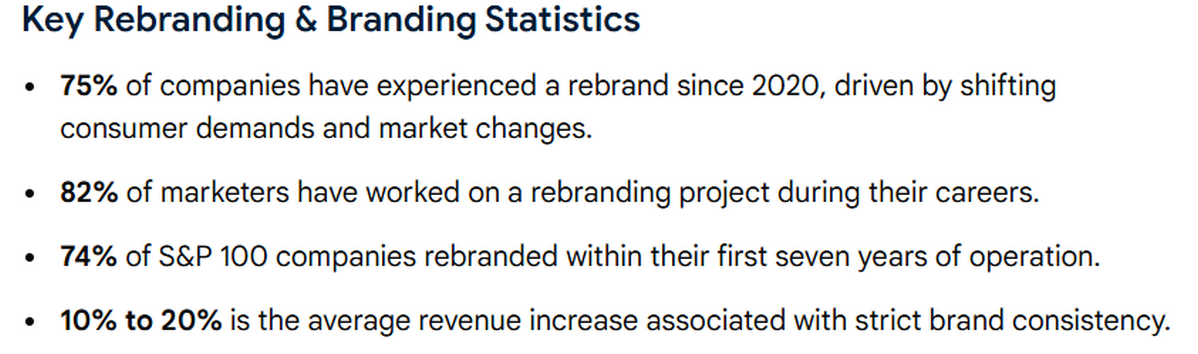
Key rebranding statistics (provided by Google)
1. Why rebrand now?
Is it time to change the company’s appearance, feel, or communication methods? This is perhaps one of the most popular brand redesign questions.
Time is money, and acting too early or too late can easily halt you. To get the timing right, companies need to recognize the trigger for change, understand its nature, and plan the adjustments accordingly.
Many drivers signal urgency for transformation, or at least refreshment. The most common are increased competition, changing audience demands and expectations, economic instability, organizational shifts, ruined reputation, and even technical necessities driven not only by the technology landscape but also by laws and regulations.
Defining the right drivers for change is crucial, as every step requires significant investment of time, human resources, and money.
2. What business problem should the rebrand solve?
Rebrand is a generic term that often confuses entrepreneurs, making them falsely believe that updating their logotype, using modern design features, or adding catchy phrases might do the trick. In fact, the process goes much deeper, influencing not just the company's core but its entire internal structure and work culture.
On the other side, rebranding is one of the best tools to “cure” underlying business problems. For instance, when applied at the right time, it can save a company’s shattered reputation, strengthen customer trust, increase brand equity, attract international markets, empower internal operations, unite the team, generate new ideas, and give a new product a chance to survive.
3. Would a brand refresh be enough?
Brand refreshment can be a true lifesaver for some companies, and a waste of money for others. How well it performs largely depends on the company’s ability to understand what needs to change and how: overall strategy, brand positioning, brand architecture, visual design, communication, or internal operations.
Not all situations require a full restructuring and re-evaluation; sometimes even a small visual or communication update can solve the problem. A company’s rebranding strategy largely depends on its core values, the reason for the rebrand, and the ultimate goal.
4. What must the rebrand preserve?
The rebranding process comes in many shapes and sizes, from a small logotype tweak to drastic changes driven by mergers. Most of the time, companies make minor changes that involve adjustments to visual elements, communication methods, or market positioning. During this process, brand identity and personality remain untouched: values, mission, and proposition stay intact, while recognizable assets, credibility, and vision may change.
In a full overhaul, merger, or acquisition, companies might rebuild everything, including core units such as brand values and mission. They might change their visual design, brand message, and value proposition to emerge with new equity.
Therefore, what elements to preserve during the rebranding process largely depends on business objectives, cause, project scope, limitations, and available resources.
5. What has changed in the business?
Multiple factors drive the need for rebranding, making it hard to identify the correct trigger in time. A shift in audience preferences can signal action, but so can changes in revenue model, ownership, vision, brand values, mission, products, the economic landscape, and technical progress.
Business owners should track changes across the board and document them for thorough, evidence-based analysis. Only clean, relevant data, plus consistent documentation and tracking of the landscape, provide a solid foundation for timely decisions.
6. What should the company be known for in 3–5 years?
The first decade of a company’s lifecycle can be harsh, often the toughest period. To get through it, it is highly advisable to conduct a deep brand audit and set the right goals by understanding what your company should be known for in 3- 5 years.
Entrepreneurs should focus on a brand’s reputation and market position, as these assets provide a solid foundation for decisions inside and outside the company. They must align with strategy, planning, and the ultimate goal and vision. When done well, they help the company grow from a fresh face nobody knows to a strong competitor in the category.
7. What is included in the rebrand?
Rebranding is a multi-layer initiative that can easily drag a company into an infinite loop of changes, especially without professional assistance. Many details require careful consideration and execution.
A good example is when rebranding requires companies to adjust visual communication methods, which can affect visual identity, the website, mobile application, product UI, messaging, and internal and external operations. Defining the scope of adjustments depends on the required deliverables and goals.
8. What are the budget, timeline, and constraints?
Financial commitments, strict deadlines, and hidden mitigations can make rebranding a true nightmare. Addressing them correctly and on time by allocating resources effectively and keeping limitations from negatively affecting development and rollout can save the company from many problems.
Start by clarifying the budget, launch date, dependencies, and legal requirements; then identify constraints and limitations across boards, including even the smallest and fastest operations. Finally, analyze available resources to understand how to move forward effectively and meet internal requirements.
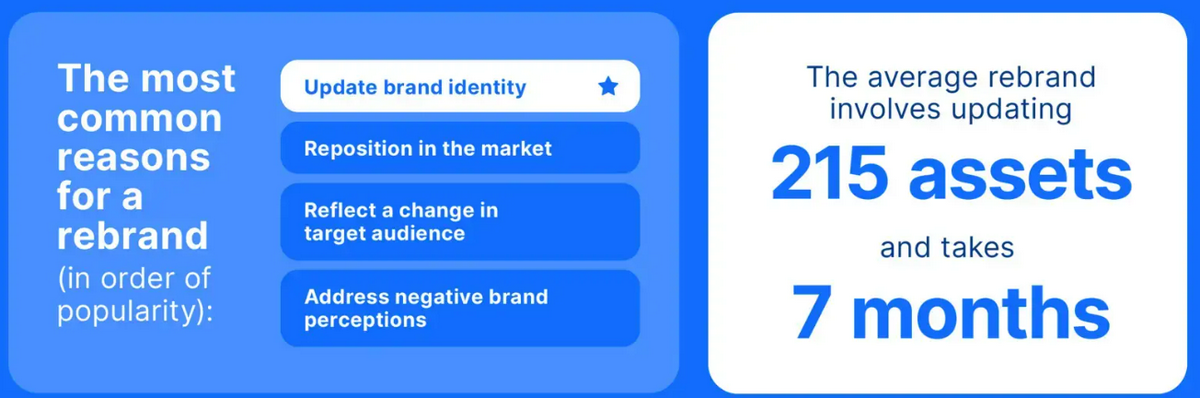
Rebrand statistics (visual snippet from infographics by Bynder)
Rebranding Questions About Your Audience
Target audience is one of the most vital factors. It drastically influences the rebranding strategy, deadline, and requirements. Many decisions depend on relevant data about customers, the fan base, and regular users. Here are several questions to ask when rebranding activities get to the point of understanding the target audience and its influence on the overall company’s perception and presence.
9. Who are your most valuable customers?
This is one of the most popular brand redesign questions coming from new companies. The first thing to consider when rebranding is your most valuable customers.
Business owners should know everything about them – they need a clear understanding of not only the pain points that drive demand for your product and company, but also the expectations that build trust and loyalty.
Multiple factors drive these aspects and must be considered. At minimum, companies need to define their target audience’s demographics, preferences, behavior patterns, profitability, and loyalty. After thorough research, they should analyze the data and use key points to define the strategic value.
10. Has your target audience changed?
Shifts in your target audience’s preferences, demands, and expectations are a main driver of rebranding. If you fail to keep up with the market and recognize the “winds of change”, your company starts to lag, gradually destroying your reputation and overall progress.
Therefore, closely inspect your target market segment using professional software and human assistants. Identify new demands and preferences among your users, buyers, and loyal fan base. Consider cultural contexts, changes in social media, and potential conflicts between new audiences and existing customers that may arise when you adjust your rebrand.
11. What customer problems does the brand solve?
Thoroughly understanding the target audience provides invaluable information for making your brand, and, more precisely, its value, mission, and proposition, relevant to the market. It guides businesses in creating services or products that meet demands, preferences, and expectations.
How does a customer use your product? When does a client seek help, and what issues do they bring to your brand? Ask these questions before rebranding. Honest, thoroughly researched answers form the foundation for the value your company should communicate.
12. How do customers perceive the brand today?
This information guides you; without knowing how your brand is perceived today, you will fly blind, make poor decisions, and risk your investments. Current customer perception offers golden opportunities not just to make adjustments, but to improve your brand, giving you a much-needed boost to achieve your goals faster.
The best way to find this vital information is to conduct rebranding questionnaires, surveys, interviews, and market research through specialized platforms that keep up with social media and internet trends. Use professional help and tools not only to find this information but, more importantly, to analyze customer behavior and demands accurately.
Rebranding Questions about Current Brand Equity
Brand equity is the core element of a company’s personality and overall existence. It represents customer trust, emotional attachment, and value. During rebranding, it is crucial to decide what to remove and what to keep, as changes can easily affect brand assets and revenue.
13. What brand associations are strongest?
Brand associations are the first things that come to mind when customers interact with the brand, whether through the product or customer-facing staff. They can include emotions, images, attributes, or mental links.
Define the strongest associations by conducting surveys and rebranding questionnaires. Be honest and clear to separate desirable associations from actual data. This gives you a clear image of where to head next.
14. Which brand assets are most recognizable?
Like brand associations, recognizability is vital to a company’s ability to stand out from the competition, catch the audience’s attention in a noisy, overcrowded market, and develop new products and services.
Defining which design or communication elements make the brand instantly recognizable provides clear insights for effective rebranding. Start with auditing visual design elements like color scheme, shapes, logotypes, mascots, backgrounds, and illustrations. Then inspect verbal cues and communication methods.
15. Where does the brand experience break down?
Brand experience breaking points include channel inconsistencies, overbranding, customer fatigue, broken customer journeys, or poor support. These faux pas offer valuable insight into a company’s market presence, making them a crucial factor to consider during rebranding. They reveal confusing, inconsistent, irrelevant, and problematic customer touchpoints, as well as flaws in customer-facing staff.
Start by comparing the brand promise with the experience clients get when they interact with the product, service, website, mobile app, support, and sales team. Identify both weaknesses and strengths.
16. What evidence shows a rebrand is needed?
Many clues signal the urgency of rebranding. These include poor conversion, declining revenue, competitor mimicry, negative word associations, a weak emotional connection, and even attraction of the wrong leads.
To catch those clues, regularly review your brand’s identity, image, reputation, and market positioning. With a professional brand agency, you can gather valuable insights into customer confusion, weak competitive advantage, lost deals, irrelevant adoption, outdated architecture, or accessibility issues.
Rebranding Questions about Market and Competitor Analysis
If you want to eliminate guesswork and ground your rebranding decisions in facts, thorough competitor and market analysis is essential. Relevant evidence helps companies pursue better differentiation and recognition.
17. Who are your direct and indirect competitors?
If you define your competitive landscape too narrowly or too broadly, you risk getting poor information for an accurate decision. Clearly distinguishing between direct and indirect competitors provides important insight into what your customers choose and why they choose alternative solutions in your category.
In this step, companies should also identify adjacent categories, substitute solutions, and manual alternatives to understand strategic threats, expansion potential, and opportunities for development through effective investments.
18. Which category codes should you keep?
Merchant Category Codes are an essential categorization tool used by financial institutions (like Banks and payment gateways) to determine a business's economic group and market category.
During rebranding, even when it is a simple refresh of the visual design or packaging, businesses need to understand which cues in their codes, appearance, and market presence help customers identify their category and leave them untouched unless the rebranding strategy requires a total overhaul or merger.
19. How can the brand differentiate?
Brand differentiation is perhaps one of the hardest tasks for companies, as it directly influences competitive advantage that allows a company to stand out from the crowd and become the first option for customers in the category. Visual novelty, no matter how unique or grandiose, cannot do it alone.
Determining how the brand can differentiate requires a thorough analysis of products, the brand’s capabilities, services, customer support, user experience, interactions across multiple touchpoints, and the competitive landscape.
20. What market changes could affect the new brand?
The market is constantly changing. But the good news is that not every shift or novelty triggers rebranding. Some trends come and go, while other technological solutions or economic instabilities don't affect customers’ preferences and demands, leaving businesses where they are.
To understand and catch the true signals for updates, companies need to keep a close eye on customer behavior, as it is the primary source. They should also review technologies, regulations, and the political landscape to devise an accurate plan that makes the most of rebranding.
Vital Rebranding Questions about Brand Positioning, Personality, and Messaging
These brand’s features are the core personality traits that define the company in the eyes of customers, competitors, employees, and investors. They underlie most decisions, and rebranding is no exception. The desired outcome of a revamp must be aligned with this essential trio.
21. What is your value proposition?
On one side, a value proposition is the core promise a brand commits to. On the other side, it is the main reason customers choose the brand over others. It is a two-way road that cannot be blocked, as it is not only a solution to customers’ problems but also a core trait of the company’s personality that affects its operations, departments, and internal elements.
During rebranding, the value proposition may change, but it must align with the brand’s identity, mission, and ultimate goal. Therefore, conduct thorough research and analysis of the target audience and possible solutions to define the specific, credible benefits of your services that make customers believe in your company and separate it from others.
22. What brand promise can you deliver?
The company must meet the brand promise at all costs. It defines its trustworthiness, credibility, reliability, overall value, and pricing. Customers believe in it and use it as a main driving force in their decision-making.
During rebranding, it is crucial to define the promise accurately. Ask yourself: what can your company execute flawlessly every day at every touchpoint? What can your team deliver consistently in every interaction? These are the main questions to ask when rebranding is on the radar. Gather information and connect the promise to your product, service, customer experience, and working culture.
23. What is your brand personality?
As a set of visual traits and emotional characteristics, brand personality makes the brand closer and more relatable to the audience, winning their trust and loyalty. It also powers other core elements like promise, value, message, mission, and goal. It plays a crucial role in a successful company’s existence in the market.
The best way to determine a brand’s personality is to gather information and be honest with yourself about the company. What key features define it? Select several and stick with them if they don't conflict. As long as they are authentic and clearly aligned with the brand’s identity, they will support your rebranding and repositioning.
24. How should the brand voice adapt?
A brand’s presence is diverse. It reaches customers through various touchpoints and communication methods, using not only message or visual tools but also voice. Brand voice is how companies communicate with customers through spoken and written media. It builds trust, activates mental shortcuts, and creates emotional connections.
During rebranding, companies define voice principles and standards that need to be met across all communication channels. It must stay consistent for sales, support teams, product UI, social media, websites, mobile applications, and all sorts of crises.
Brand Identity Requirements – Crucial Rebranding Questions to Ask
Brand identity represents a company in the real world, almost like an individual with responsibilities to meet general standards and legal, accessibility, and technical requirements.
25. Where must the brand identity work?
There are dozens of communication channels and hundreds of touchpoints. It is hard to exist everywhere; for some companies it is almost impossible. So, it is crucial to narrow the medium and prioritize only those that deliver the most value.
Focus on touchpoints with the highest visibility or operational importance. It could be social media, websites, emails, customer service, packaging, and partner materials. Select several and work with them to maximize communication and rebranding.
26. What accessibility and technical requirements apply?
Accessibility and technical requirements are standards that directly affect a company’s safety, presence, and reputation. They support searchability, deliverability, reliability, and credibility, and can also open golden opportunities for market expansion. During rebranding, companies must consider these aspects.
A good starting point is to conduct a brand audit and analyze visual design, niche, and standards to define production and presentation requirements, as well as communication limits and constraints.
27. Are naming and migration risks resolved?
Many risks arise during rebranding. For instance, migration might easily destroy your company’s personality and relationships with the fan base; or, inconsistent naming can erode trust and create legal liabilities. Every niche and every type of rebranding has its dangers.
To mitigate the risks, companies should manage their naming and assets, such as trademarks, domains, mobile applications, and social media accounts, properly. If changes are necessary, it is crucial to redirect customers to new assets in an unobtrusive, smooth way.
Rebrand Rollout, Governance, and Measurement
Deployment is the last but certainly not least operational phase. It requires caution and total commitment, as its success determines the rebranding's efficiency. Companies should establish metrics before launch to get accurate insights on what works best, and they should also make key operational decisions.
28. Who makes rebranding decisions?
Rebranding decisions are not left to a single person. As a rule, it is a collective decision that involves votes from various executives and stakeholders. For instance, large corporations have a structured governance hierarchy with clearly defined responsibilities.
At minimum, companies should assign a project owner, contributors, approvers, and a final decision-maker, guided by criteria for resolving disagreements.
29. How will you roll out the rebrand?
To ensure rebranding moves the company forward instead of dragging it back, the roll-out campaign has several essential stages, such as
- Aligning internally around the rebrand through team-building events and guidance.
- Integration of new assets.
- Adjusting customer communication.
- Updating partners.
Deciding what to do with outdated assets, like defining an archive and access roles. Launching an updated version of the company.
30. How will you measure rebrand success?
Measuring success drives the improvements and adjustments needed to meet customers’ needs and expectations and reach the ultimate goal. To do this, the company sets baseline metrics focused on awareness, associations, consideration, conversion, and retention. It also closely monitors employee adoption and reviews qualitative feedback.
How to Run a Rebranding Workshop?
A rebranding workshop includes several phases: pre-workshop, agenda, and post-workshop.
- Pre-Workshop is all about preparation. It sets clear operational boundaries, gathers necessary materials, and selects the right facilitator and team.
- The agenda is broken into several steps to cover the whole process. It starts with an introduction, includes a rebranding questionnaire, surveys, and discussions, and ends with a summary of key takeaways.
- In the post-workshop phase, the facilitator gathers, analyzes, and synthesizes information. At the same time, companies verify claims with evidence and prioritize decisions, outlining the brief for a smooth transition and next actions.
How to Create a Rebranding Brief?
A rebranding brief is a short yet explicit document that summarizes key aspects of rebranding, covering the problem, core objectives, target audience, positioning, personality, market realities, and guidance for the brand's ultimate transformations.
Creating this essential document requires businesses to align internal departments and team partners. They state the core problem, include insights from the rebranding workshop, define scope and constraints for partners, assign governance, and list explicit actions.
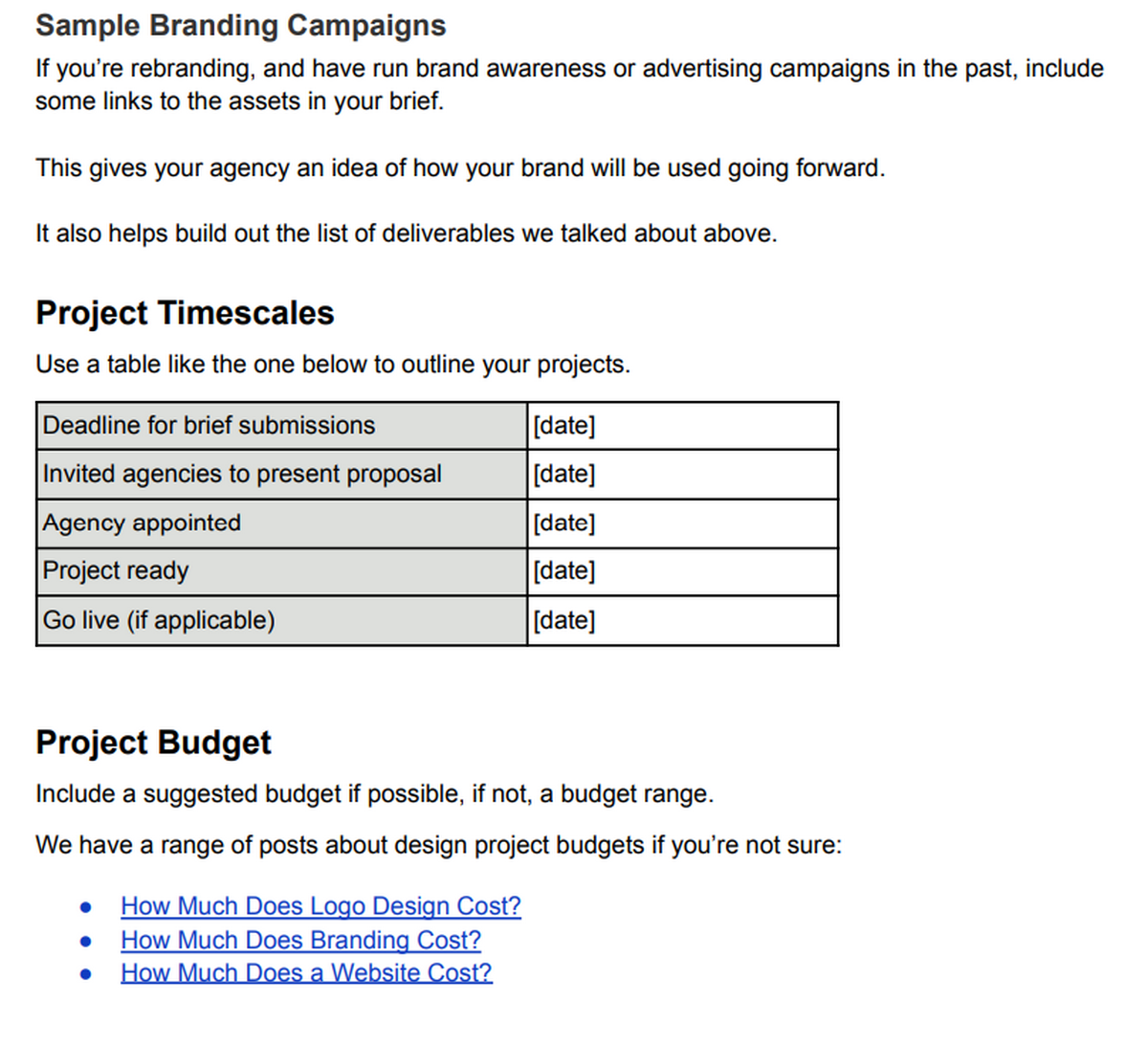
Rebranding Red Flags Before Design
Rebranding is a complex, multi-task process that requires commitment and dedication from start to finish. Businesses should not rush, and deployment is not an exception. The roll-out requires companies to take every step with caution, as it comes with hidden obstacles. Unresolved strategic issues can easily undermine the desired impact and lead to catastrophic reputational losses.
Here are several rebranding red flags to address before deployment: poorly selected objectives, conflicting audiences, an inconsistent brand proposition, missing senior leadership alignment, weak onboarding metrics, or highly volatile business events.
Conclusion
Whatever rebranding your company needs, whether it is a simple visual refresh or a full-scale overhaul, it shouldn't be taken lightly. Every tweak to a company’s image, identity, presentation, market positioning, and communication methods can disrupt the target audience and competitive landscape and easily drag the company down.
Rebranding is a strategic decision carried out through multiple small yet complex tasks that underlie the company’s transformation both internally and externally. It starts with a thorough brand audit, deep research and analysis of why the business should change, moves to creating an evidence-based brief, and ends with the deployment event.
To conduct it successfully, companies need not only to do their part perfectly, which implies their total commitment, but also to find the right partners who understand business needs and expectations and help achieve their ultimate goals.

Creates insightful, strategy-driven content that translates complex design and branding concepts into accessible knowledge, supporting Ramotion’s mission to elevate digital experiences.