
Modern software no longer lives behind a single front door. A typical product today is a website, a mobile client, a set of public and private APIs, cloud services, and a long list of third-party integrations that talk to each other constantly.
Every one of those connections is a place an attacker can probe, and traditional website defenses were never built for that shape of traffic.
Web app and API protection, usually shortened to WAAP, is the security approach that emerged to close this gap. It brings several protective layers together so both the human-facing application and the machine-facing APIs behind it are covered by one coordinated defense.
This guide explains what WAAP is, how it works, what it protects against, and when a business needs it.
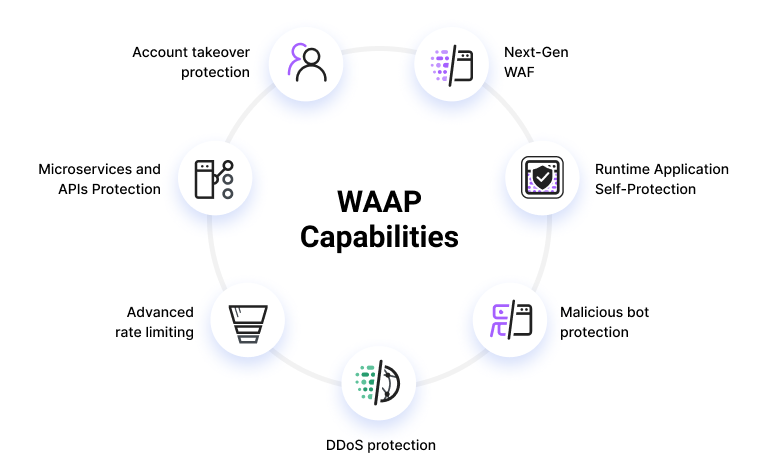
Web app and API protection overview (Source)
What Is WAAP?
Web application and API protection, WAAP, is a security approach that combines multiple defensive capabilities into a single service to protect web applications and APIs from attacks, regardless of where they are hosted.
The term was introduced by Gartner to describe the next generation of application defense, extending classic firewall protection to cover APIs and automated traffic. The important thing to understand is that WAAP is not one tool. It is a consolidation of security modules that work together, and Gartner defines four capabilities that a solution must include to qualify: a web application firewall, distributed denial-of-service (DDoS) mitigation, bot traffic management, and protection against advanced API attacks.
Each of these handles a different slice of the problem. The firewall filters malicious requests, bot management separates real users from automated abuse, DDoS mitigation keeps services available under traffic floods, and API protection guards the endpoints that power logins, payments, and data access. Together they form a layered defense rather than a single checkpoint.
Why Web Apps and APIs Need Better Protection
Older websites had a small, predictable surface: a few pages, a login form, maybe a search box. A modern application is different. It exposes public APIs, internal microservices, mobile backends, webhooks, and dozens of integrations with external providers, and each of those is a potential entry point that has to be defended.
APIs in particular have changed the math. They now carry the bulk of sensitive operations, and attackers have noticed. According to the 2026 Thales Bad Bot Report, automated traffic made up 53% of all internet traffic in 2025, with malicious bots accounting for 40% of it. Human traffic dropped to just 47% of the total.
APIs sit right in the middle of that trend. Imperva and Thales research found that although APIs represent only about 14% of the overall attack surface, they attract 44% of advanced bot traffic, and 27% of all bot attacks are aimed directly at API endpoints.
The report also logged more than 40,000 API incidents across 4,000 monitored environments in the first half of 2025 alone.
The reason older, perimeter-based protection struggles is simple: there is no longer a single perimeter. Traffic arrives from browsers, mobile apps, partner systems, and automated clients across cloud and hybrid infrastructure, so defending only the front page leaves everything behind it exposed.
Why Traditional WAF Is Not Enough
A web application firewall is still valuable, and WAAP does not throw it away. The firewall remains excellent at catching well-known web attacks such as SQL injection and cross-site scripting, and it enforces protections mapped to the OWASP Top 10. The problem is that classic web attacks are only part of the modern threat picture.
Today's attacks increasingly target logic rather than code. A request can be valid HTTP, pass every signature check, and still abuse a business workflow, drain an API, or take over an account. WAAP is best seen as an extension of application security that surrounds a firewall with extra layers, not a wholesale replacement for it.
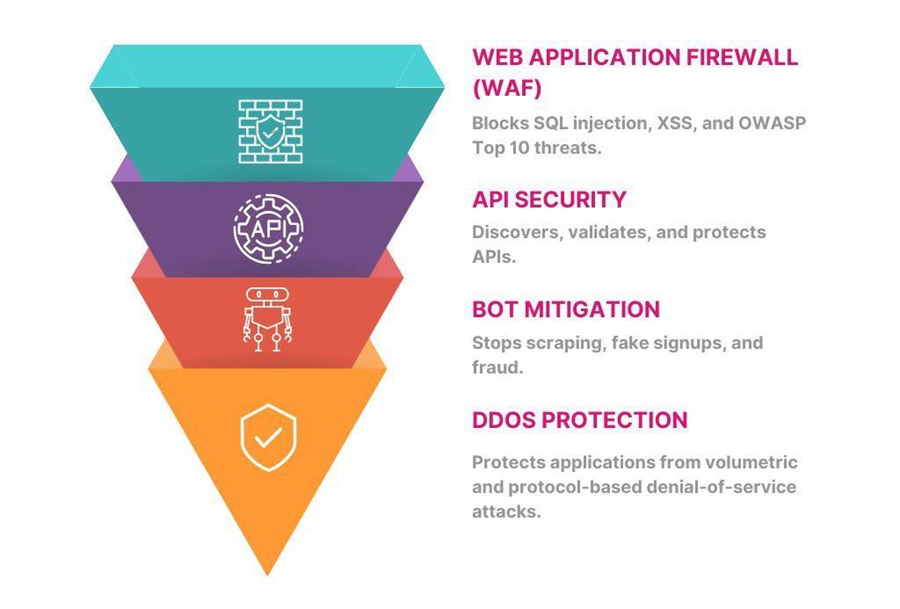
WAF versus WAAP layers (Source)
WAF rule limitations
Rule-based and signature-based protection works by matching known bad patterns. That approach misses attacks it has never seen before, and it often lacks the application-specific context needed to judge whether a request is genuinely harmful.
The practical result is a trade-off between two failure modes. Tighten the rules and you get false positives that block real customers and flood the security team with noise. Loosen them and unusual attacks slip through. Static rules alone cannot resolve that tension, which is why modern solutions add behavioral analysis on top.
API security risks
APIs need controls that go beyond filtering standard web traffic. They require access control, rate limiting, token validation, request-structure enforcement, and a way to spot suspicious behavior over time. A firewall inspecting individual requests rarely has enough of this context.
Most damaging API attacks target business logic rather than a technical flaw. The OWASP API Security Top 10 highlights issues like broken object-level authorization (BOLA), mass assignment, and excessive data exposure, where the request is technically well-formed but the intent is abuse.
Protecting APIs means understanding structure, authorization, and behavior together.
How WAAP Works
At a high level, a WAAP solution sits in front of an application and inspects traffic before it reaches the backend. It analyzes each request, applies security policies, blocks activity that looks malicious, and lets legitimate users through with minimal friction. The same pipeline covers both the web application and its APIs.
Because it operates in-line, this protection happens early, filtering harmful requests at the edge rather than after they reach sensitive systems. The pipeline is simple in principle: inspect, analyze, decide, and act on every request.
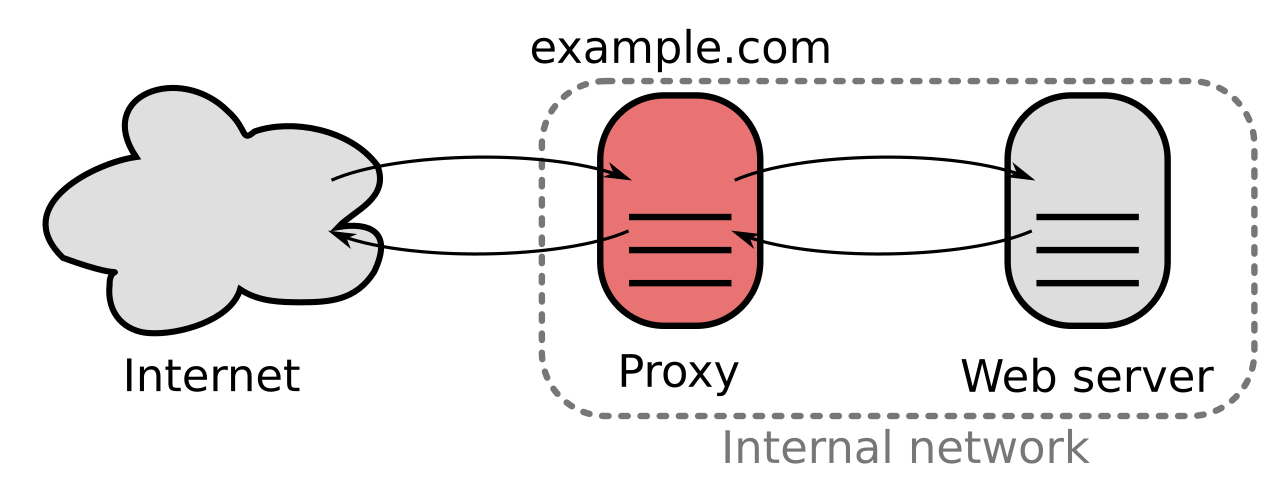
How WAAP inspects and filters traffic (Source)

Traffic analysis
WAAP inspects incoming requests before they touch the application. It evaluates several signals at once: the source of the request, its structure, the behavior of the client sending it, and any indicators that match known attack techniques.
By weighing these signals together, the system blocks harmful traffic early while letting normal requests through. A single request may look fine in isolation, so the value comes from combining structural, reputation, and behavioral checks.
API discovery
You cannot protect what you cannot see, and this is one of the biggest problems in API security. Applications accumulate endpoints over time, and many are forgotten, undocumented, or spun up outside official processes. These are often called shadow APIs.
WAAP helps by continuously discovering the APIs that are actually live, including those that never made it into documentation. Bringing hidden endpoints into view is the first step toward securing them, because an undiscovered API receives no protection at all.
Behavior-based protection
Beyond inspecting single requests, WAAP evaluates patterns of behavior across many requests. This is how it detects automated abuse that individual-request filtering would miss.
Simple examples make the idea concrete. A burst of repeated login attempts against many accounts suggests credential stuffing. An unusual spike in request volume from one client can signal scraping or a scripted attack. By watching how a client behaves over time, the system can flag activity that each isolated request would never reveal.
Core WAAP Components
A complete WAAP solution is built from several layers, each addressing a different part of modern application risk. Treating them as distinct modules makes it easier to see what each one contributes.
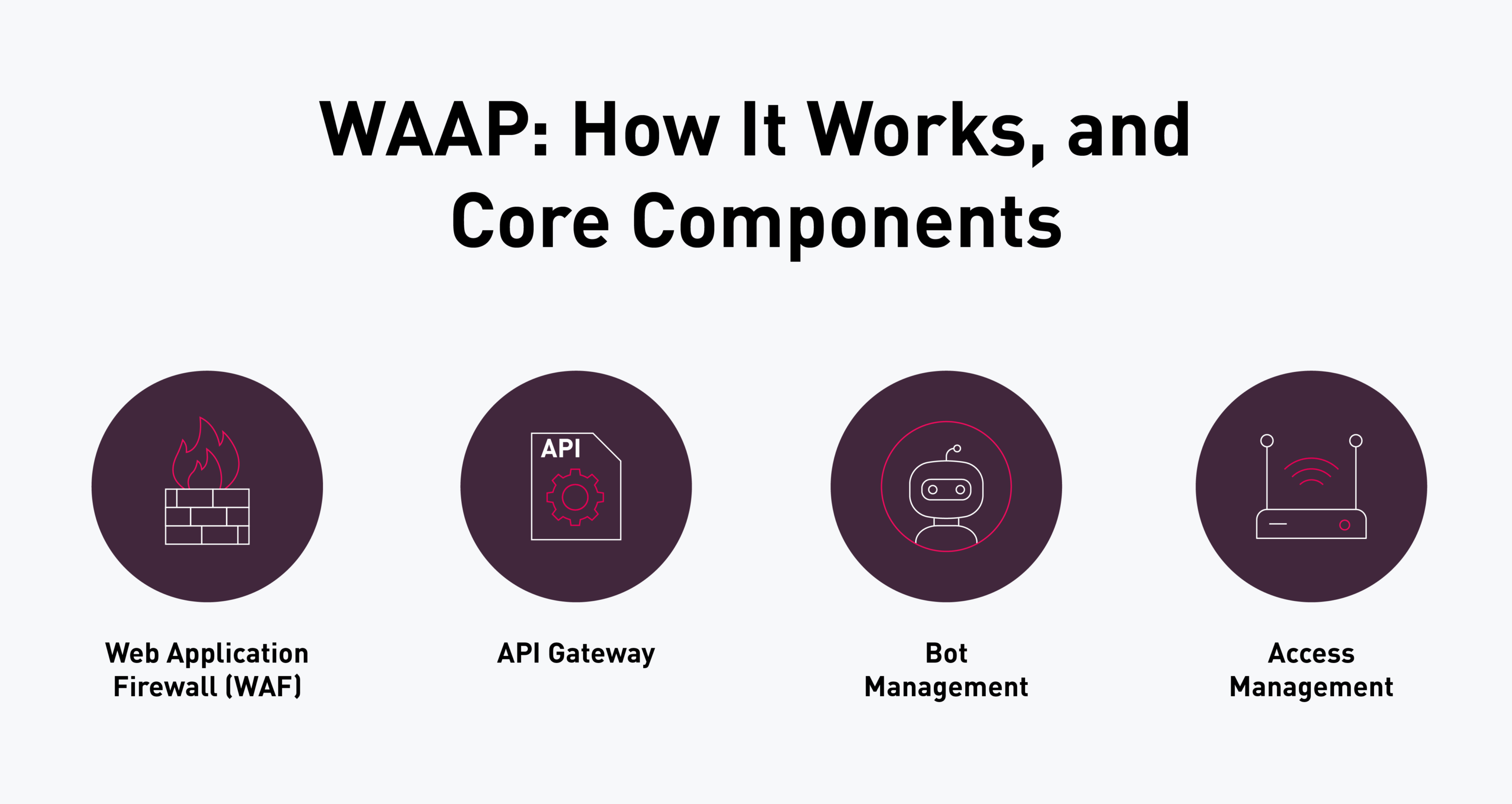
Core components of a WAAP solution (Source)
Web application firewall
The firewall is the baseline layer, focused on common web application attacks. It inspects HTTP traffic and blocks code injection, malicious requests, and attempts to exploit known vulnerabilities such as those in the OWASP Top 10.
It is the first line of defense, but it should not be oversold. A firewall handles well-understood attack classes reliably, and the other WAAP layers exist because it cannot cover everything alone.
API protection
API protection is the layer that separates WAAP from a firewall alone. It combines API discovery, request inspection, access control, rate limiting, and abuse prevention into one focused capability. To do this well, it has to understand the structure of each API, the behavior expected on each endpoint, and the authorization rules that should apply.
The practical outcome is that requests are judged against what an API is supposed to do. Schema validation rejects malformed or manipulated payloads, and anomaly detection flags usage that falls outside normal patterns, catching business-logic abuse that generic filtering ignores.
Bot protection
Bot protection separates real users from malicious automation. Given that bad bots now generate a large share of internet traffic, this layer carries real weight for both security and day-to-day operations.
The examples are familiar to anyone running an online service: brute-force and credential-stuffing attacks against logins, mass fake registrations, content scraping, and automated buying of limited-stock items. Blocking this activity protects accounts and data, and it also keeps inventory, pricing, and analytics honest for the business.
DDoS protection
DDoS protection defends against traffic floods intended to overwhelm a service and make it unavailable. It operates in-line, absorbing both volumetric attacks and protocol-based ones before they can exhaust application resources.
This matters for APIs as much as for web pages. Imperva reported an application-layer flood reaching 15 million requests per second against a single financial services API, a scale that no unprotected backend could survive.
Account takeover protection
Account takeover protection watches login and authorization behavior for signs of compromise. It looks for the use of stolen credentials, unusual activity on an account, and repeated login attempts that suggest an automated guessing campaign.
This layer connects security directly to user trust. When attackers reach real customer accounts, the damage extends past data loss into fraud and reputation, so catching suspicious authentication early protects both the user and the business.
WAAP vs WAF vs API Gateway
These three terms are easy to confuse because they overlap. A firewall protects web traffic against known attack patterns, an API gateway manages how API requests are routed and authenticated, and WAAP combines several protection layers, including a firewall, into one security service. The table below is meant to clarify the roles, not to push one option over another.
| Tool | Main purpose | What it protects | Main limitation |
|---|---|---|---|
| WAF | Filter malicious web requests using rules and signatures | Web applications against common attacks like SQLi and XSS | Limited API context; misses bots, logic abuse, and DDoS |
| API gateway | Manage, route, and authenticate API traffic | API access, versioning, and rate limiting | Focused on management, not deep threat detection |
| WAAP | Unify multiple defenses into one security approach | Web apps, APIs, availability, and automated traffic | Broader scope means more configuration and tuning |
The takeaway is that these tools solve different problems and often work together: a gateway can route and authenticate API calls while WAAP inspects them for abuse, with the firewall inside WAAP handling the classic web attacks.
Threats WAAP Helps Prevent
The value of WAAP is the breadth of coverage it provides across web, API, and automated traffic. Rather than defending against one category, it spans the main threats that modern applications face:
- Common web attacks such as injection and cross-site scripting
- API abuse, including business-logic attacks and broken authorization
- Malicious bots running credential stuffing, scraping, and fake signups
- DDoS attacks aimed at knocking services offline
- Account takeovers using stolen or guessed credentials
- Data leakage and exposure through poorly protected endpoints
The point is not to memorize a glossary but to recognize the pattern: a single WAAP approach reaches across the web application, its APIs, and the automated traffic hitting both, which is where most of today's damage originates.
Benefits of Web App and API Protection
The clearest benefit is unified visibility. Instead of stitching together separate products for firewalling, bots, DDoS, and APIs, a WAAP solution gives teams one view of what is happening across their applications and one place to act on it.
That consolidation speeds up response. When detection and blocking share the same platform, security teams investigate and mitigate faster, and machine-learning-based behavioral analysis improves accuracy while cutting the manual rule-writing older setups demand.
There is a business dimension too. By protecting web apps, APIs, bot exposure, and availability in one approach, WAAP reduces the overhead of running many disconnected tools and lowers the risk of a gap opening between them where an attacker can slip through.
How to Choose a WAAP Solution
Selecting a WAAP solution comes down to fit. The right choice matches a company's architecture, traffic patterns, risk level, and the way its security team already works. The criteria below make that evaluation easier to scan. For teams without deep in-house security engineering, working with experienced custom web application development companies can help align the choice with the application's design.
Web and API visibility
A strong solution should surface every active web app and API, not just the ones the team already knows about. That includes public endpoints, forgotten services, undocumented interfaces, and anything left poorly protected.
Visibility maps directly to risk reduction. Each endpoint that stays hidden is one that no policy is guarding, so discovery is the foundation everything else builds on.
Accurate threat detection
Detection accuracy deserves close attention because errors cut both ways. False positives block legitimate customers and bury analysts in alerts, while missed attacks defeat the purpose of the tool entirely.
Gartner recommends prioritizing solutions that use AI and machine learning to cut false positives and alert fatigue. The goal is balanced protection: strong blocking of real threats without needless disruption to real users.
Cloud and multi-cloud support
Applications rarely live in one place anymore, so a WAAP solution should support cloud, hybrid, and distributed environments. Cloud-delivered services that route traffic through their own network tend to be easier to deploy and scale across mixed infrastructure.
Consistency is the key requirement. Protection should behave the same way whether an application runs in one cloud, several clouds, or a combination of cloud and on-premises systems, and it should scale with traffic without leaving gaps.
Security tool integrations
A WAAP solution does not operate alone. It should connect to the monitoring, logging, SIEM, and incident-response tools a team already relies on so that data flows into existing workflows.
Good integrations make investigation faster. When WAAP telemetry lands in the same systems analysts use every day, correlating an alert with logs and traces takes minutes instead of hours, which shortens the time to respond.
When Businesses Need WAAP
WAAP is most useful when web applications and APIs are central to how a business operates.
Certain profiles benefit more than others, and the following use cases are the strongest fits:
- SaaS platforms whose product is delivered entirely through web and API access
- Ecommerce sites facing scraping, scalping, and payment fraud
- Fintech services handling money movement and sensitive financial data
- Companies exposing public APIs to partners or external developers
- Mobile apps that depend on backend APIs for core functionality
- Login-heavy platforms that are frequent targets for account takeover
The common thread is exposure. Any organization handling sensitive user data or absorbing high volumes of automated traffic gains the most, because those are the conditions attackers look for. When web apps and APIs are business-critical, WAAP stops being optional.
Conclusion
Web app and API protection represents the evolution of classic web application defense for a world where APIs, automation, and cloud infrastructure define how software runs. By combining a firewall, API protection, bot management, and DDoS mitigation into one approach, WAAP covers the full surface that modern attacks target instead of guarding a single entry point.
It is worth being clear about what WAAP does not do. It does not replace secure development practices, careful access control, or ongoing monitoring; it complements them. A WAAP solution is a strong runtime layer, but the applications behind it still need to be built and maintained responsibly.
The main takeaway is straightforward. Web application and API protection WAAP unifies defense for web applications, APIs, automated traffic, and service availability in one coordinated layer, and as bots and API abuse continue to climb, that unified approach is becoming the baseline for keeping application security effective.

Creates insightful, strategy-driven content that translates complex design and branding concepts into accessible knowledge, supporting Ramotion’s mission to elevate digital experiences.