
The API-first CMS market is experiencing explosive growth, projected to surge from 973.8 million in 2025 to 7.11 billion by 2035. This shift reflects a fundamental change in how we build and deliver digital content.
As a result, 73% of businesses now use headless architecture, with 98% of others planning to evaluate these solutions within the next year. What drives this momentum? Developers report significant advantages, such as simplified content reuse (82%) and improved scalability (79%).
We'll explore what an API-first CMS is, how API-first architecture works, and why API-first headless CMS platforms outperform traditional systems. You'll discover key benefits, top platforms, and practical insights for implementing this approach in your projects, whether you're building in-house or evaluating top companies for scalable web app development to bring on as a partner.
Defining API-First CMS
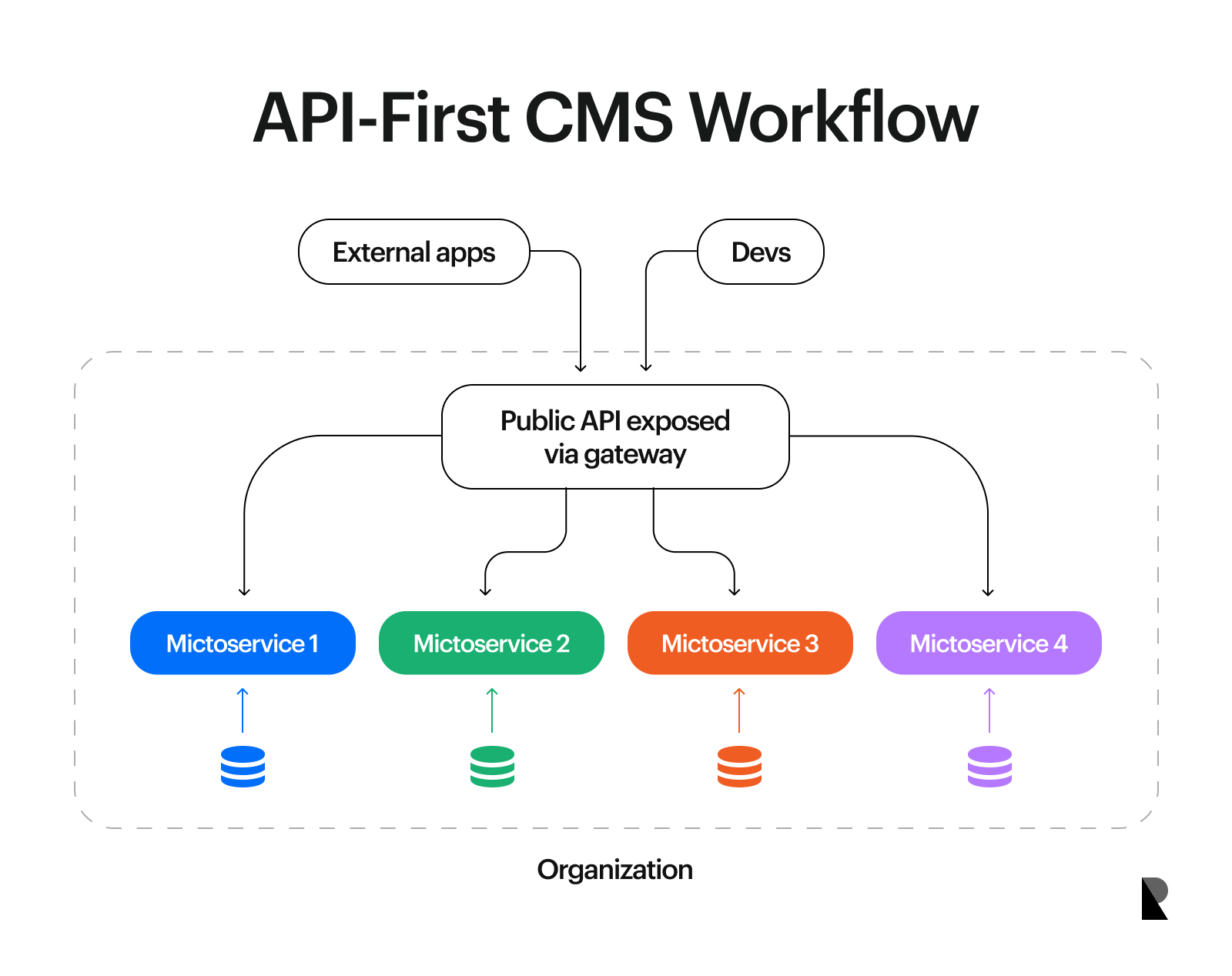
Diagram showing a public API gateway connecting external apps and devs to four distinct microservices within an organization
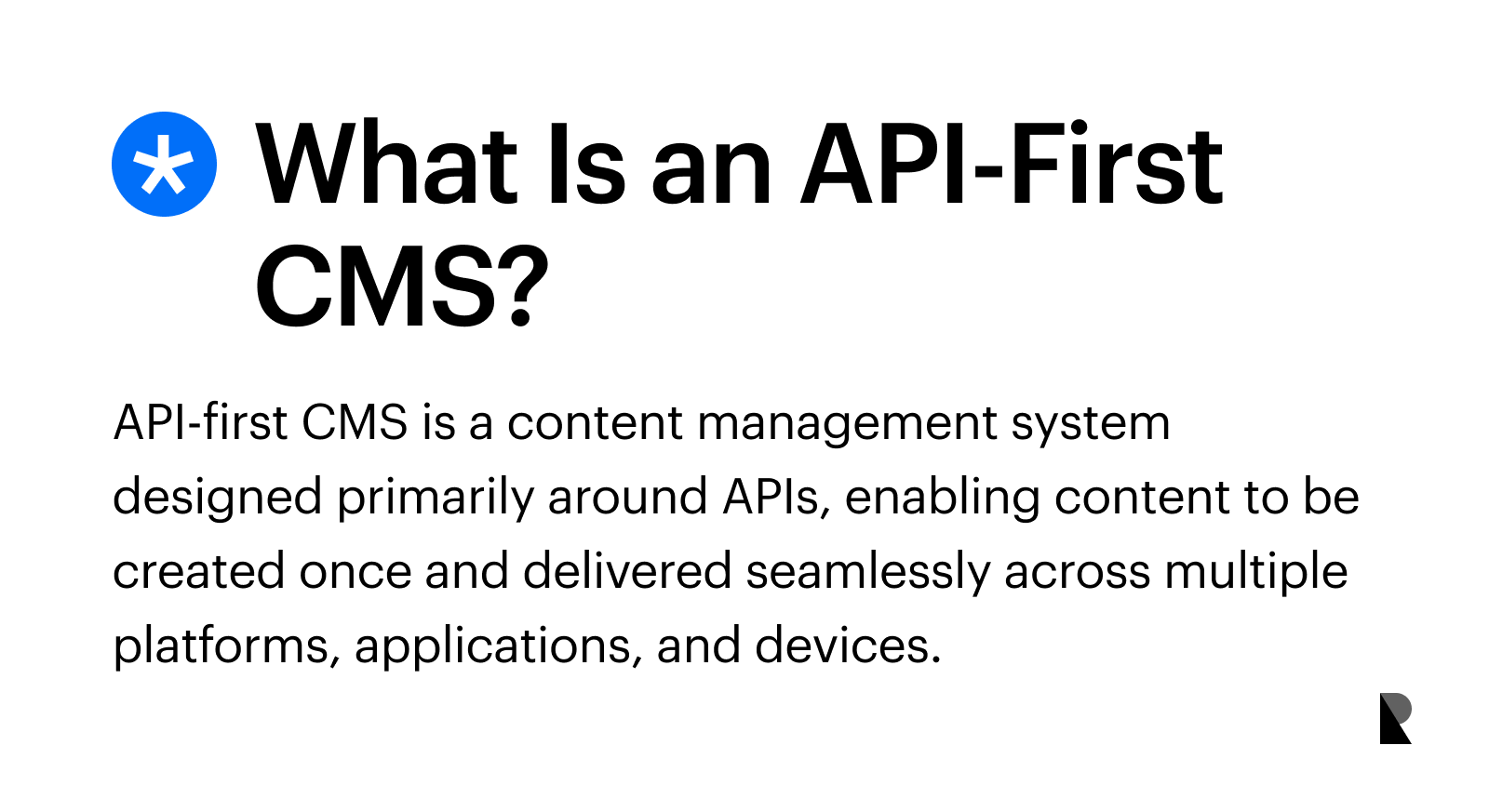
An APIi-first CMS positions APIs at the core of its design philosophy. Unlike systems where APIs get added as an afterthought, this architecture builds everything around API access from day one. Content exists independently of any presentation layer, stored in a structured format that APIs can deliver to any channel or device.
The CMS API serves as the primary interface for all interactions. Developers retrieve content through API calls rather than relying on coupled front-end templates. This approach treats content as data that moves freely across platforms. When you request an article, product description, or media file, the API delivers it in a clean, structured format like JSON or XML.
API-first architecture means the system prioritizes API functionality above all else. Content creators work in a backend interface while developers consume that content through robust, well-documented APIs.
The separation runs deep, with no assumptions about where or how content will appear. Your mobile app, website, smartwatch, and IoT device all pull from the same content repository through identical API endpoints.
In contrast, traditional CMS platforms tightly couple content with presentation templates. Making changes requires touching both content and code. An API-first CMS eliminates this dependency. You update content once, and every connected platform receives the changes through the API.
What is CMS APIi in this context? It's the gateway that transforms your content management system into a flexible content hub. The API handles authentication, content delivery, asset management, and even workflow operations. Developers interact with your content inventory programmatically, building custom experiences without backend constraints.
The API-first headless CMS takes this further by removing the presentation layer entirely. You get pure content management with API delivery, nothing more. This stripped-down approach maximizes flexibility.
Front-end teams work independently, choosing their preferred frameworks and technologies while the CMS focuses solely on content operations and API performance.
How an API-First CMS Works?
Understanding the operational mechanics reveals why this architecture performs so effectively. When you publish content in an API-first CMS, the system stores it in a database as structured data, stripped of any formatting or presentation rules. Content editors work within an administrative interface, creating and organizing materials without touching code.
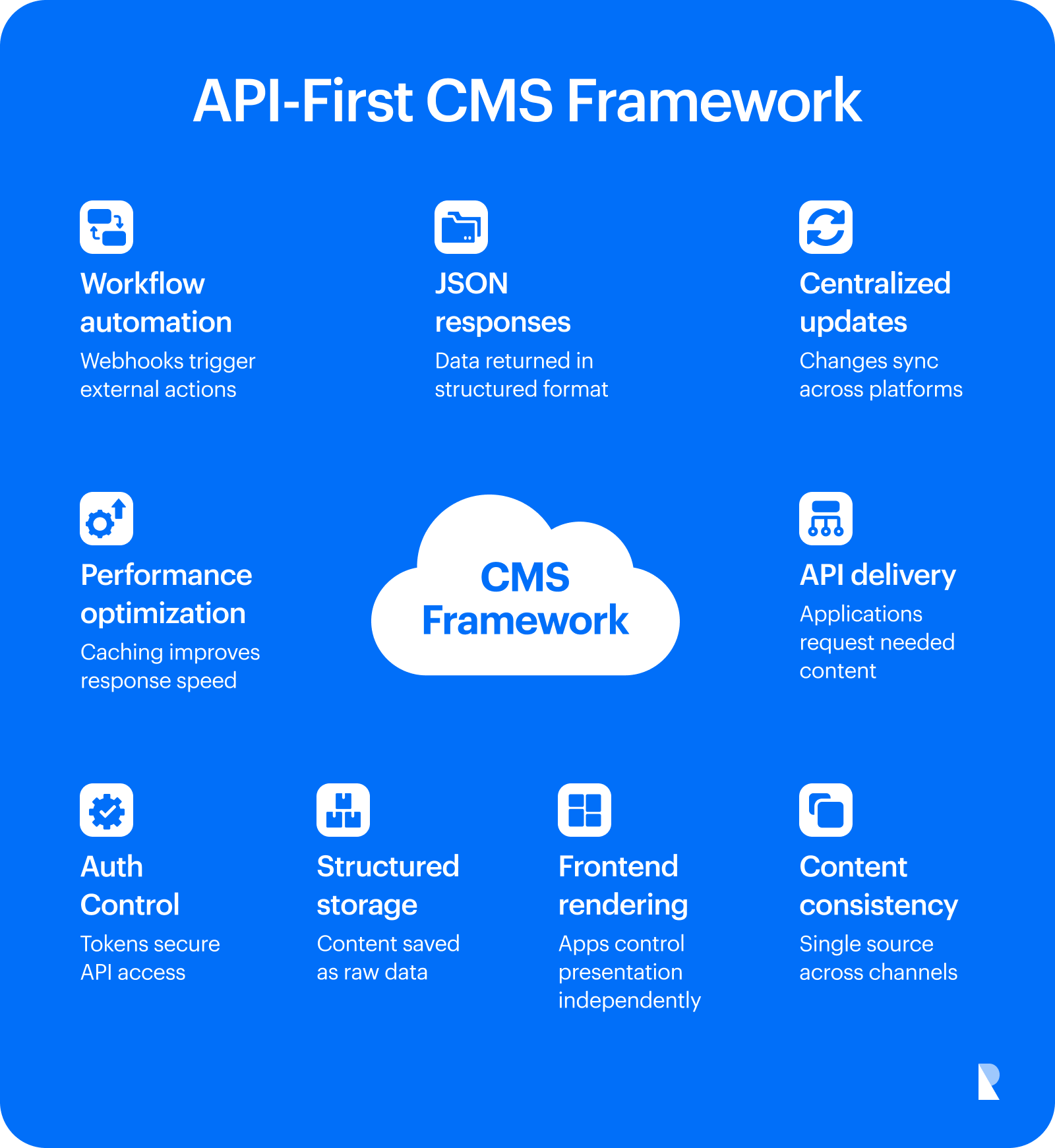
Here's where the CMS API becomes active. A developer building a mobile application sends an HTTP request to the API endpoint. This request specifies what content is needed: a blog post, product catalog, or user profile. The API receives this request, authenticates the caller, and queries the content database.
The system retrieves the requested content and formats it according to API specifications. For instance, a JSON response might include the article title, body text, author metadata, and associated images as separate data fields. The API sends this structured payload back to the requesting application.
Your front-end application receives this data and applies its own styling, layout, and presentation logic. The same content can simultaneously serve a React website, iOS app, and smart display, each rendering it differently based on their specific requirements.
Content updates follow an equally streamlined path. When an editor modifies an article, the change saves to the central repository. Every connected application pulling that content through the API receives the update automatically. No redeployment, no template modifications, no duplicate entry across platforms.
The API-first architecture handles authentication through tokens or API keys. Rate limiting prevents abuse while caching layers improve response times. Version control within the API allows backward compatibility when you update endpoints. Webhooks notify external systems when content changes occur, triggering automated workflows.
This separation between content management and delivery creates the flexibility developers seek. The CMS API becomes your single source of truth, feeding content wherever needed while maintaining consistency and control from a centralized backend.
API-First CMS vs Traditional vs Headless CMS
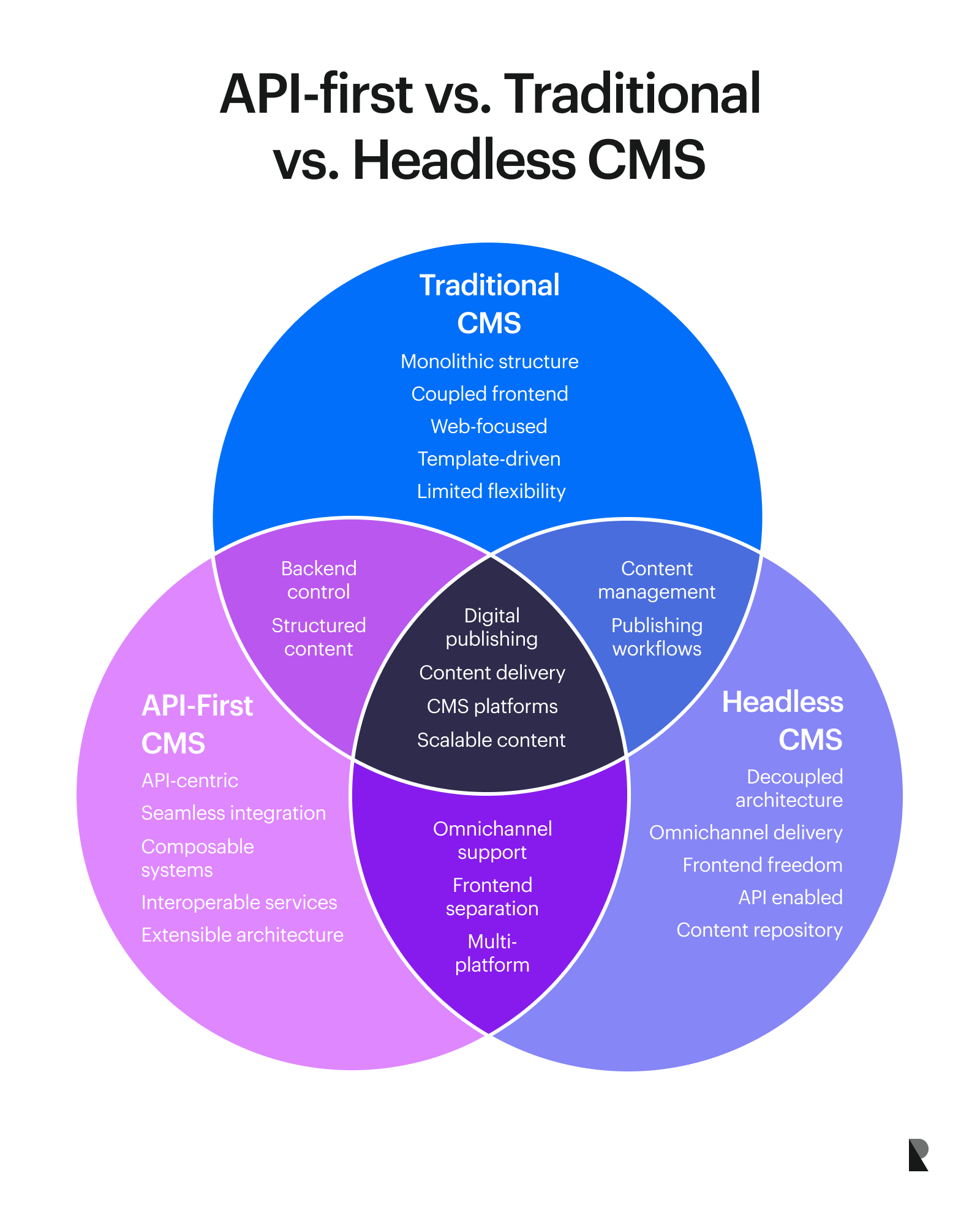
Three distinct architectures serve different content management needs, each with specific trade-offs. Traditional CMS platforms like WordPress and Drupal combine backend content management with frontend presentation in a monolithic system.
The frontend and backend operate as one tightly integrated application, where content creation and display remain intertwined. This coupling limits flexibility since content gets locked into rigid structures designed exclusively for web publishing. Scaling becomes challenging, and adapting to new channels requires significant rework.
Headless CMS decouples the backend content repository from frontend presentation. Content flows to various platforms through APIs, enabling omnichannel delivery across websites, mobile apps, and IoT devices.
Developers gain freedom to choose their preferred frontend frameworks while editors manage content independently. However, not all headless systems prioritize API architecture equally.
Here's the critical distinction: an API-first CMS builds APIs before any other functionality. This approach ensures interoperability and extensibility from the ground up. In contrast, some headless platforms favor Git-based strategies or add API layers onto legacy code after initial development.
WordPress can function as a headless CMS through API additions, yet integration challenges and scalability limitations persist because APIs weren't the foundation. While every API-first CMS qualifies as headless, the reverse doesn't hold true. The API-first architecture positions your CMS as a true content hub within composable systems, integrating seamlessly with eCommerce platforms, marketing automation tools, and other services through robust, well-designed APIs.
Key Benefits of API-First CMS
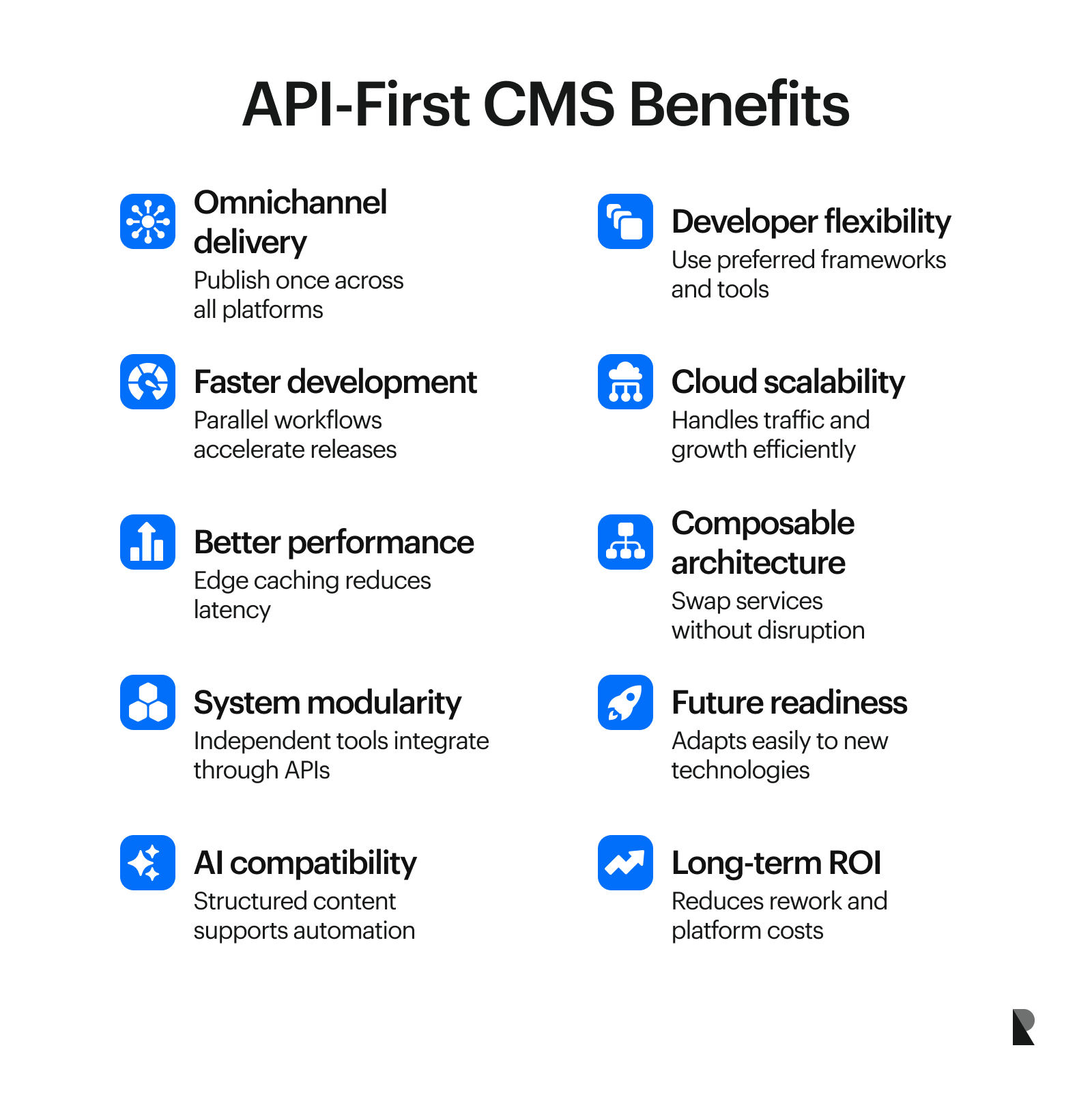
Omnichannel content delivery
Create content once and distribute it across websites, mobile apps, IoT devices, smartwatches, and voice assistants through APIs. This workflow eliminates duplicate content creation for each platform.
The CMS API maintains consistency across all touchpoints while allowing channel-specific rendering. Your content flows freely between systems, creating unified brand experiences that follow users across devices.
Developer flexibility
Teams select their preferred programming languages and frameworks without CMS constraints. APIs operate language-agnostically, enabling frontend and backend developers to work in parallel. This independence accelerates development cycles.
Organizations using API-first CMS solutions reduced development time by 80% and cut publishing time by 90%.
The freedom extends beyond language choice into tooling, testing, and deployment infrastructure. A team can adopt a static site generator for a marketing site, a server-side rendering framework for an e-commerce storefront, and a native SDK for a mobile application, all pulling from the same content source.
Each project uses the build pipeline, hosting environment, and deployment workflow that fits its requirements. There is no lowest common denominator imposed by the CMS vendor.
Scalability and performance
Cloud-native architecture enables independent scaling of frontend and backend systems. Auto-scaling handles traffic spikes without performance degradation. Content delivery networks distribute assets globally, reducing latency. The decoupled structure supports growing content volumes efficiently.
Content delivery networks sit at the edge of this architecture, caching API responses and static assets across globally distributed nodes. A user in Singapore requesting a product page retrieves content from a nearby edge location rather than a distant origin server.
That reduction in round-trip latency adds up across millions of requests and has a direct impact on Core Web Vitals, bounce rates, and ultimately conversion. API-first platforms are well-suited for this kind of edge caching because the content payload is structured, predictable JSON rather than server-rendered HTML with session-specific state baked in.
Composable architecture enablement
An API-first CMS serves as the foundation for microservices ecosystems. Best-of-breed services integrate through APIs, creating flexible technology stacks. You can swap components without disrupting the entire system. This modularity supports specialized tools for commerce, search, and personalization.
The practical payoff of this modularity is the ability to swap components without systemic disruption. If a better search solution enters the market, you replace it at the integration layer without touching the CMS or the frontend.
If your commerce vendor changes, the content layer remains stable. This is composable architecture in practice: loosely coupled components with clear contracts, where improvements compound over time rather than requiring big-bang platform migrations.
Teams working across commerce, search, personalization, analytics, and experimentation can operate with genuine independence. Each domain owns its service, integrates through the content API, and ships on its own schedule. The CMS becomes infrastructure rather than a bottleneck.
Future-proof infrastructure
New platforms and technologies integrate through existing APIs without backend modifications. When emerging channels appear, you build new frontends that consume current APIs. AI services connect seamlessly to structured, API-accessible content. Organizations achieved 295% ROI through this adaptable architecture.
AI capabilities integrate through the same pattern. Large language models, semantic search, automated tagging, and content generation services all operate more effectively when content is structured, consistently modeled, and accessible through a programmatic interface.
An API-first CMS provides exactly that surface: clean, queryable, schema-defined content that AI services can read, enrich, and write back to without requiring custom extraction pipelines or brittle scraping approaches.
The financial case matches the architectural argument. Organizations that have adopted this approach have reported substantial returns: Contentstack's research points to a 295% ROI figure tied to the reduced cost of integrations, faster channel expansion, and lower total rework over the platform's lifetime.
When infrastructure adapts to change rather than resisting it, the savings accumulate across every new initiative that does not require a platform replacement to ship.
Top API-First CMS Platform Examples
Several platforms demonstrate how API-first architecture translates into production-ready solutions. Each addresses different organizational needs while maintaining API-centric design principles.
Strapi API-first CMS
Strapi operates as an open-source headless CMS built with Node.js. The platform automatically generates REST and GraphQL APIs from your content models. You maintain complete infrastructure control through self-hosting or Strapi Cloud deployment.
The Content-Type Builder enables schema design through a no-code interface, while Strapi AI handles content modeling, translations, and image metadata. With 250+ marketplace extensions, you can customize authentication, workflows, and integrations.
Pricing starts free for the community edition, USD 45.00 monthly for Growth, and custom enterprise contracts.
Storyblok API-first CMS
Storyblok combines visual editing with API-first headless CMS capabilities. The drag-and-drop interface provides real-time content previews while maintaining component-based architecture.
Content Delivery and GraphQL APIs enable fast, responsive delivery across channels. Marketing teams manage layouts independently while developers work with modern frameworks. Pricing begins at free for starters, 99€ monthly for Growth, and custom premium plans.
Hygraph API-first CMS
Hygraph builds natively on GraphQL, treating structured content as interconnected data graphs. Content Federation pulls information from multiple systems through a single API endpoint. The platform holds MACH certification and appears in Forrester's Digital Experience Platforms report.
AI agents automate translation, summarization, and SEO optimization. Plans start free with 3 users and 5K entries, USD 199.00 monthly for Growth with 10 users and 20K entries.
Contensis API-first CMS
Contensis merges headless flexibility with integrated deployment infrastructure. The RESTful Delivery API publishes content as JSON across platforms. Site View provides hierarchical content management for non-developers, while the deployment platform controls feature releases. Built by UK-based Zengenti, it serves large organizations across education, government, and private sectors.
Conclusion: Why API-First CMS Matters
API-first CMS platforms represent a fundamental shift in content management, delivering measurable advantages through omnichannel delivery, developer flexibility, and scalable architecture. As a result, development teams achieve faster deployment cycles and future-proof infrastructure.
The platforms we explored demonstrate this architecture in production environments, each addressing specific organizational needs. I encourage you to evaluate these solutions based on your technical requirements and content workflows. The API-first approach positions your team for success across emerging channels and technologies.

Creates insightful, strategy-driven content that translates complex design and branding concepts into accessible knowledge, supporting Ramotion’s mission to elevate digital experiences.