
Your web app is no longer a side project — it’s your front door, engine room, and best salesperson. And with 84% of consumers now spending a lot more time on digital platforms, the stakes have never been higher. A strong app experience isn’t optional. It’s your competitive edge.
This is why choosing the right web app development company matters. The best firms don’t just write code — they create digital experiences that drive growth, loyalty, and revenue. Did you know that, when done right, every $1 invested in UX can return $100? That’s a staggering 9,900% ROI. So, when picking a development partner, you’re not just investing in an app. You’re investing in outcomes.
Web App Development Companies Ranking System
We know that choosing a web app development partner is one of the biggest technology investments a business can make. That's why we don't pick agencies based on reputation alone. We use a fair, proven, and measurable system to grade every agency on this list.
Our entire system is based on finding objective proof that an agency provides high-quality, scalable, and trustworthy engineering. We convert fundamental principles of performance, reliability, and risk mitigation into four clear checks.
Does the agency truly possess the expertise to use advanced technology? Have they demonstrated the experience to manage large-scale projects? Do they uphold the necessary internal controls to be trustworthy? We check this by looking at their technology specialization, portfolio history, quality checks, and process controls.
By using these standards, we ensure the ranking is based on real engineering quality, not just attractive promises or marketing claims. We assign scores based on verifiable performance in four critical areas:
- Tech Depth: Do they master specialized languages and complex frameworks? A high score means they don't just use common languages; they hold official certifications (like AWS or Microsoft Partner) and can handle advanced engineering (AI/ML, Microservices).
- Project Scale: Have they successfully completed massive projects? A high score means they have a track record of delivering solutions for major brands or high-stakes organizations and can operate at enterprise complexity.
- QA Standard: Do they guarantee a bug-free, secure product? A high score means they enforce external audit standards (ISO 27001) and use rigorous, automated testing methods to find security flaws and bugs before the product launches.
- SDLC Model: Do they work transparently and predictably? A high score means they strictly adhere to mature methodologies (Agile/Scrum/DevOps), providing the client with real-time visibility into the project schedule and milestones.
This process gives you a clear, measurable score that quantifies exactly how professional and reliable the agency is.
Top Web App Development Companies in 2026
1. Ramotion
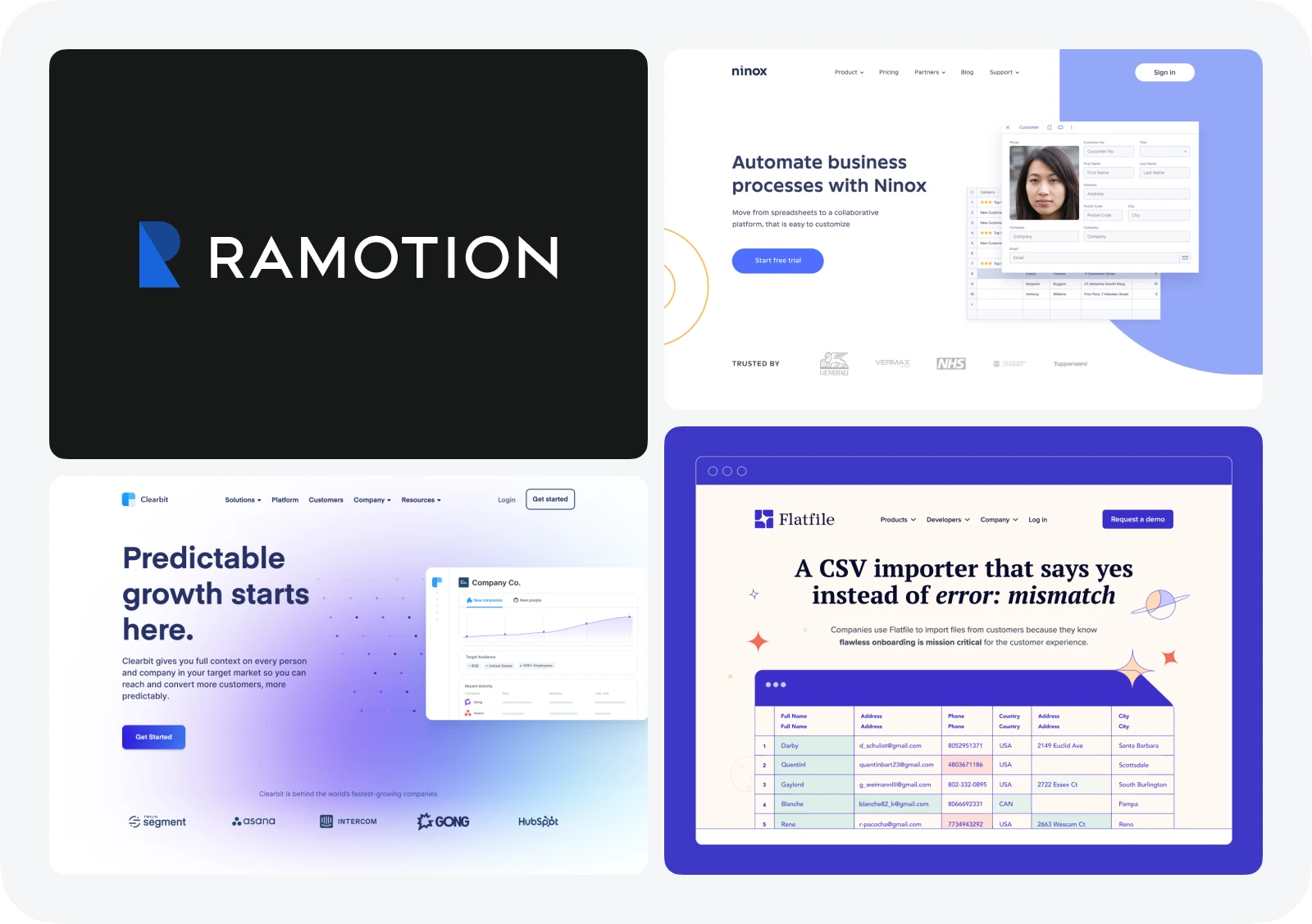
Ramotion combines branding, UI/UX, and web app development under one roof — making us a strong fit for tech-forward startups and growing product teams. Our work is known for combining function with sharp, coherent design. We focus on building digital ecosystems that feel as good as they look.
Another thing that makes us special is that we intentionally limit our number of active clients to stay deeply embedded in each engagement. Our team’s structured and imaginative process delivers high-performing, scalable apps that align with long-term brand and business goals.
Ramotion
- Best for: Custom SaaS platforms, B2B, and FinTech clients who need robust engineering combined with elite, visually stunning UI/UX and design-centric problem solving.
- Tech Stack: Focused on modern, scalable architectures: Microservices backend, API Design & Development, Database Architecture, Continuous Integration (CI/CD), DevOps, and Type-Driven Development.
- Strengths: Design-Centric Developers (developers understand design principles), high performance optimization, Proactive UX Improvements during implementation, and HIPAA-compliant healthcare app development.
- Downside: While not explicitly stated as a downside, their "visually stunning" focus and "developers with design intuition" approach imply a premium service that may come at a high cost/longer timeline relative to pure engineering shops.
- Portfolio: Custom web apps, rich interactive apps, visually stunning apps, data processing apps, and AI-powered web apps across Fintech, Healthcare, and E-commerce/Retail.
- Unique Offerings: Type-Driven Development (enforcing correctness and logic using strong type systems) and Domain-Driven Design with types for enforcing business logic.
| Location | San Francisco (CA, USA) |
| Founded | 2009 |
| Team size | 10–49 |
| Clients | Firefox, Descript, Salesforce |
| Services | UI/UX design, branding, web application development services |
| Budgets | $35,000+ |
| Industries | SaaS, tech, B2B |
| Website | ramotion.com |
| Social links | LinkedIn, Twitter |
2. Iflexion
Iflexion is one of the more established players in this space, having delivered digital products since 1999. With deep roots in agile development and a tech stack that includes PHP, Java, and Angular, they’ve built web platforms for brands like Adidas and Toyota.
Their model blends offshore development with enterprise-level process maturity — perfect for companies needing robust custom systems and long-term product partnerships.
- Best for: Global enterprises needing universal, full-cycle custom software and legacy application modernization across a vast range of industries (20+ verticals).
- Tech Stack: Comprehensive and highly versatile. Certified experts for Microsoft, AWS, Google, Salesforce, Odoo, and SAP Commerce. Focus on BI, ML, and secure development lifecycle (end-to-end encryption, MFA).
- Strengths: Massive Scale and Maturity. 25+ years in business, 1,000+ specialists (86% senior/mid-level), 2,000+ projects completed. ISO 9001 and ISO 27001 certified for quality and security management.
- Downside: Due to their broad focus and large team size, the cost and engagement process are tailored for enterprise-level projects rather than smaller startups.
- Portfolio: Experience in Healthcare, Retail, Logistics, Insurance, Manufacturing, and Finance. Noted by clients (e.g., HSBC) for a well-organized and well-controlled development process.
- Unique Offerings: Secure SDLC. Follows a formal secure development lifecycle compliant with ISO/IEC 27001, OWASP guidelines, and NIST Cybersecurity Framework.
| Location | Decatur, USA; London, UK |
| Founded | 1999 |
| Team size | 500+ |
| Clients | Toyota, Adidas,Phillips |
| Services | Custom development, legacy modernization, QA |
| Budgets | $20,000+ |
| Industries | Manufacturing, logistics, retail |
| Website | iflexion.com |
| Social links |
3. Simform
Simform is a tech consultancy and web app development company that helps startups and enterprises alike scale with custom software. Known for their modern architecture (microservices, serverless, and cloud-native apps), they specialize in AWS, React, and Golang development.
They’re listed on the Deloitte Fast 50 and have built solutions for tech-forward clients looking to modernize infrastructure without sacrificing UX. Their team works closely with in-house stakeholders for smooth delivery and long-term scalability.
- Best for: Enterprises and companies needing to accelerate product roadmaps, adopt the cloud, and innovate with Gen-AI/custom ML development.
- Tech Stack: Digital Product Engineering, Cloud/DevOps Engineering, Data Engineering, and AI/ML Engineering. Focus on full-stack observability and modern cloud-native systems.
- Strengths: Engineering-Focused Excellence. Named the #1 AI services provider globally by Clutch (2025). Achieved Datadog Advanced Tier Partner Status. Strong approach to Co-Engineering and digital innovation.
- Downside: Their focus on complex, high-end engineering and large-scale solutions means they may not be the right fit for simple, low-budget web application projects.
- Portfolio: Case studies include a semiconductor manufacturer boosting data accuracy by 80% with automation and a supply chain giant using AI to reduce shipment costs by 20%.
- Unique Offerings: AI Studio Advantage. A special unit with its own engineering culture, proprietary libraries, and MLOps tools focused on achieving digital excellence.
| Location | Orlando, USA |
| Founded | 2010 |
| Team size | 1000+ |
| Clients | Redbull, Tryg |
| Services | Web application development services, cloud migration, DevOps |
| Budgets | $30,000+ |
| Industries | Tech, education, logistics |
| Website | simform.com |
| Social links | LinkedIn, Twitter |
4. Cyber-Duck
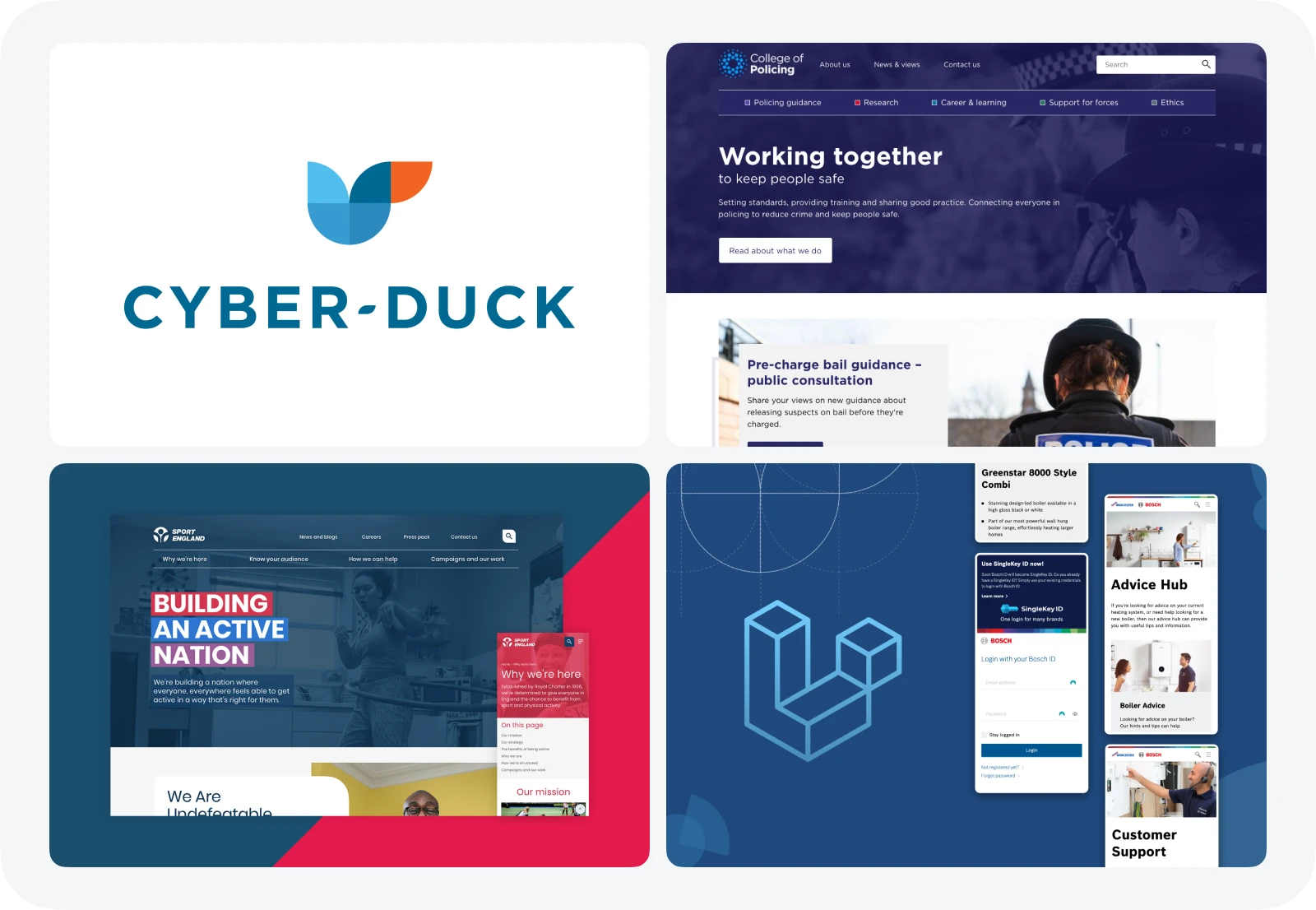
Cyber-Duck is a UK-based digital agency known for secure, accessible, and user-first web apps. Thanks to its firm grasp of WCAG accessibility standards and Cyber Essentials certification, it is trusted by organizations like the NHS and Sport England.
Their team uses Laravel, React, and Drupal, combining robust engineering with service design and user research — especially for complex public-sector and non-profit platforms.
- Best for: Organizations requiring the highest standards of quality, security, and compliance (e.g., government, regulated finance, large charities).
- Tech Stack: Focus on Human-centered design, secure web application development, CMS/DXP, and DevOps/Platform Engineering. Complies with OWASP security standards.
- Strengths: Most Accredited Agency. Certified by ISO 9241 (Human-centered design) since 2011 and ISO 27001 (Information Security) since 2016. Works to the Government Digital Service Standard (GDS).
- Downside: Their rigorous, accredited process and focus on security/compliance may lead to longer timelines and higher costs compared to agencies without these standards.
- Portfolio: Expertise in public sector standards (GDS), implying large-scale, high-impact projects often found in government and financial services.
- Unique Offerings: The Cyber-Duck Way. A pioneering process accredited by six independent global standards, ensuring quality, security, and inclusive design for every project.
| Location | London, UK |
| Founded | 2005 |
| Team size | 50–249 |
| Clients | NHS, Bank of England, Sport England |
| Services | UX design, secure web apps, digital transformation |
| Budgets | $35,000+ |
| Industries | Public sector, health, finance |
| Website | cyber-duck.co.uk |
| Social links | LinkedIn, Twitter |
5. MentorMate
MentorMate brings over 20 years of experience in custom software and web app development. With a strong presence in healthcare and life sciences, they build highly regulated digital products using .NET, React Native, and Angular.
Clients like Cargill and Soundview rely on MentorMate for enterprise-grade delivery at scale — particularly where security, scalability, and cross-functional collaboration are essential.
- Best for: Organizations seeking digital transformation at scale, particularly in complex and regulated industries like Healthcare and Financial Services.
- Tech Stack: Full digital stack: Strategy, Design, AI, and Engineering. Expertise in integrating ethical, scientifically backed, empathetic AI into user-centered solutions.
- Strengths: Deep Compliance Knowledge. Builds durable and scalable solutions that can withstand HITRUST and SOC2 certification requirements, and is compliant with FDA and IEC62304 for medical device software.
- Downside: At over 1,000 employees, the personalized approach may rely heavily on the assigned project manager and team, requiring strong client oversight.
- Portfolio: Serves clients in Agriculture, Manufacturing, Financial Services, Education, and Healthcare, delivering digital health solutions designed with empathy for providers and patients.
- Unique Offerings: Blending Human-Centered Design, AI, and Engineering to deliver intuitive, efficient, and innovative products tailored to user insights and cross-cultural behavioral patterns.
| Location | Minneapolis, USA |
| Founded | 2001 |
| Team size | 1000–9999 |
| Clients | Cargill, Soundview |
| Services | Custom web app development, strategy, cloud |
| Budgets | $60,000+ |
| Industries | Health tech, pharma, enterprise |
| Website | mentormate.com |
| Social links | LinkedIn, Instagram |
6. SmartOSC
SmartOSC is an enterprise-grade eCommerce and custom development firm with a strong Asian foothold and an expanding global presence. It is an Adobe-certified partner and uses technologies like Magento, Node.js, and React to build scalable solutions for large businesses.
With major clients like Lotte and ASUS, SmartOSC understands how to deliver on complex, high-volume platforms. They also bring expertise in composable commerce, headless architecture, and multi-market rollouts.
- Best for: Enterprise and major retail brands focused on complex Digital Transformation and optimizing E-commerce/Retail operations and supply chain.
- Tech Stack: Highly specialized in E-commerce/DXP platforms. Strong focus on AI for operations, including predictive inventory, smart shelving, loss prevention, and demand forecasting models.
- Strengths: Operational AI Expertise. Focus on using AI "behind the scenes" in supply chain and logistics to deliver real savings and agility, which is crucial for modern retail margins.
- Downside: While not a downside, their specialization means their core business advantage is focused on Digital Commerce and not generalized web app development outside of that vertical.
- Portfolio: Implied portfolio is large retail and e-commerce giants, focusing on operational improvements. AI integration in retail is projected to grow from $9.36B (2023) to $85.07B (2032).
- Unique Offerings: AI for Supply Chain and Operations. A focus on AI to power predictive inventory and demand forecasting, not just front-end engagement/marketing AI.
| Location | Hanoi, Vietnam; Melbourne, Australia; Seattle, USA; Singapore |
| Founded | 2006 |
| Team size | 800+ |
| Clients | Asus, Paypal, Lotte |
| Services | eCommerce, web application development firm, custom solutions |
| Budgets | $55,000+ |
| Industries | Retail, tech, B2B |
| Website | smartosc.com |
| Social links | LinkedIn, YouTube |
7. One Beyond
One Beyond (formerly DCSL GuideSmiths) is a UK-based firm focused on custom software development for enterprise clients. They offer high-grade solutions built with .NET, Azure, Angular, and React and follow ISO 27001 security standards.
With clients like Costa and the NHS, their work consistently bridges internal operations and user-facing excellence. Their team is particularly experienced with large-scope app development and integrations across legacy systems.
- Best for: Established businesses, non-profits, and government organizations seeking cost-effective, award-winning bespoke software and large-scale digital transformation.
- Tech Stack: Microsoft .NET, Power BI, React, and Node.js. Also proficient in Python, MySQL, and Cloud deployment (Microsoft Azure/AWS).
- Strengths: Cost-Efficiency and Quality. Accredited with Microsoft Solutions Partner and AWS Select Tier Services Partner status, plus ISO 9001 & ISO 27001, all while offering competitive nearshore rates ($50 - $99/hr).
- Downside: Review highlights mention occasional "Challenges with Initial Project Management," suggesting the client needs to maintain clarity and focus at the project start.
- Portfolio: Custom portals for transportation companies, government app UI/UX enhancement, and business systems for logistics, retail, and manufacturing.
- Unique Offerings: Hybrid Delivery Model. Utilizes nearshore centers (UK, Spain, Romania, Hungary) operating under a single best-practice methodology to deliver cost-effective, ISO-certified quality.
| Location | Farnborough, UK; Budapest, HU; Madrid, ES |
| Founded | 1994 |
| Team size | 300+ |
| Clients | Costa, NHS |
| Services | Custom web app development, cloud, systems integration |
| Budgets | $60,000+ |
| Industries | Government, healthcare, enterprise tech |
| Website | one-beyond.com |
| Social links | LinkedIn, Facebook |
8. Closeloop Technologies
Closeloop is an innovation-driven agency that offers full-cycle development services from discovery through deployment. With expertise across Node.js, React, Flutter, and Python, they excel at rapid prototyping and product-market fit delivery.
They’ve built web apps for healthcare, fintech, and eCommerce brands and consistently rank high on Clutch and GoodFirms. Their strong R&D backbone makes them a smart pick for companies building something new—not just something functional.
- Best for: Businesses seeking strategic technology services and C-level expertise to build scalable solutions, from startup inception to enterprise expansion.
- Tech Stack: Full Stack Engineering, Cloud Engineering, Data Engineering, Generative AI integration, and platform integration (Salesforce, NetSuite).
- Strengths: C-Level Expertise. Provides a Virtual CTO offering, delivering C-level expertise and strategic planning, backed by accountability for project success.
- Downside: While they work with startups, their focus on C-level guidance and innovation suggests a higher engagement cost reflecting the caliber of their strategic leadership.
- Portfolio: 250+ projects delivered. Case studies show 30% reduction in IT costs (Ithos Global) and 40% faster bulk order processing (Upright). Strong in Fintech, HealthTech, and Regulatory software.
- Unique Offerings: Virtual CTO Service. Positions the company as a strategic partner, offering innovative technology consultation and seamless system integration, not just coding services.
| Location | Mountain View, CA |
| Founded | 2011 |
| Team size | 50–249 |
| Clients | LastPass, We are social |
| Services | Web application development firm, MVP builds, R&D consulting |
| Budgets | $35,000+ |
| Industries | Healthcare, fintech, SaaS |
| Website | closeloop.com |
| Social links | LinkedIn, Instagram |
9. Imaginary Cloud
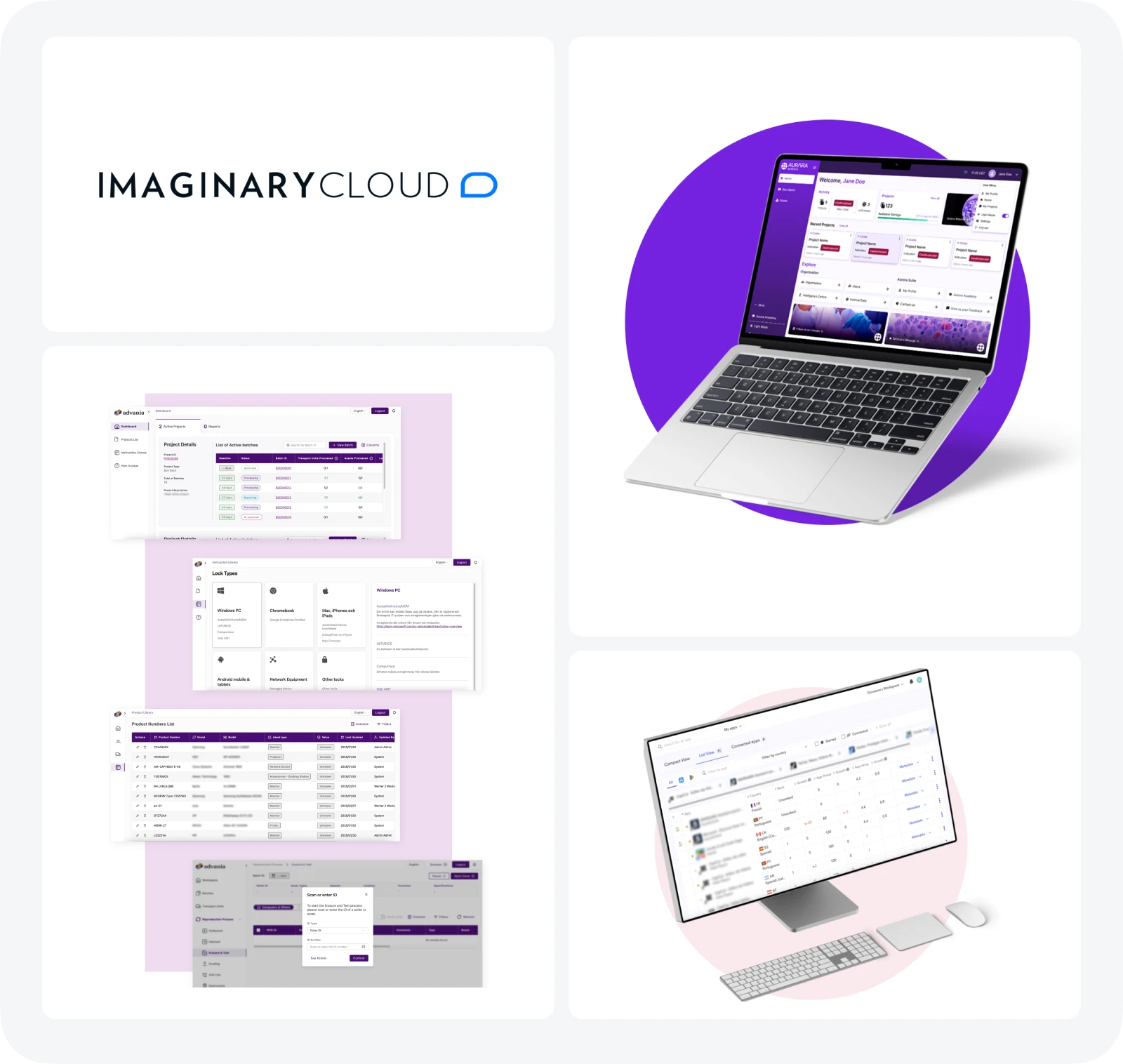
With over a decade of experience, Imaginary Cloud has earned its spot among the best web app development companies by quickly building innovative, scalable apps. Their focus on UX design and agile development ensures a clean handoff from concept to deployment. Core technologies include Python, Django, and React, ideal for MVPs and growth-stage products.
They’ve worked with clients like BNP Paribas and Nokia, demonstrating the flexibility to serve enterprise- and innovation-first startups. Their commitment to iterative delivery means clients see results early and often.
- Best for: Companies seeking Seamless Digital Acceleration and end-to-end digital products, especially in Fintech, Healthtech, and Proptech that need a highly process-oriented partner.
- Tech Stack: Proficient in web, software, and mobile. Expertise includes Data Science, AI/Machine Learning integration, and best practices for Code Review and managing technical debt.
- Strengths: Highly process-oriented with proven processes for quality and debt-free delivery. Offers Code Audits and UX Audits to optimize existing products.
- Downside: While focused on "Built to Scale," their track record of 300+ products since 2010 positions them as a strong mid-to-large-scale partner, but not in the same capacity as a 1000+ person firm.
- Portfolio: Over 300 web and software products across 15+ industries. Case studies include improving dashboard loading time by 80% (AppTweak) and full marketplace migration (Flipped Normals).
- Unique Offerings: AI-Enabled Development. Developers, processes, and workflows are AI-enabled, ensuring greater efficiency and quality across the SDLC.
| Location | London, UK; Lisbon, Portugal |
| Founded | 2009 |
| Team size | 50–249 |
| Clients | Nokia, BNP Paribas, Thermo-Fisher |
| Services | Web app development services, UX/UI design, data science |
| Budgets | $30,000+ |
| Industries | Fintech, healthcare, SaaS |
| Website | imaginarycloud.com |
| Social links | LinkedIn, Instagram |
10. EitBiz
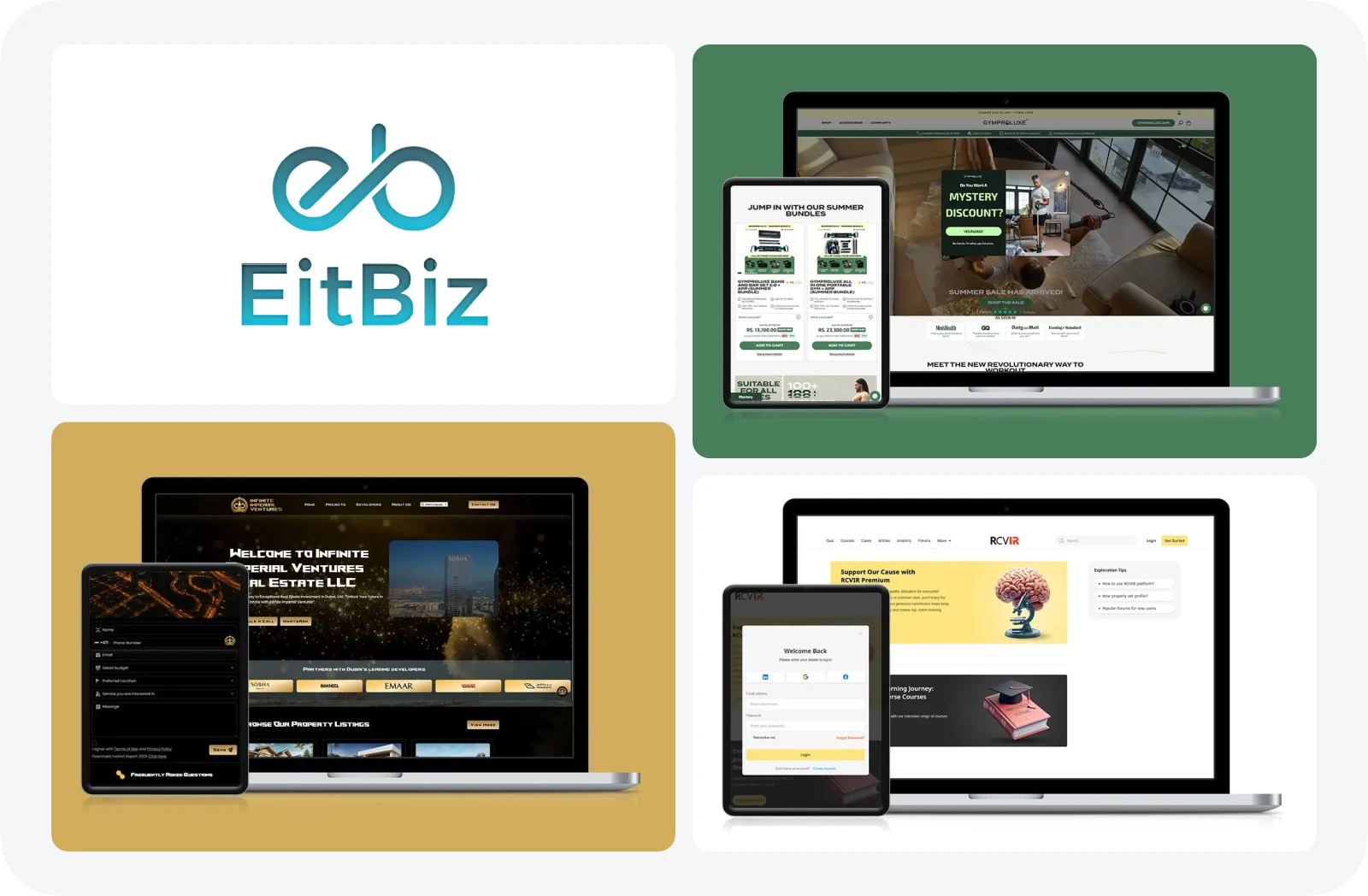
EitBiz is a full-service digital agency covering everything from UI/UX design to backend architecture and DevOps. They are especially popular with SMBs thanks to a practical, transparent approach and solid Clutch reviews. Their go-to tech stack includes Laravel, Angular, and Flutter.
Clients highlight their strong post-launch support and flexibility, which makes them a reliable partner for businesses without large in-house dev teams.
- Best for: Founders and businesses (including those with no IT experience) needing reliable, affordable custom website and app development.
- Tech Stack: Full-stack development capabilities, often utilizing common modern stacks. Developers are noted for their technical skills and ability to solve complex problems.
- Strengths: Dedication and Reliability. Clients consistently highlight the team's professional, reliable, and attentive nature, willingness to stick to a fixed price, and accommodating nature to changes/extra functionality.
- Downside: While focused on affordability and general development, their core strength appears to be reliable execution rather than a highly specialized or niche technology focus (like enterprise DXP or advanced AI).
- Portfolio: Custom web apps, mobile development, website transformation, and support for social media channels and SEO tracking.
- Unique Offerings: True Partnership Model. Takes time to assess needs, identify solutions, and educate clients on the why behind the solution, which is valuable for non-technical founders.
| Location | Fort Wayne, USA; London, UK; Delhi, India |
| Founded | 2017 |
| Team size | 50–249 |
| Clients | Getting Ahead, Trailer, Medical Optics |
| Services | Mobile and web app development, design, DevOps |
| Budgets | $15,000+ |
| Industries | Retail, eLearning, healthcare |
| Website | eitbiz.com |
| Social links | LinkedIn, Pinterest |
11. Toptal
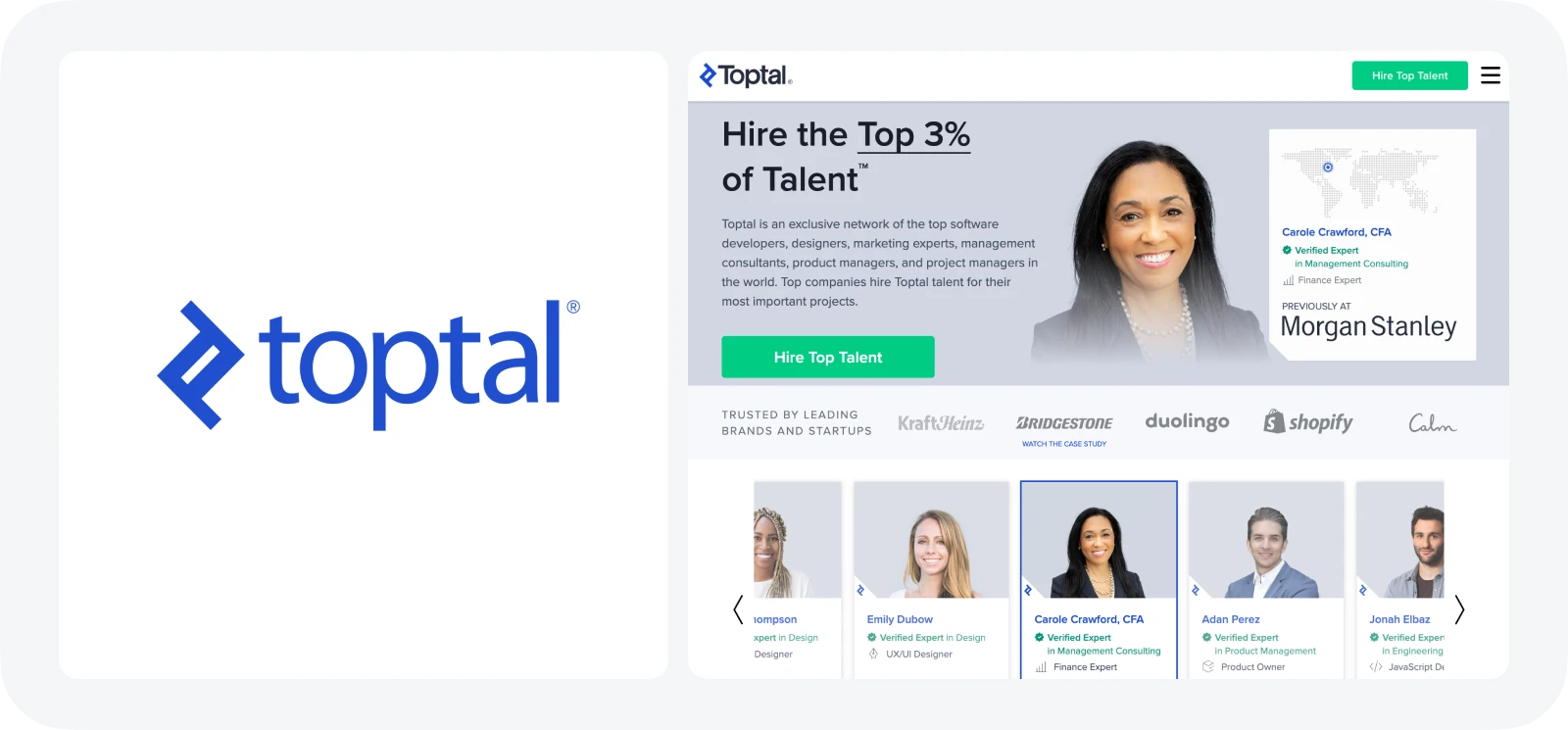
Toptal isn’t a traditional agency — it’s a curated global network of top-tier developers, designers, and product managers. Their on-demand model gives clients access to elite web app developers without the overhead of a full-time team. Their stack includes React, Node.js, Ruby on Rails, and Python.
Companies like Airbnb, Bridgestone, and Shopify trust Toptal for critical projects. Whether you’re building from scratch or need to augment your existing team, Toptal provides unmatched flexibility and quality control.
- Best for: Companies that need to augment their in-house teams with highly skilled, pre-vetted senior talent (engineers, designers, product managers) quickly.
- Tech Stack: The platform provides talent across virtually every modern and niche tech stack. Talent is matched based on project requirements, skills, and experience.
- Strengths: Unmatched Vetting Process. Less than 3% of candidates are accepted after a multi-stage process including timed skill tests, live screenings, and test projects.
- Downside: The Client Manages the Project. Toptal is a talent platform, not a vendor that provides a fully managed project team. The client remains responsible for the SDLC, QA, and project management.
- Portfolio: Toptal's talent pool is leveraged by clients like Bridgewater Associates, Hewlett Packard Enterprise, and Motorola.
- Unique Offerings: Highly Personalized Pairing. Combines AI and customer service agents to match clients with talent based on experience, personality, and specific project needs.
| Location | San Francisco, USA |
| Founded | 2010 |
| Team size | 1000–9999 |
| Clients | Shopify, Airbnb, Bridgestone |
| Services | Web app development agency, UI/UX, team augmentation |
| Budgets | $20,000+ |
| Industries | SaaS, eCommerce, fintech |
| Website | toptal.com |
| Social links | LinkedIn, Twitter |
How to Choose the Best Web App Development Company?
Choosing a web app development company is no longer a simple vendor-selection exercise. The market is crowded, everyone claims to be “full-stack” and “Agile”, and one wrong decision can cost months of runway and damage your roadmap.
For CTOs, founders, and marketing leaders, the real risk isn’t just a missed deadline. It’s brittle architecture, poor code quality, and a product that can’t scale when the business finally starts to grow.
This guide moves past generic advice and focuses on what actually separates a true technology partner from a body shop.
1. Check out the hard skills
Core tech stack
Don’t be impressed by a wall of acronyms. Ask how they structure the stack by responsibility:
- Frontend for user experience: React, Vue, Next.js or similar frameworks for fast, responsive interfaces.
- Backend for business logic: Node.js, Python, .NET, Java for robust APIs and core workflows.
- Data & storage: Relational databases (PostgreSQL, MySQL) and NoSQL options (MongoDB, Redis) where appropriate.
- Cloud & infrastructure: AWS, Azure, or GCP for deployment, monitoring, and CI/CD.
Look for T-shaped engineers: people deep in one area (e.g., backend architecture) but conversant across the full stack, including DevOps and basic UX. This reduces handoff friction and “not my area” delays.
Architecture & scalability
Your question isn’t “Can you build this?” but “Can you build this so it still works when we grow 10–100x?”. Ask how they would design for:
- Scaling from 100 to 1,000,000 users
- Cloud-native deployment on AWS/Azure (containers, serverless, managed databases)
- Observability (logging, metrics, alerts) from day one
If they can’t explain trade-offs in plain language, they’re not ready for your scale.
2. Soft skills: where real differentiation happens
Most agencies can write code. Far fewer can collaborate at the level a growing tech company needs.
Transparent communication
You want more than “regular updates.” Clarify:
- Which tools they use (Slack/Teams for async comms, Jira/Trello for task tracking, Confluence/Notion for documentation).
- How often you’ll talk (daily standups, weekly sprint reviews, monthly roadmap check-ins).
- Who your accountable point of contact is (not just a generic support email).
The communication structure they propose is a preview of project discipline.
Agile mindset
Short iterations and frequent releases let you react to user feedback and prevent you from investing six months in features nobody uses. Ask how they handle:
- Backlog refinement and prioritization
- Changing requirements mid-sprint
- Demoing increments to stakeholders
If their process can’t accommodate pivots, your product will fall behind your market.
Culture fit
A good partner doesn’t just say “yes.” You want a team that:
- Challenges weak assumptions
- Pushes back on features that add complexity without value
- Proposes simpler alternatives when scope is bloating
If they never say “no” during sales, they’ll likely avoid hard conversations later too.
3. Portfolio: go beyond prettiness
A polished screenshot doesn’t prove they can deliver outcomes.
Look for business impact in their case studies. Instead of “We redesigned the dashboard,” look for statements like:
- Reduced page load times by 40%
- Increased trial-to-paid conversion by 15%
- Cut manual processing time from days to hours
Focus on projects similar to your situation: B2B vs B2C, SaaS vs marketplace, complex integrations, compliance-heavy environments, etc. Then ask for references you can actually speak to. A quick call with a previous client will tell you more about reliability, communication, and problem-solving than any proposal.
4. Think past launch: long-term partnership and reliability
Your web app is never “done.” It evolves with your product strategy, sales cycles, and compliance requirements.
Maintenance & continuous improvement
Clarify what happens after go-live:
- Who owns monitoring and incident response?
- How are bugs triaged and fixed?
- How often do they propose improvements based on data, not opinions?
You want a partner who treats software as a living system, not a one-off project.
DevOps & security fundamentals
Ask how they handle:
- CI/CD pipelines and automated testing
- Role-based access, secrets management, and data encryption in transit and at rest
- Compliance considerations (GDPR, cookie consent, data retention policies)
If they build good security and DevOps into the foundation, your team avoids expensive retrofits later.
5. Checklist for choosing your web app development company
When you’re down to a shortlist, use a simple but strict filter:
- ✅ Code review: Request anonymized code samples or access to a GitHub repo. Look for structure, tests, and clarity—not just cleverness.
- ✅ The “bus factor”: Ensure knowledge isn’t trapped in one developer’s head. Ask about documentation, onboarding, and how they handle staff turnover.
- ✅ Communication test: Note how long they take to respond to your first email and how clearly they answer. That’s your baseline for the entire engagement.
- ✅ Stack justification: Ask, “Why this stack for my use case?” You should hear reasoning tied to your goals (performance, hiring market, time-to-market, budget), not personal preferences.
*If an agency can’t pass this checklist, don’t sign—no matter how attractive the price looks.
The right web app development company is a force multiplier for your roadmap. It turns strategy slides and backlog items into a product that prospects understand, customers rely on, and internal teams can build on without fear.
Whether you are evaluating the firms in this guide or others you have worked with before, the pattern is the same. Look for partners who tie their work to business outcomes, make thoughtful architecture decisions, communicate with real transparency, and treat security and maintainability as first-class concerns rather than nice-to-haves.
If you combine that lens with a clear understanding of costs, timelines, deliverables, and IP, you dramatically reduce the risk of an expensive misstep. You also give yourself the best chance of finding a team that can move as quickly as your market, and turn your web app into an asset that compounds over time rather than a constraint you are always trying to work around.
What Does a Web App Development Company Actually Do?
When you hire a web app development company, you are not just buying “code hours.” You are buying a product capability that turns strategic bets into usable software your customers and sales teams can rely on.
A web app development company designs, builds, and scales browser-based applications that sit at the core of your revenue engine: onboarding flows, customer dashboards, partner portals, internal tools, and workflow automation. That work usually spans product strategy, UX and UI design, front- and back-end engineering, quality assurance, DevOps, and ongoing optimisation.
In practical terms, a strong partner will help you move from a fuzzy idea (“we need a better self-service experience for mid-market accounts”) to a clear roadmap, working software in production, and a cadence of improvements tied to pipeline, retention, or efficiency metrics.
What Web App Development Is (and Isn’t)
In B2B and SaaS, “web development” often gets conflated with spinning up a marketing site or a quick WordPress build. That is not what is at stake here.
Web app development, in this context, is about building interactive products that handle real business logic, permissions, data flows, and integrations. Think subscription management, analytics dashboards, quoting engines, or multi-step onboarding—not just a page describing those features.
It is also not the same as hiring a single freelancer to “hack something together.” A web app development company brings a cross-functional team that can design the experience, choose the right architecture, implement it, test it, ship it, and keep it running when your user base and data volumes grow.
How a Web App Development Company Fits Into Your Team
For most CMOs, founders, and marketing leaders, the agency doesn’t replace your internal product and go-to-market brain. Instead, it plugs into it.
You typically provide the product vision, business constraints, and customer insight. The web app development company translates that into user journeys, architecture, implementation, and delivery. When it works well, you keep a clear internal owner—often a product lead or marketing leader—and the agency behaves like an embedded product team that can ramp up or down as your roadmap evolves.
Is a Web App Development Company Right for You?
Not every team is ready for a full web app development partner, and that is okay. The question is whether the constraints you face are primarily about ideas or about execution.
You are usually ready for an agency when the business problem is clear, the stakes are meaningful, and speed matters. If your sales team is losing deals because prospects cannot trial or onboard themselves, if customer success is drowning in manual work that should be automated, or if you have a validated product direction but no bandwidth to build it, an external team can compress months of waiting into a predictable delivery timeline.
You might not be ready if you are still iterating on the problem itself, do not have a clear internal owner for the product, or cannot commit a budget or decision-making time. In those cases, lightweight experiments, prototypes, or even no-code tools may be a better short-term path until the opportunity is clearer and worth a larger investment.
A good web app development company will be honest about this. If they are willing to sell you a large build when the fundamentals are not yet in place, that is a signal in itself.
In-House vs Freelancers vs Agency: Which Path Fits Your Stage?
Most B2B and SaaS teams bounce between three options when they need to ship a web app: hire in-house, hire freelancers, or partner with a specialised agency. Each path can be right; the key is matching it to your stage and risk profile.
An in-house team gives you the most control and long-term ownership. It is usually the best option once you have a stable product, a steady roadmap, and the budget to hire and retain senior engineers, designers, and product managers. The trade-off is time. Building that team takes months, and in tight talent markets it can easily delay critical initiatives by a whole planning cycle.
Freelancers can be a fast and flexible way to explore ideas, fix isolated issues, or handle well-contained pieces of work. This route tends to break down when you need continuity, a cohesive architecture, or cross-functional collaboration. Managing a rotating cast of freelancers quickly becomes a job in itself, especially when you are balancing brand, compliance, and stakeholder expectations.
A web app development company sits somewhere in between. You get a ready-made, cross-functional team with a playbook for discovery, delivery, and optimisation, without carrying that fixed cost on your balance sheet. You trade some day-to-day control for speed, depth, and the ability to scale up or down as the roadmap and funding situation change.
A useful rule of thumb: use freelancers for tactical tasks, build in-house for long-term core capabilities, and bring in a specialised agency when time-to-market and execution quality are the primary risks.
What Happens If You Underinvest in Web App Development?
The easiest mistake to make is not choosing the “wrong” partner, but assuming you can postpone the decision without consequences. In reality, underinvesting in your web app shows up everywhere else in the business.
Sales cycles stay longer than they need to be because prospects cannot self-serve or see value quickly. Customer success teams become the glue holding together manual workflows that should have been productised, which drives up costs and burnout. Marketing launches campaigns that push traffic into clunky experiences, wasting paid spend and eroding trust.
On the technical side, quick fixes accumulate as debt. You end up with a fragile product that slows every future initiative, limits experiment velocity, and makes even simple changes risky. By the time the business feels the impact, the only option left is an expensive rebuild on an accelerated timeline.
Treating web app development as a strategic asset rather than a line item changes that trajectory. It turns your product into a compounding advantage instead of a hidden drag on growth.
How to Measure the Business Impact and ROI of Your Web App
For CMOs and founders, a web app project only makes sense if you can connect it to concrete business outcomes. That starts before you sign the contract. Define, with the agency, which levers this project is meant to move: conversion to trial, trial-to-paid, activation, expansion, churn, sales cycle length, or internal efficiency.
Once those are clear, ask the agency how they plan to instrument the product so those metrics can actually be measured. That might mean analytics events around onboarding steps, tracking completion rates for key workflows, or monitoring response times and reliability for revenue-critical journeys.
ROI then becomes straightforward to reason about. If an improved trial experience increases conversion by a few points on a meaningful volume of traffic, or if automating a core workflow frees several full-time-equivalents in a high-cost team, you can quickly compare those gains to the total project cost. You will rarely get a perfectly precise number, but you should at least get to a shared, directional view of whether the investment is paying off.
When you review case studies, look for that same discipline. Strong partners do not just show new screens; they show the numbers that changed because those screens exist.
Common Mistakes When Choosing a Web App Development Company
Most teams do not fail because they looked at nothing; they fail because they optimised for the wrong things. The most common mistake is choosing purely on day rate or headline project cost, without weighting communication quality, architecture decisions, and the cost of rework. A slightly cheaper team that builds the wrong thing, or builds it in the wrong way, is always the most expensive option.
Another frequent issue is focusing on visual polish in the portfolio while ignoring whether those products moved any real metrics. Attractive interfaces are useful, but only if they support faster onboarding, higher activation, or more efficient account expansion. If a case study cannot connect the work to business movement, treat it as an incomplete story.
A third pattern is underestimating culture and fit. An agency that says “yes” to everything in the sales process, never pushes back, and never asks hard questions about scope or priorities will be very easy to work with for the first two weeks and very hard to work with once the trade-offs start. You want a partner who can challenge your thinking as well as execute it.
Red Flags in Web App Development Proposals
Proposals are where red flags are easiest to spot, if you know what to look for. Be wary of documents that are long on buzzwords and short on specifics. If scope, success criteria, and deliverables are vague, you are effectively signing a blank cheque and hoping for the best.
Unrealistic timelines are another warning sign. If a team promises to deliver a complex, integrated B2B product in a fraction of the time other credible vendors suggest, and cannot explain how, they are either cutting corners you will care about later or do not yet understand what you are asking for.
Pay attention to how they handle risk. A mature partner will talk openly about assumptions, dependencies, and what happens if priorities change mid-project. If a proposal ignores discovery, glosses over maintenance and scalability, or says nothing about ownership of source code and infrastructure, pause and get clarity before you move forward.
Questions to Ask Before You Sign
Beyond checking boxes, the questions you ask in the evaluation phase reveal how a potential partner thinks. Good questions force them to move past the sales script and show you how they operate under constraints.
Use questions like:
- “If we had to cut the scope by 30% one month before launch, what would you remove and why?” This shows you how they prioritise under pressure and whether they understand your business outcomes, not just your feature list.
- “What are the biggest risks you see in this project, and how would you mitigate them?” Mature teams have a clear view of technical, product, and organisational risks because they have shipped similar work before.
- “Who on your side will be accountable for outcomes, and how will they work with our internal stakeholders?” The answer reveals whether you’re getting a coherent, accountable team or a loose group of contributors.
- “How do you handle it when data shows a feature we were excited about is underperforming?” You want a partner who is comfortable changing course based on evidence, not one who defends sunk cost.
- “Can you walk us through a recent project where things did not go to plan, and what you changed as a result?” This exposes their learning culture and how they behave when reality diverges from the original plan.
The goal is not to catch anyone out, but to see whether they have real, lived answers rather than generic assurances. If an agency struggles with these questions, or defaults to platitudes, you can expect the same pattern when the product is live and the decisions get harder.
Pricing Models You Can Expect
Web app development companies usually work with a small set of familiar commercial models. Understanding them helps you choose the one that best matches your risk tolerance and how clearly your scope is defined.
- Time and materials is the most common approach for complex B2B work. You pay for the actual time the team spends, usually at an agreed rate, and you gain the flexibility to adjust priorities and scope as you learn. This aligns well with Agile delivery and evolving roadmaps.
- Fixed-price projects can make sense when the scope is very tight and unlikely to change, for example a well-defined integration or a narrowly scoped feature. The trade-off is that any ambiguity becomes a negotiation later, and teams will naturally optimise for delivering the agreed scope rather than revisiting whether that scope still makes sense.
- Retainers or dedicated teams give you a stable capacity over a longer period. You are effectively “renting” a cross-functional product team that learns your business and works through a backlog of initiatives. This can be attractive when you want predictable spend and continuous progress without building the entire team in-house.
- Performance or value-based components occasionally appear in more mature relationships, usually as an overlay on one of the models above. For example, a bonus tied to hitting specific adoption or conversion targets. These structures work best once both sides have already delivered together and trust the underlying numbers.
How Long Does It Take to Launch and Iterate?
The hours it takes to build a web app—whether a few hundred or a few thousand—only matter insofar as they translate into calendar time and business impact. For many B2B and SaaS teams, a focused cross-functional team can deliver a first usable version of a product or major feature in roughly two to three months, assuming the scope is well shaped and decision-makers are available.
Larger, more integrated initiatives might run over two or three quarters, especially when they touch multiple internal systems, involve compliance reviews, or require significant design exploration. The important thing is not the total duration but the path to first value. You want a plan that gets a real slice of functionality into production early, so you can learn from actual users rather than debating hypotheticals.
When you discuss timelines with an agency, ask how they would structure milestones and what you can expect to see at thirty, sixty, and ninety days. If the only visible progress is at the very end, you are taking on unnecessary risk.
What a Good Onboarding Process Looks Like
Onboarding sets the tone for the entire engagement. A strong web app development company will not rush straight into writing code. They will start with a structured discovery phase to understand your business model, target segments, existing product, and success metrics.
You should expect a mix of workshops and working sessions covering user journeys, current friction points, systems and data sources, and any constraints such as brand, security, or compliance. In parallel, the team will be setting up the practical foundations: repositories, environments, analytics, communication channels, and access to existing tools.
The outcome of onboarding should be tangible. That usually means an initial product backlog, a clear definition of the first release, a high-level architecture direction, and an agreed cadence for ceremonies and reporting. If onboarding consists only of a single kickoff call and a promise to “get started on the build,” something is missing.
Deliverables and Reporting You Should Expect
Clarity on deliverables avoids surprises later. Over the course of an engagement, you should expect a mix of strategic, design, and technical artefacts that make the work legible to your organisation and portable if your needs change.
At a minimum, ask what you will receive in terms of:
- Strategic deliverables: a concise product vision for the initiative, user and account journey maps, and a prioritised backlog that makes trade-offs transparent.
- Design deliverables: user flows, wireframes, high-fidelity UI designs, and any component library or design system work that can be reused across future features.
- Engineering deliverables: well-structured code in shared repositories, automated tests, architecture documentation, and deployment or runbooks so your team (or another partner) can operate and evolve the product.
Reporting matters just as much as artefacts. Regular updates should highlight what was delivered, what is coming next, which risks or decisions are on the horizon, and how early metrics are trending against the outcomes you agreed at the start. If you cannot easily explain to your leadership team what you are getting for your investment, ask for a clearer reporting structure.
Conclusion
Every agency on this list earned its spot by delivering more than just functioning web apps: they’ve proven time and time again that they can build platforms that solve problems, scale with demand, and give clear ROI.
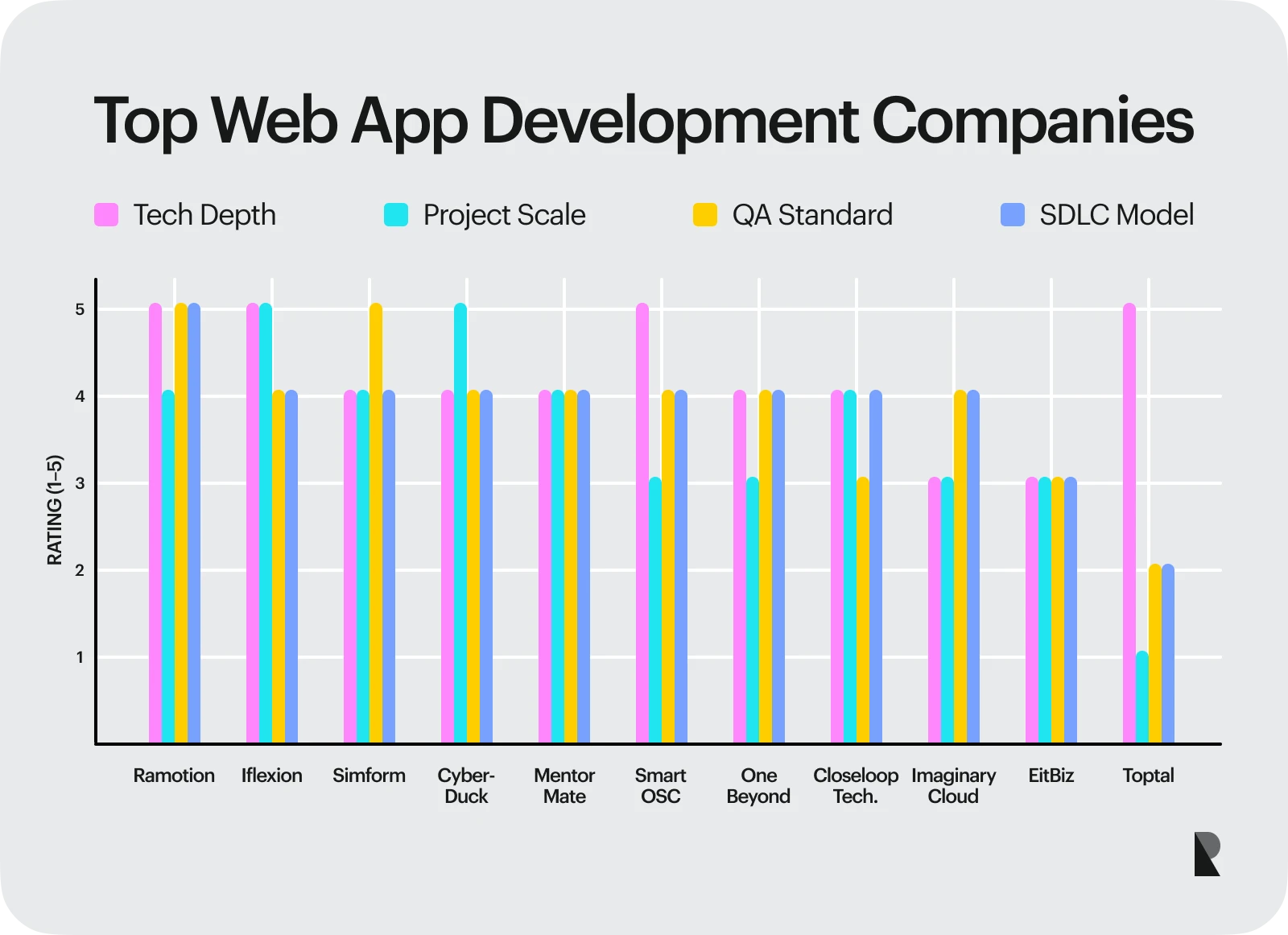
Use the comparison chart as a quick way to sanity-check your shortlist against the capabilities that matter most for a B2B or SaaS product: technical depth, ability to handle complex projects, quality practices, and the maturity of their development process. It will help you focus your time on the few partners most likely to match your standards and stage.
The chart gives a clear, friendly snapshot of how leading web app development companies stack up across four key strengths: tech depth, project scale, QA standards, and SDLC models. Most companies show solid consistency, with Ramotion, Iflexion, and SmartOSC standing out for their strong technical expertise and well-structured development processes.
Others like Simform, Cyber-Duck, and MentorMate demonstrate balanced performance across categories, making them reliable choices for teams seeking all-around capability rather than specialization.
Some companies take a more focused approach. For example, Imaginary Cloud and EitBiz show moderate ratings across most areas, appealing to teams looking for dependable but simpler engagements. Meanwhile, Toptal stands out with very high tech depth but lower scores in scale and structure, making it ideal for organizations prioritizing top-tier engineering talent over large, process-heavy development cycles.
FAQ
What red flags to watch out for when hiring a web app development company?
Be cautious if a company talks only about technology stacks without understanding your business model or product goals. A lack of discovery and UX research at the start of a project often leads to misaligned outcomes. Portfolios that show interfaces but not performance metrics or case results may indicate limited delivery depth.
Overpromising timelines or avoiding discussions about scalability and maintenance are serious warning signs. Reliable partners communicate clearly, provide transparent estimates, and explain how each development decision supports long-term product success.
What does a web app development company do?
A web app development company designs, builds, and scales digital products that run in the browser or hybrid environments. Its work combines product strategy, UX and UI design, front- and back-end development, quality assurance, and ongoing support.
The goal is to create applications that are fast, secure, and adaptable to changing business needs while providing users with a seamless experience across devices.
How much does it cost to develop a web app?
Costs vary a lot — from $10,000 for a basic MVP to $250,000+ for a complex, enterprise-level platform.
How many hours does it take to build a web app?
Anywhere between 300 to 2,000+ hours depending on scope, features, and integration complexity.
What are the 3 types of web development?
Frontend (user interface), backend (server-side), and full-stack (both).
How do I evaluate a development agency?
Look beyond the portfolios; interview team members, check Clutch ratings, and test with a small project.
Can I hire a part-time or freelance web app developer?
Yes. Platforms like Toptal and Upwork allow you to hire vetted freelancers on demand.
What is the difference between custom and off-the-shelf web apps?
Custom apps are tailored to your needs; off-the-shelf apps are prebuilt with limited flexibility.
Jun 17, 2025

Creates insightful, strategy-driven content that translates complex design and branding concepts into accessible knowledge, supporting Ramotion’s mission to elevate digital experiences.