
With technology becoming more and more common in workplaces, including healthcare, product design, and digital interfaces, the way we interact with them becomes increasingly important. A big part of today’s technological advancement is about the design of robots and agents, leading to the idea of human-robot interaction.
Human-robot interaction (HRI) studies and designs how humans and robots perceive, communicate, and work with one another. Unlike traditional technologies that usually rely on screens and manual inputs, robots can move through physical spaces, respond to their surroundings, and perform tasks alongside people. These capabilities bring new considerations and complications for communication, collaboration, autonomy, safety, and task coordination.
Effective human-robot interaction focuses on making these exchanges intuitive, predictable, and safe. By understanding human behavior and designing robots for appropriate interactions, designers and engineers can create systems that support productive collaboration.
In this article, we discuss human-robot interaction (HRI) and explore the ways in which humans and robots communicate. We also share some applications of HRI along with the challenges in creating intuitive experiences.
Read along as we explore the constantly advancing world of human-robot interaction.
Human-Robot Interaction vs. Human-Computer Interaction
Human-computer interaction (HCI) refers to the way people interact with digital products, services, and systems. This interaction typically happens through screens, keyboards, touch interfaces, and other input devices. Human-robot interaction (HRI), on the other hand, particularly focuses on robots that can physically move, manipulate objects, and operate in spaces shared with people.
What is the difference between human-robot interaction and human-computer interaction?
Human-computer interaction focuses on how people use and communicate with digital systems, typically using screens and input devices. On the other hand, human-robot interaction involves physical robots that can perceive their surroundings, act autonomously, and collaborate with people in real-world environments.
The main differences between HCI and HRI lie in the physical presence, autonomous behavior, and real-world consequences. While HCI primarily deals with digital interactions, HRI needs to account for a robot’s movements, decisions, and actions that impact human safety, comfort, and task performance.
Table 1 – Comparison of Mobile Table Layouts
| Aspect | HCI | HRI |
|---|---|---|
| Interaction environment and context | Primarily through digital interfaces | Physical and shared environments |
| Interaction methods | Screens, keyboards, touch interfaces, and voice | Speech, gestures, movement, and physical actions |
| Autonomy | Typically responds to user inputs | May independently perceive, decide, and act |
| Key considerations | Usability, accessibility, and efficiency | Usability, physical safety, trust, and coordination |
How Humans and Robots Communicate
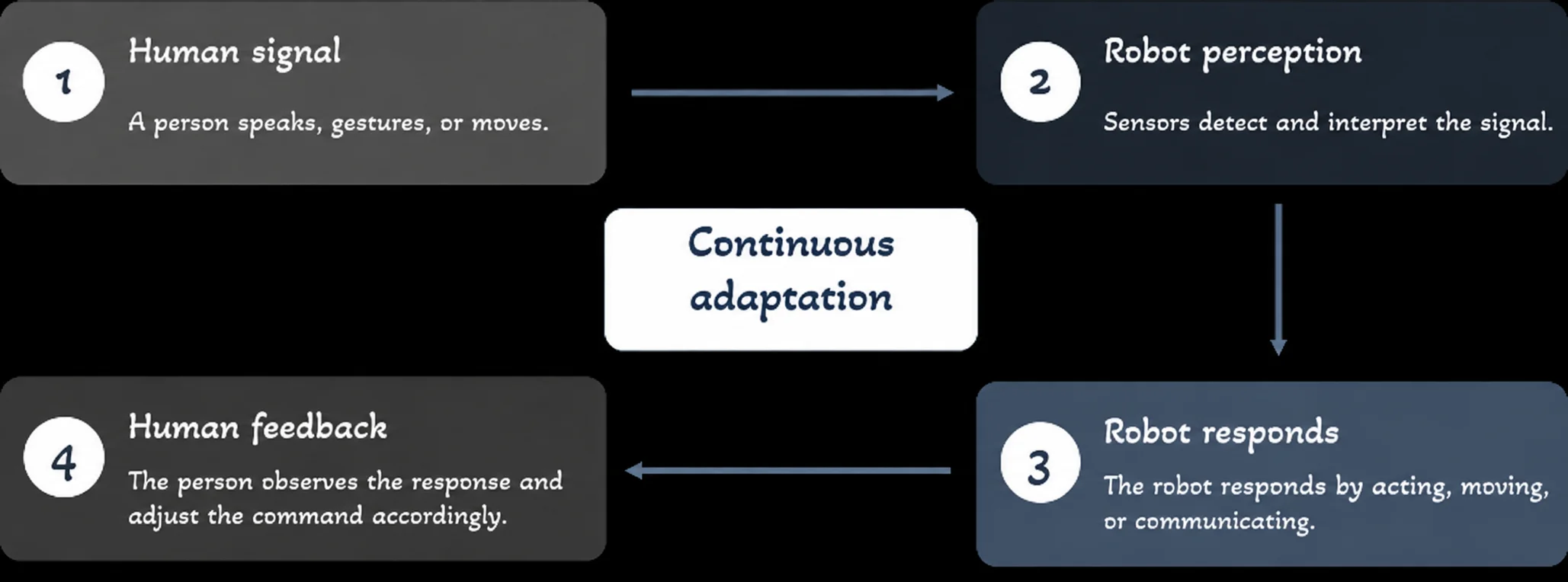
Before we think about the examples and principles of HRI, it is important to understand how humans and robots typically communicate. Communication between humans and robots is a continuous, two-way process where both parties exchange information and respond to each other. More often than not, it begins with a human signal, such as a voice command or gesture. The robot perceives this command or input and interprets it before producing an appropriate response.
The interaction then moves on as the human observes the robot’s response and provides further feedback. This feedback could either be intentional (in the form of further commands) or through their behavior.
For example, a robot may adjust its movement when a person steps into its path, while the person may change their position based on the robot’s movements. This ongoing feedback loop helps both parties coordinate their actions, thus improving the interaction.
Robot interaction modalities
The communication and interaction between humans and robots can take place through several different modalities. These include speech, gestures, gaze, graphical interfaces, physical controls, movement, sounds, lights, and physical contact. Each modality serves a different purpose, from issuing commands and confirming actions to communicating direction and movement intentions.
Many robots combine multiple modalities to make communication effective and more reliable. For example, a robot might use speech to announce its next action while displaying visual signals to reinforce the message. This combination provides better feedback and helps people understand the robot’s intentions, particularly in noisy or busy environments.
Human-Robot Roles and Autonomy
The roles of humans and robots in HRI vary based on the level of autonomy and control in the interaction. Typically, there are three levels of control or autonomy in the process.
Direct human control
In direct human control, the human makes decisions and operates the robot. This often happens through a control device or interface. The robot’s job is primarily to execute commands instead of taking independent actions.
Partial autonomy
With partial autonomy, robots can perform certain tasks or make some decisions independently while humans provide instructions, monitor progress, or intervene when necessary. For example, a robot in a warehouse may navigate to a location on its own while a human assigns specific tasks.
Continuous human-robot collaboration
Continuous human-robot collaboration involves active contributions from both humans and robots toward a shared goal. Both parties adapt their actions and give feedback to each other as the work progresses.
Across these levels of autonomy, responsibility for decisions and task execution shifts from direct human involvement toward greater robot independence. However, greater autonomy does not eliminate human oversight.
Predictability, Feedback, and Trust
Autonomy, communication, and feedback come with responsibility and a certain level of trust. Trust in human-robot interaction depends on how closely a user’s expectations align with a robot’s capabilities and limitations. When robots behave predictably and provide clear feedback, humans can better understand what the system is doing, what to expect next, and how to achieve their goals. However, too much or too little trust can be problematic.
Undertrust occurs when users doubt a robot’s abilities, even when it can perform a task effectively. This lack of trust does not allow a better use of the robot’s capabilities. Overtrust develops when users assume a robot is more capable or reliable than it actually is, thus leading them to overlook errors and reducing oversight.
Effective HRI design aims to build and calibrate trust based on the robot’s capabilities, feedback, and performance. Predictable outputs, transparent communication, and better feedback help users recognize when they can rely on a robot and when human intervention is necessary.
Human-Robot Interaction Safety
Safety is another critical consideration in HRI, particularly when robots and humans share the working space or when the robots are placed in busy environments. Ensuring safe interactions requires a combination of reliable system design, environmental sensing, motion control, and appropriate force and speed limits.
Workspace design and operating procedures also play a crucial role in understanding and mitigating risks. In order to prevent accidents, it is important to provide clear space, movement paths, designated work areas, emergency stop mechanisms, and appropriate user training.
However, safety requirements may vary depending on the work environment, type of robot, and its application. For example, an industrial robot handling heavy equipment requires different safety standards than a food delivery robot on the street.
User-Centered Human-Robot Interaction Design
Now that we know some fundamentals of human-robot interaction, let’s take a look at ways in which the design of this interaction can be made more effective.
Like any other user experience process, HRI begins with understanding the user’s needs, tasks, and context. For HRI, however, paying attention to possible risks is also critical. Designers must also consider what information users need to make decisions, monitor progress, and respond to situations before selecting appropriate interaction methods.
A key part of the HRI design process is the division of responsibilities between humans and robots. Tasks requiring human judgment or critical decision-making may need direct control, while repetitive or predictable activities can often be automated and delegated to robots.
Designers also need to identify potential errors and safety concerns. This helps determine which situations require the strongest safeguards. For example, errors involving physical contact or hazardous equipment demand stricter controls than small delays. This user-centered approach helps create effective interactions without compromising efficiency, usability, and safety.
Human-Robot Interaction Applications
Human-robot interaction is being used across several industries, including manufacturing, healthcare, logistics, hospitality, and public services. These applications require interfaces that support different user needs, tasks, and environments. Organizations developing robotic products may benefit from hiring the best UX design agencies to create intuitive and accessible interactions between people and robots.
Some representative cases from different industries are discussed below.
Manufacturing
In manufacturing, collaborative robots (cobots) work alongside human operators to support assembly, inspection, and material handling. Here, humans supervise production and perform tasks that require judgment, while robots handle repetitive tasks. Interaction typically occurs through control panels and shared workspaces.
Healthcare and rehabilitation
Robots assist medical professionals and therapists with surgical procedures, rehabilitation exercises, and patient care. Physicians establish treatment goals, while robots provide controlled movements or assistance according to their instructions. Touchscreen interfaces, physical controls, and real-time feedback support these interactions.
Logistics
In warehouses and distribution centers, autonomous mobile robots transport products between storage areas and other locations. Human workers assign tasks and manage exceptions, while robots move the materials. Interaction usually involves warehouse management interfaces and handheld devices.
Service robots
Service robots support employees in hotels, restaurants, and other similar facilities by delivering supplies, transporting items, or cleaning floors. Staff members assign tasks and provide oversight, while robots carry out routine operations. Touchscreen controls, mobile applications, and voice commands are used for interaction.
Research
In research environments and experiments, robots are used to investigate human behavior and test research protocols. Researchers design experiments, provide instructions, and analyze the results, while robots perform predefined actions. Interactions may involve speech, gestures, motion tracking, and control interfaces.
Public spaces
Robots in airports, museums, and shopping centers assist humans with navigation. Visitors ask questions or select destinations, while robots provide directions, display information, or guide them through the space. Voice commands, touchscreens, and visual displays are common interaction methods.
Food delivery robots
Autonomous food delivery robots transport meals using sidewalks, campuses, and other designated areas. Restaurant staff load orders, while customers receive notifications and retrieve their food when the robot arrives. Mobile applications, location tracking, and status alerts manage the interaction.
Social robotics
Social robots are designed to engage people through communication, education, or guided activities. Users participate in conversations or activities, while robots respond with text, speech, movements, or other social cues. Text input, voice interaction, and gestures are the typical interaction modes.
Human-Robot Assembly Example
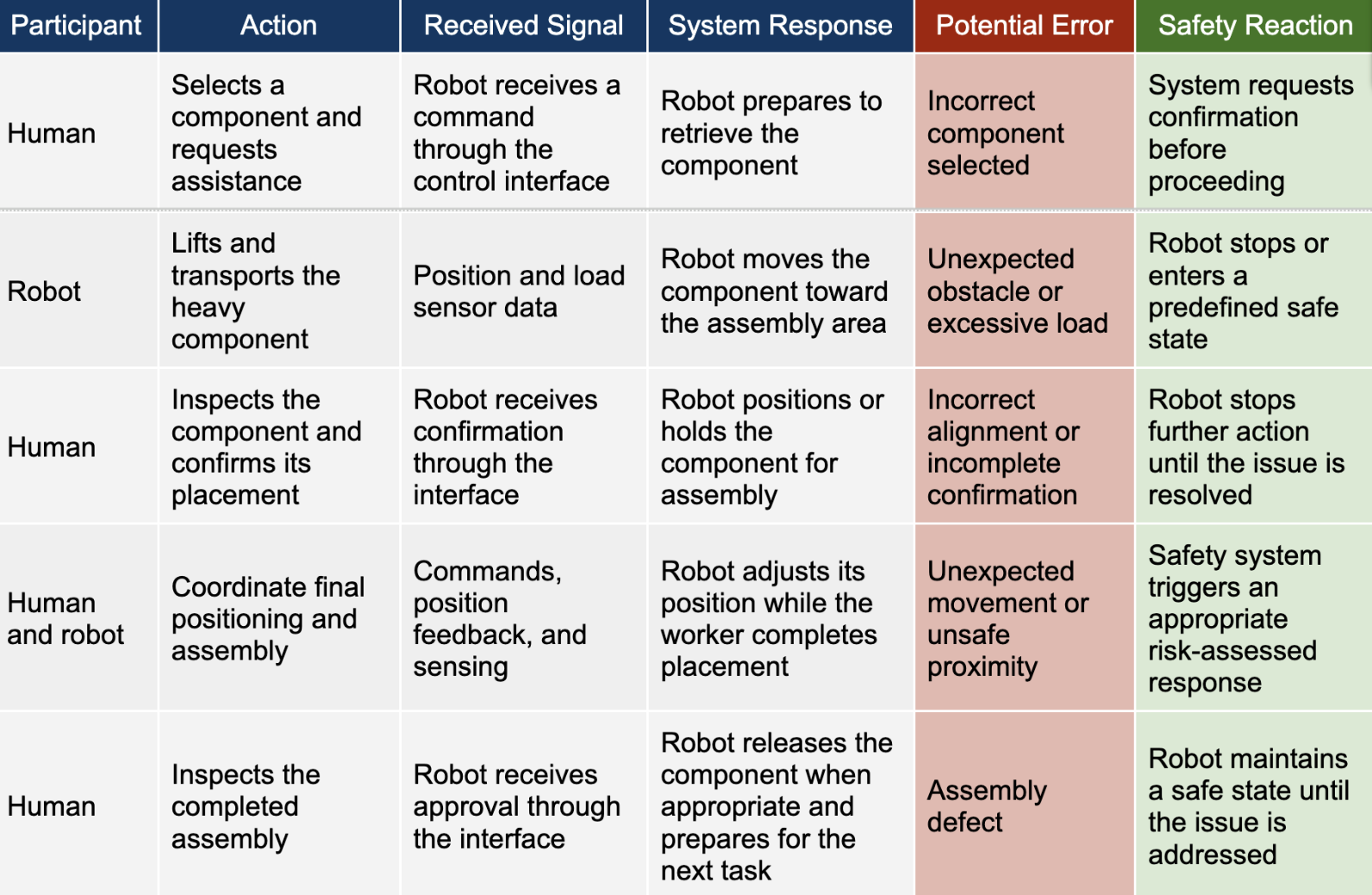
Consider a hypothetical assembly process where we can see human-robot interaction in practice. In this scenario, a human is working in collaboration with a robot to assemble a mechanical component. The human handles tasks that require visual judgment and precise placement. On the other hand, the robot lifts, moves, and positions heavier parts. Both participants coordinate their actions through commands, sensor feedback, and predefined safety procedures.
A detailed interaction, including the actions, signals, and responses, could look something like the table below.
Interaction Table of a Hypothetical Human-Robot Assembly
Note: This example is hypothetical and does not specify real operational distances, speeds, forces, or timing values. Any such values should be validated through an engineering risk assessment and applicable safety standards. The described safety reactions in the table must also be evaluated for the specific robotic system and work environment.
Measuring Human-Robot Interaction Performance
When it comes to the evaluation and performance measurement of human-robot interaction, the focus cannot just be on the task or the speed of completion. It requires a broader perspective, taking safety, predictability, and accuracy into consideration. Key performance metrics include task effectiveness, error rates, the frequency of human interventions, and how clearly users understand the robot's current state and actions.
Designers also need to assess user workload, training time, and safety to understand how well the system supports human operators. Usability testing, performance data, and user feedback can help identify interaction difficulties and potential risks.
Another important measure is the level of trust and satisfaction with robots. Evaluating how accurately users understand a robot’s capabilities and limitations can reveal undertrust or overtrust, thus helping designers improve the interaction.
Human-Robot Interaction Design Challenges
HRI can be complicated to implement, evaluate, and sustain. There are several challenges associated with the design of effective interaction and collaboration between humans and robots.
One of the biggest human-robot interaction challenges is managing the unpredictability of real-world environments and human behavior. People may move unexpectedly, provide ambiguous instructions, or respond differently to the same situation. Similarly, changing conditions and sensor errors can make it difficult for robots to interpret information accurately.
These uncertainties mean that robots cannot always rely on predefined responses or predict human actions. Effective interaction design must account for incomplete or conflicting information, allowing robots to request clarification, adjust their actions, or pause when there is a lack of clarity. This adaptability helps maintain reliable interactions across different users, tasks, and environments.
AI in Human-Robot Interaction
As HRI is becoming popular in different industries, artificial intelligence is making rapid advances at the same time. Both HRI and AI influence each other and work hand in hand.
AI can help robots recognize information in an environment, making interactions with humans more responsive and adaptable. AI and human-robot interaction work together through technologies that process speech, images, movements, and environmental changes. These capabilities also lead to better identification of indicators of human intent, such as gestures, body movements, or spoken instructions.
However, accurately recognizing a signal does not necessarily mean understanding what a person intends. For example, a robot may correctly detect a hand gesture but misinterpret whether the person is giving a command or simply moving naturally. Effective HRI systems must account for this uncertainty by using contextual information, requesting clarification, or avoiding actions where intent is unclear.
Conclusion
When working on systems where human-robot coordination is desired, attention to the principles and best practices of HRI design must not be considered an add-on. Effective human-robot interaction must be considered throughout the design and development of a robotic system, instead of being added as a separate interface at later stages.
Successful HRI design depends on clear communication, appropriate role allocation, reliable safety measures, and predictable robot behavior. By prioritizing user-centered design, organizations can develop robotic systems that enable safe, intuitive, and productive collaboration between humans and robots.

Creates insightful, strategy-driven content that translates complex design and branding concepts into accessible knowledge, supporting Ramotion’s mission to elevate digital experiences.