
Microsegmentation is granular access control between individual workloads, applications, or small resource groups. It limits which resources can communicate, under which conditions, and for what purpose. A workload might be a virtual machine, a containerized service, or a physical application server.
Traditional network segmentation often separates broad zones, such as departments or production environments. Microsegmentation applies finer boundaries within those zones, so sharing a subnet does not automatically justify access. The purpose is to remove unnecessary internal communication while preserving the connections applications need.
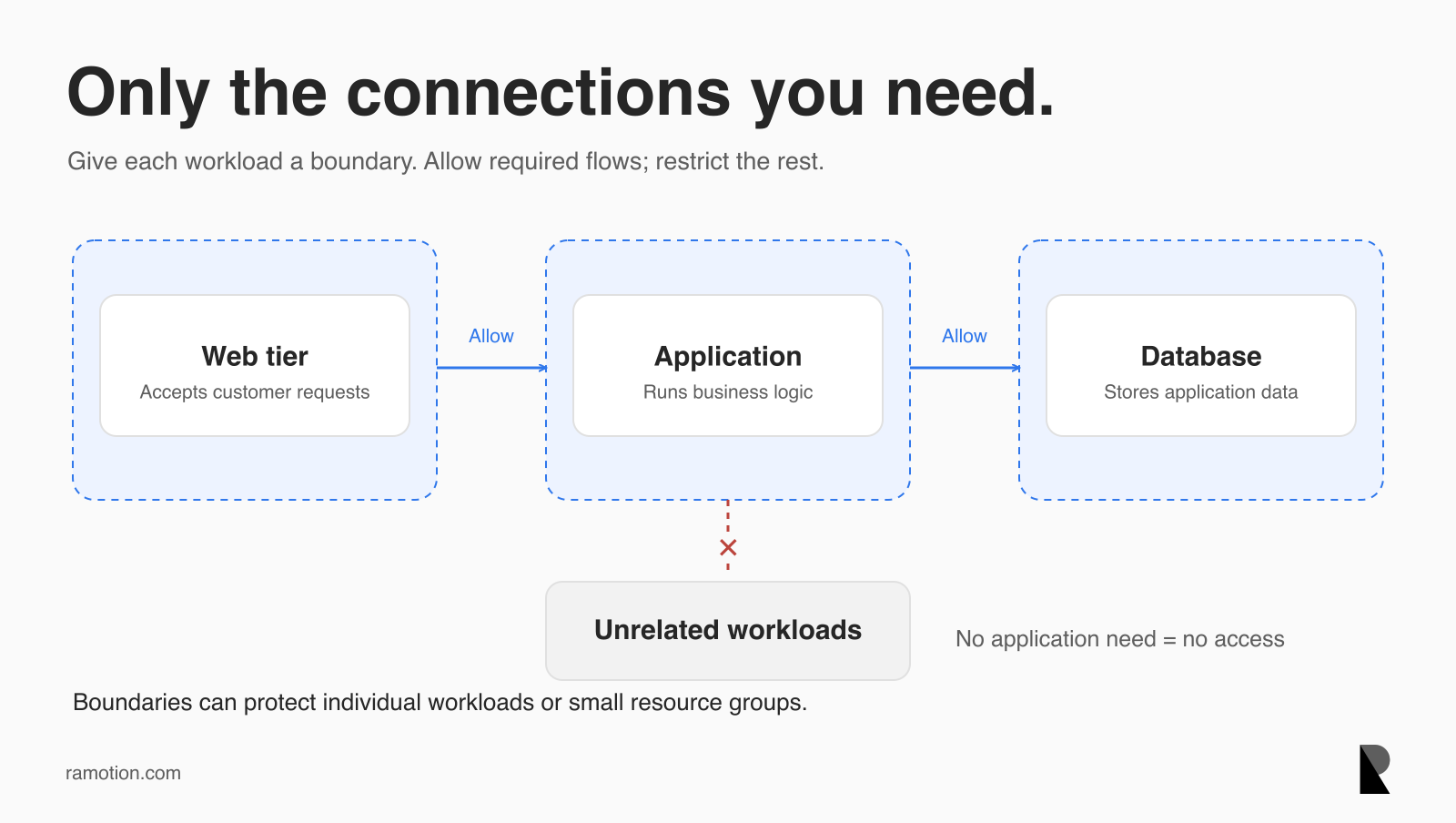
Workload boundaries allow required application flows and restrict unrelated access
Why Modern Networks Need Microsegmentation
A perimeter firewall controls traffic crossing a network boundary. It cannot, by itself, regulate every connection between workloads already inside that boundary. Cloud deployments, virtualization, and containers create internal communication paths that may never pass through a central inspection point.
East-west traffic means communication between internal systems, such as an application calling a database or another service. As applications split into services, these dependencies multiply. A broad rule permitting all internal systems to communicate gives a compromised workload access it never needed.
Microsegmentation addresses that exposure by restricting reachable destinations and services. It does not assume that a private address makes a workload trustworthy. Teams can then limit how far a compromise spreads without routing every internal connection through the same physical firewall.
How Microsegmentation Works
Microsegmentation begins with understanding application behavior. Teams identify workloads, observe their connections, and ask application owners which dependencies are legitimate. An observed connection is evidence to investigate, not automatic permission to preserve it.
A practical microsegmentation workflow follows these steps:
- Discover assets, owners, environments, and existing traffic.
- Map required connections, including operational dependencies.
- Define least-privilege policies for sources, destinations, and services.
- Validate proposed rules, then enforce them within a limited scope.
- Monitor denied traffic and revise policies as applications change.
Least privilege means allowing the minimum communication necessary for a workload's job. An application may need its assigned database endpoint without needing every database in production. A default-deny policy blocks connections outside the approved set, but teams must validate dependencies before enabling it.
Microsegmentation remains an operational process after deployment. Releases, replacement instances, and new services can change required flows. Policy ownership and change reviews keep restrictions aligned with the application rather than its historical configuration.
Before enforcement, write down the expected result for each important flow. Include permitted application requests and connections that must fail, then test both outcomes.
Successful customer transactions alone do not prove isolation because a broad allow rule could preserve functionality while leaving unrelated destinations reachable. Keep the results with the policy change so reviewers can verify its purpose later.
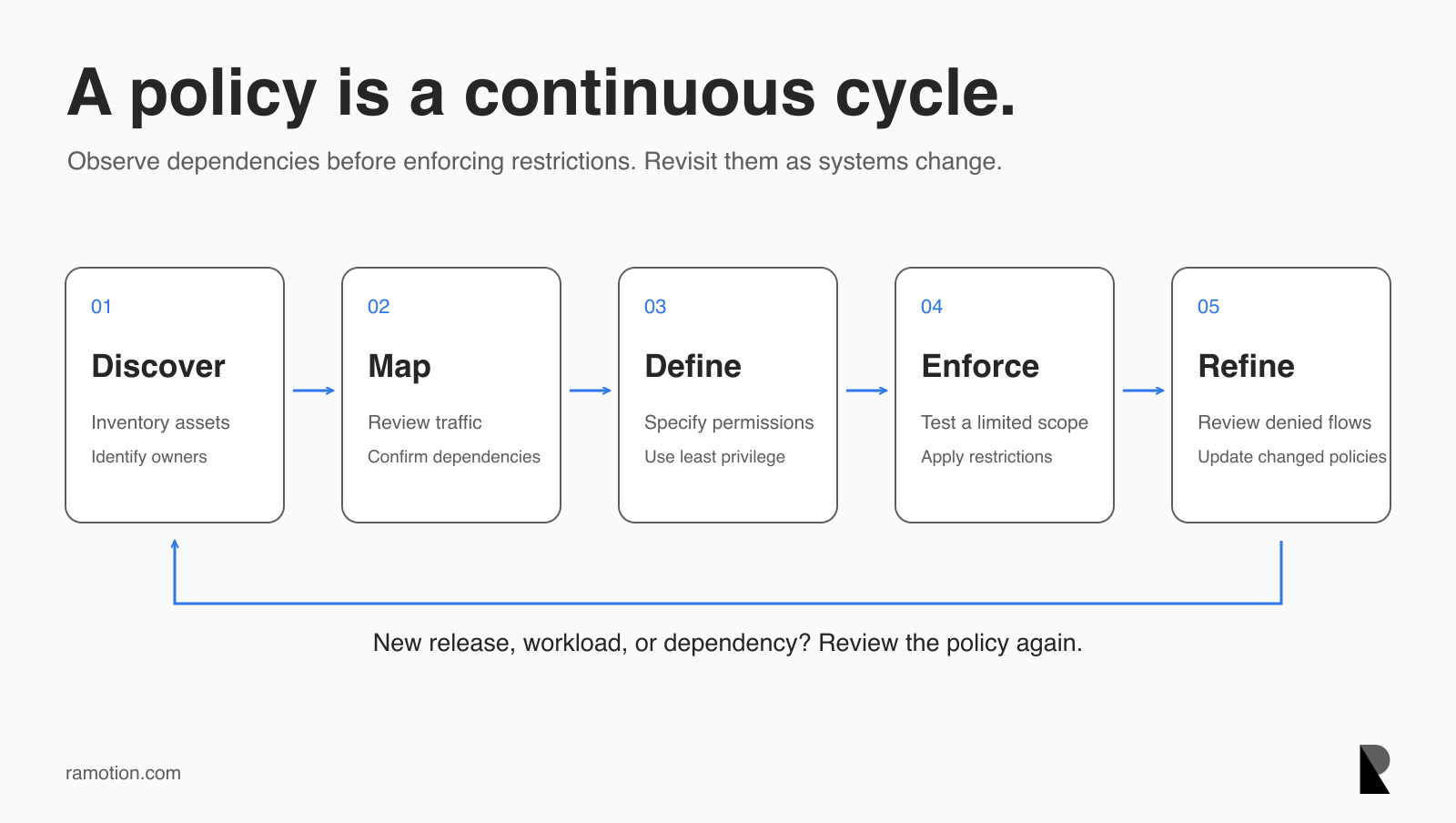
Discover, map, define, enforce, and refine workload communication policies
What microsegmentation policies can use
Policies may identify resources through IP addresses, workload names, application roles, environment tags, service identities, or other attributes. Available selectors depend on the platform and enforcement method. A host firewall and an identity-aware service proxy may offer different policy choices.
For example, a rule could allow production application workloads to reach production database workloads on an approved service. Stable labels can reduce dependence on changing IP addresses. However, incorrect labels can grant incorrect access, so teams must control who can assign them.
Microsegmentation vs. Network Segmentation
Both approaches regulate communication by creating boundaries. The useful distinction is the size of the protected group and how precisely teams can express permitted relationships. This comparison describes common deployment patterns rather than universal product limits.
| Criterion | Traditional network segmentation | Microsegmentation | Practical impact |
|---|---|---|---|
| Granularity | Broad zones, subnets, or departments | Individual workloads or small application groups | Smaller groups can receive narrower permissions. |
| Policy basis | Often addresses, ports, and network location | Addresses plus supported workload attributes or identities | Rules can express application relationships. |
| Enforcement scope | Commonly between network zones | At or near protected workloads | Controls can cover traffic inside a zone. |
| East-west control | Depends on traffic crossing controlled boundaries | Targets specific internal communication paths | Unnecessary workload connections can be restricted. |
| Topology dependence | Often closely tied to subnet design | May use logical groups independent of subnets | Workload moves may require fewer policy changes. |
| Cloud suitability | Useful for broad cloud network boundaries | Useful for granular cloud workload isolation | Both can contribute to cloud security. |
| Operational complexity | Fewer, broader rules in simple deployments | More detailed dependency and policy management | Precision requires ongoing ownership. |
Modern solutions may combine both approaches, and the distinction is not absolute. A firewall can enforce granular policies, while a microsegmentation platform can group resources broadly. Evaluate actual policy coverage rather than relying on the product category.
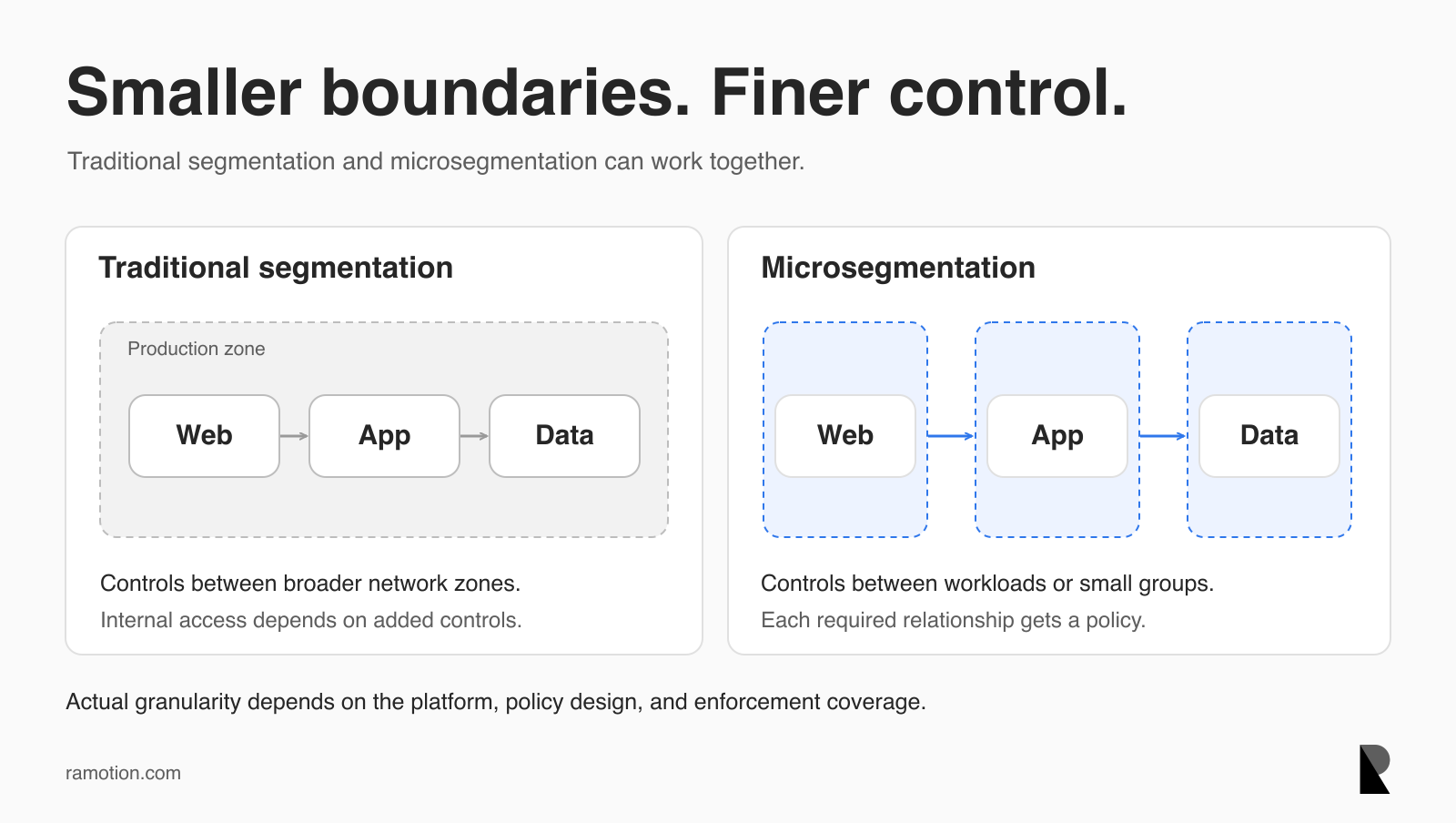
Broad network zones compared with granular workload boundaries
Microsegmentation and Zero Trust
Zero Trust is a broader security architecture that removes implicit trust based on network location or ownership. NIST's Zero Trust Architecture guidance focuses protection on resources and requires authentication and authorization before access. Microsegmentation is one possible enforcement mechanism within that architecture.
Both concepts support least privilege, but they are not interchangeable. Microsegmentation can restrict a server's reachable destinations without determining whether every application request is authorized. Identity controls, endpoint security, and application authorization still have separate responsibilities.
For example, allowing a billing service to connect to its database does not establish which customer records it should read. Database privileges and application logic must enforce that decision. Microsegmentation reduces communication exposure while those controls govern activity over permitted connections.
Where Microsegmentation Is Enforced
Enforcement can occur in network infrastructure, on hosts, within virtualization platforms, or through cloud-native controls. These methods overlap, and they do not form a fixed taxonomy. The right placement depends on where the traffic flows and which resources the organization controls.
Host-based microsegmentation can use local firewalls or agents to regulate workload connections. Virtualization platforms can enforce distributed rules near virtual network interfaces. Network devices can protect small resource groups where traffic passes through their enforcement points.
Cloud controls include security groups and container network policies. The Kubernetes NetworkPolicy documentation notes that enforcement requires a supporting network plugin. Creating a policy object alone does not guarantee that traffic restrictions take effect.
Application- or identity-aware proxies may also restrict service communication using authenticated identities or request attributes. Check the implementation's coverage and limitations before treating these controls as equivalent to network enforcement. Traffic that bypasses an enforcement point remains outside its protection.
Also check which traffic directions and resource types each control supports. A deployment may regulate incoming connections while leaving outgoing connections unrestricted. Managed services may expose different controls from virtual machines.
Document these gaps explicitly, then decide whether another enforcement layer is needed to meet the stated isolation objective. Otherwise, a uniform policy description can conceal uneven protection.
Common Microsegmentation Use Cases
Microsegmentation is useful when systems share infrastructure but should have different permissions. Critical applications can receive stricter communication boundaries than less sensitive services. Development workloads can also remain separated from production databases despite shared operational tooling.
Common microsegmentation use cases include:
- Restricting access to payment, identity, or other critical application components.
- Separating development and testing systems from production services.
- Isolating sensitive-data workloads from unrelated applications.
- Applying consistent communication objectives across hybrid or cloud deployments.
During ransomware or another compromise, microsegmentation can deny connections to unrelated servers and management interfaces. That can restrict lateral movement through the paths the policy covers. It cannot guarantee attack prevention or protect data already accessible through an allowed connection.
Example: Containing a Compromised Application Server
Consider a hypothetical application with a web tier, an application tier, and a database tier. Separate administration systems manage servers, while monitoring systems collect health data and logs. Assume a server in the application tier becomes compromised.
Its normal dependencies remain specific. The web tier initiates application requests to the application tier, and the application server connects to its assigned database service. The application server also sends logs to an approved collector and uses approved infrastructure services, such as DNS.
Microsegmentation policies can preserve those flows while blocking unrelated destinations. The application server should not initiate administrative sessions to the administration systems, connect to another application's database, or access unrelated file servers. Any peer application-server connection needs a documented application requirement.
Administration should originate from approved management systems through a separate access path. Monitoring permissions must distinguish telemetry submission from administrative access to the monitoring platform. Stateful controls may permit return traffic automatically, so policy review must distinguish replies from newly initiated sessions.
The compromise still matters because the server retains legitimate database connectivity. Microsegmentation limits reachable systems, but database permissions, detection, and incident response must address misuse of allowed access. Containment may require isolating the server completely once responders assess the operational impact.
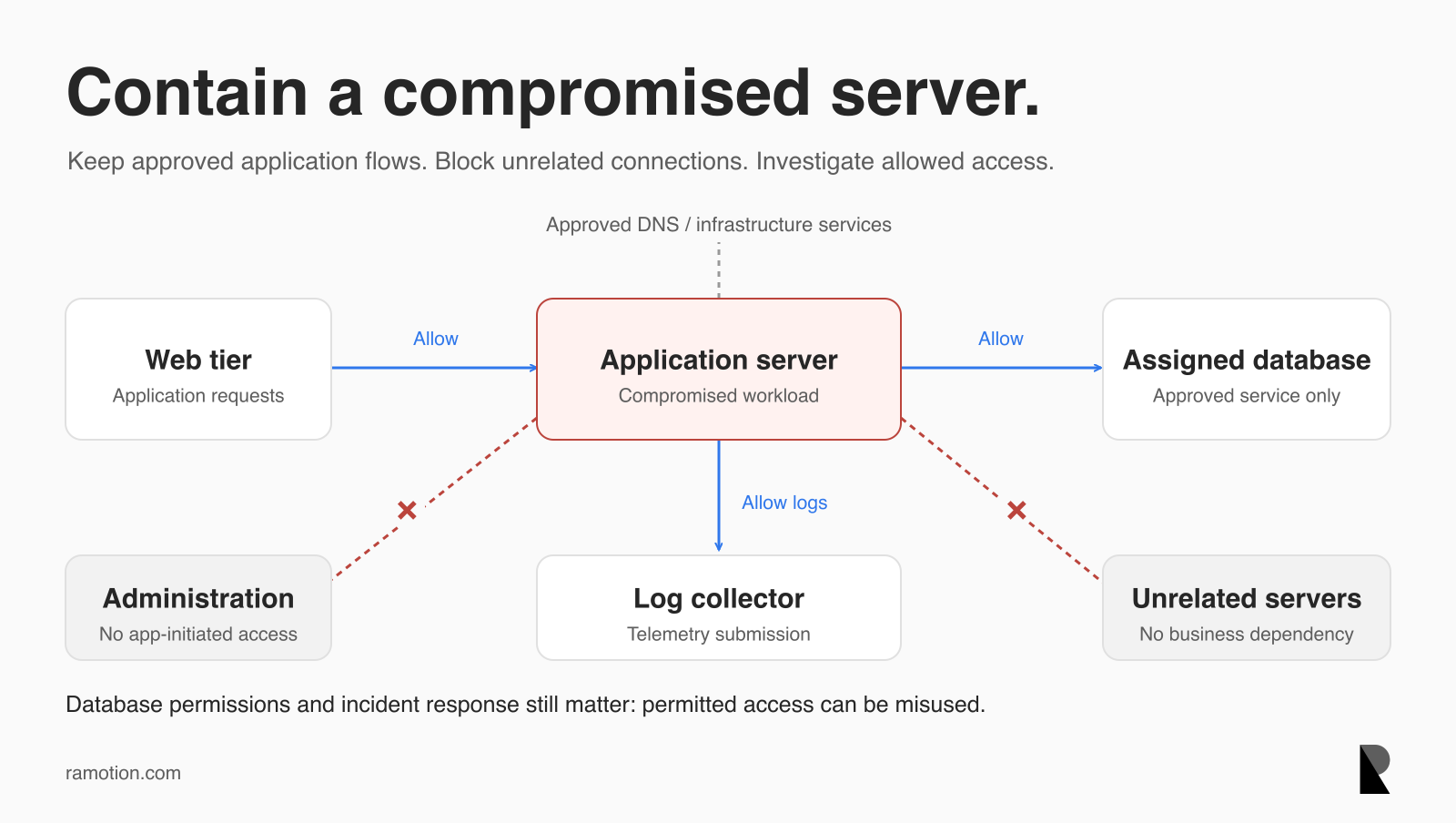
[Image: Required connections and blocked destinations for a compromised application server]
Microsegmentation Security Benefits
Microsegmentation reduces the network attack surface available to a compromised workload by removing unnecessary reachable services. It can also reduce blast radius, meaning the systems and business functions a compromise can affect. These benefits depend on the accuracy and coverage of enforced rules.
Policy discovery and traffic monitoring can give teams a clearer view of application dependencies. Denial logs can reveal unexpected connections or missing permissions. Teams still need to investigate those events because a denied connection may indicate either suspicious behavior or a legitimate dependency.
Isolation may support compliance work by separating sensitive systems and producing evidence of access restrictions. Any reduction in assessment scope depends on the applicable standard and validation of the boundary. Microsegmentation alone does not establish compliance, and an auditor must evaluate the relevant controls.
Microsegmentation Challenges and Risks
Incomplete dependency discovery is a common implementation problem. A short observation window may miss payroll processing, backups, or failover activity. Blocking a rarely used but legitimate connection can disrupt the application when that workflow next runs.
Overly broad policies preserve unnecessary access and weaken the intended boundary. Overly restrictive policies can interrupt customer requests or prevent recovery tasks. Microsegmentation teams must resolve both risks through owner review, realistic testing, and staged enforcement.
Policy maintenance becomes harder when workload inventories or labels drift. Conflicting control layers can also make connection failures difficult to diagnose. Record the reason, owner, and review date for exceptions so temporary access does not become permanent by default.
Operational readiness matters as much as rule design. Test how enforcement behaves when an agent loses contact with its controller or a cloud integration fails. Keep a controlled rollback procedure that restores service without reopening every connection across the environment.
Shared services deserve particular attention during policy review. A rule that permits access to an entire management subnet may expose backup servers or administrative consoles alongside the intended log collector.
Identify the actual destination service and limit access accordingly. Review outbound internet access as well, since restricting internal destinations does not by itself constrain communication with external systems.
When to Use Microsegmentation
Consider microsegmentation when heavy east-west traffic or critical workloads make broad internal access unacceptable. Hybrid and multi-cloud environments may benefit when teams can apply consistent policy objectives across different enforcement systems. Strict separation requirements are another reason to assess workload-level controls.
Microsegmentation can also support a Zero Trust initiative when the objective is tighter resource-to-resource access. Start with a specific risk, such as unnecessary database reachability, and assess whether available controls can address it. Product acquisition should follow that assessment.
In a small environment with few dependencies, implementation overhead may outweigh the added benefit. Existing network boundaries and well-maintained host controls may already meet the objective. Compare the reduction in exposure with the staffing and maintenance the proposed deployment requires.
Preparing for Microsegmentation
Define the objective before selecting technology. Identify the application or sensitive asset that needs protection, its owner, and the communication paths that create unnecessary exposure. CISA's microsegmentation planning guidance provides a planning reference for organizations implementing Zero Trust.
Map traffic across normal operation, maintenance, deployment, and recovery. Ask owners to validate dependencies instead of accepting every observed flow. If hiring external help, assess custom web application development companies for their ability to document application dependencies and test integration changes with security teams.
Agree on responsibility for policy changes before the pilot starts. Application owners should explain dependencies, platform teams should confirm enforcement coverage, and security teams should review the access objective.
Establish how urgent exceptions expire and who approves their renewal. This division of responsibility helps prevent application releases from silently widening access or leaving required connections blocked after deployment.
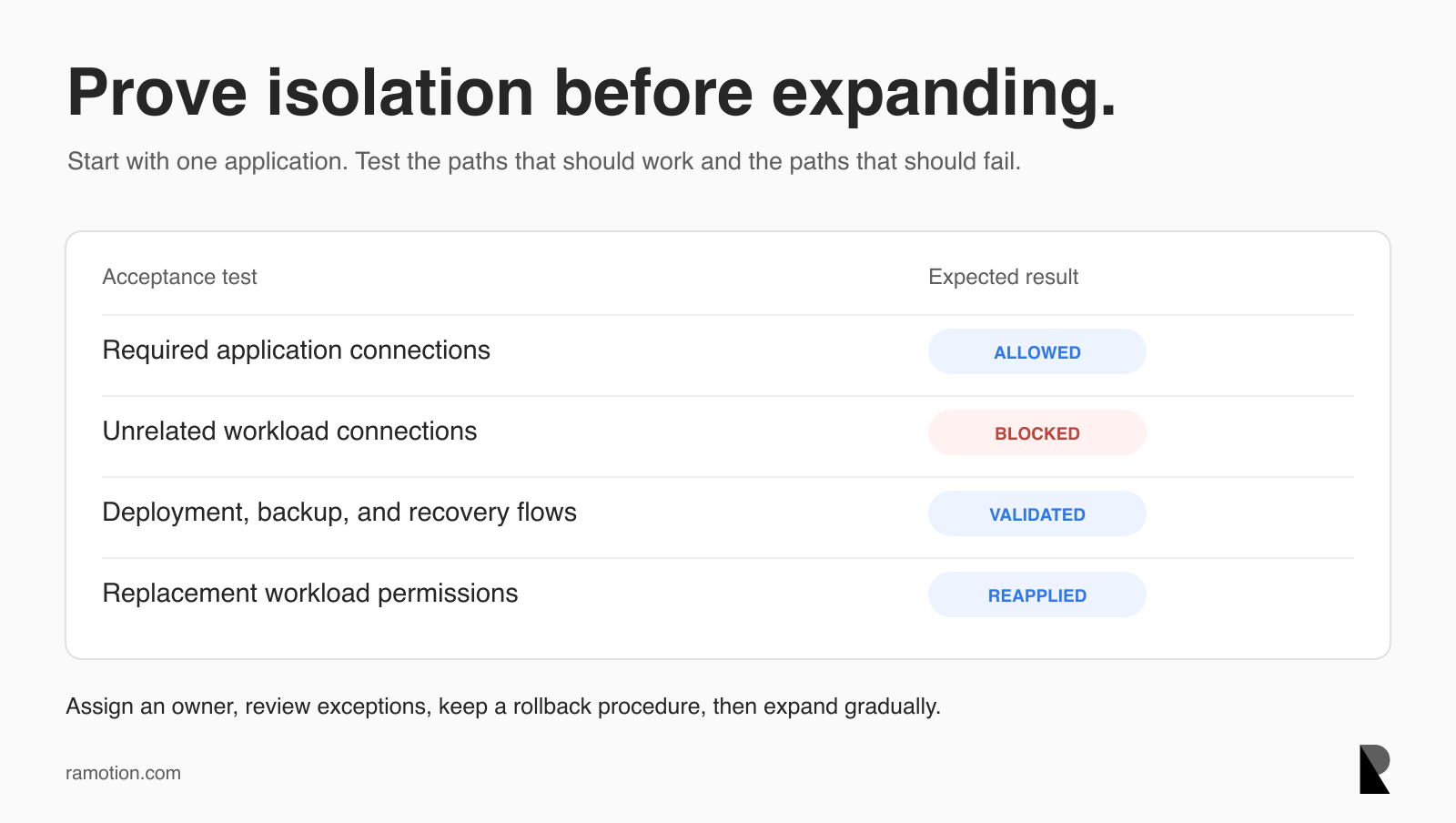
Begin with a limited policy scope and use observation or simulation modes where available. Validate customer workflows and operational tasks before enforcing restrictions. Expand gradually, measuring whether required connections succeed and unnecessary connections fail.
Include replacement workloads in acceptance testing. Recreate an instance through the normal deployment process and confirm that its intended permissions apply without manual repair. Test whether missing labels leave it isolated or grant unintended access.
This checks whether the policy survives routine infrastructure change, rather than working only for the original machines observed during the pilot rollout period.
[Image: Acceptance tests verify required access, isolation, recovery, and replacement workloads]
Conclusion
Microsegmentation creates finer security boundaries around workloads and controls resource-to-resource communication. Its value comes from removing unnecessary access while keeping legitimate applications operational. Accurate dependency mapping, minimum necessary permissions, and maintained policies determine whether those boundaries work.
Judge implementation quality by verified communication restrictions and application reliability. More segments or rules do not automatically mean better protection. A manageable policy set with clear ownership gives teams a stronger basis for sustained control.

Creates insightful, strategy-driven content that translates complex design and branding concepts into accessible knowledge, supporting Ramotion’s mission to elevate digital experiences.