
A multi-brand strategy is the art of managing several brands under a corporate umbrella, each with its own positioning, personality, and role. It allows companies to serve different audiences, price segments, categories, and markets, delivering a cohesive customer experience, without fragmenting how they represent themselves.
Consider adapting a multi-brand strategy if:
- You want to enter a new category or price point your brand can’t reach.
- You need to protect the parent brand from a risky venture.
- You’re targeting a new audience that rejects your current brand’s associations.
- You acquire a brand customers trust more than yours.
If you’re still on the fence, let’s compare multi-brand and single-brand strategies.
Multi-Brand vs. Single-Brand Strategy
A multi-brand strategy deploys several brands, each built for a specific audience, product category, or price tier. It protects the parent brand and eases diversification, but demands bigger budgets, more brand teams, and tighter coordination. On the contrary, a single-brand strategy operates under one name, making it cheaper and easier to implement. This works best when the brand already carry the audiences and the offers the business pursues.
Choosing between them depends on how many audiences you can realistically serve your long-term goals, and your resources. Neither is inherently better. The comparison below clarifies the benefits and trade-offs each entails.
| Criteria | Single-brand strategy | Multi brand strategy | Strategic implication |
|---|---|---|---|
| Audience coverage | Restricted to limited audiences | Flexible; each brand targets a distinct audience or segment | Multi-brand approach enables wider audience coverage |
| Positioning | The brand stands for one clear thing in customer’s minds | A company holds multiple positions through separate brands | Multi-brand allows clear and targeted communication per segment |
| Brand equity | Concentrated in one name | Equity spreads across names | Single-brand builds equity faster; multi brand protects the parent brand but |
| Marketing investment | One budget, one campaign | Split across brands, requiring higher total spending | Multiple brands cost more than single-brand |
| Operational complexity | Low: single process and set of teams | Moderate to high: separate teams and processes per brand | Multi brand only works if production, procurement, analytics, and infrastructure are shared across brands. |
| Reputation Exposure | A single failure can damage the whole company | Risk is isolated only to the affected brand | Multi-brand protects the parent company from direct reputational damage |
| M&A flexibility | Acquired brands must adapt into one name | Acquired brands can be kept, endorsed, or folded | Multi-brand preserves acquired equity |
| Portfolio governance | One brand team decides | Multiple brand teams need to be managed simultaneously | Multi-brand is easy to launch but hard to govern |
While a multi brand strategy affords you wider reach, risk isolation, and diverse portfolio, it has limitations. That said, it’s the wrong move when:
- Your audiences already overlap.
- Your brands are hard to distinguish from each other.
- Your existing brand already has permission to expand into the new segment.
- Funding is limited.
- The current portfolio is already too complex to manage.
Hire one of the best digital design brand strategy agencies to build your multi-brand strategy.
Multi-Brand Portfolio Strategy vs. Brand Architecture
A brand portfolio strategy answers whether a company should hold more than one brand. It is an internal tool that tells the team which brand exist, what each is for, and where resources go. Brand architecture addresses how visible the parent should be inside each brand. It is an external tool that presents customers their choices and helps them understand how each brand relate to each other
Parent brand visibility in each architecture
Brand architecture has four types—branded house, sub-brands, endorsed brands, and house of brands—sitting on a spectrum of parent visibility, from minimal to maximum.
Branded house architecture
*Parent brand visibility: Maximum *
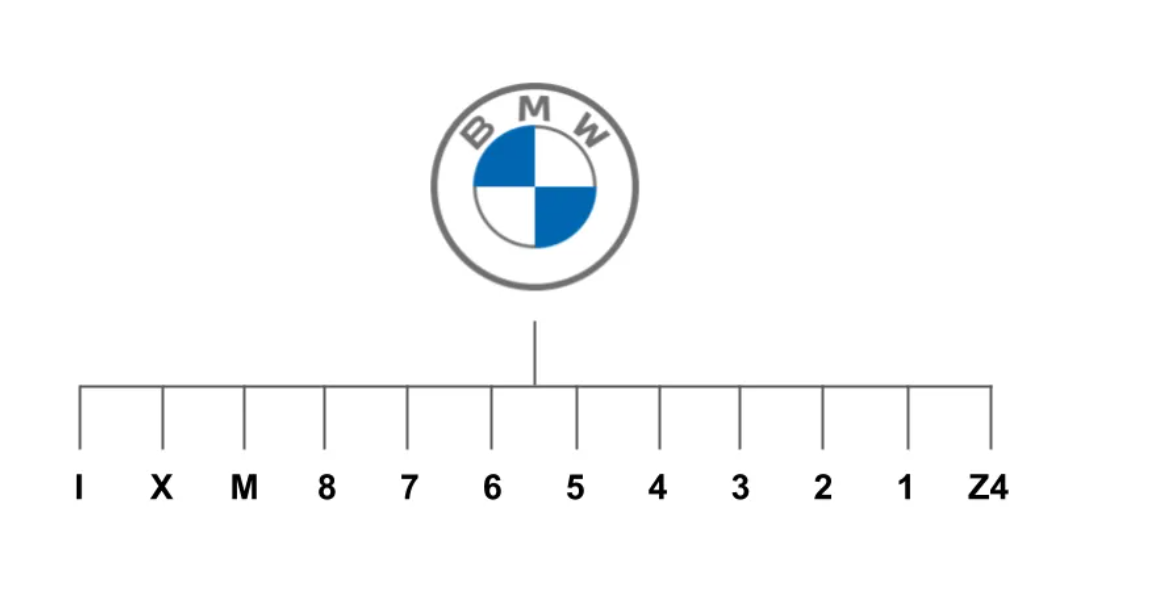
BMW branded house architecture via Prudent Pedal
The company uses one brand for all products and services. For example, BMW ties its entire vehicle lineup to the parent brand, adding an alphanumeric system to distinguish models: BMW 5 series, BMW X5, and BMW iX. Everything the parent is trusted with, the products inherit; everything that goes wrong is charged to the parent.
Sub-brand architecture
*Parent brand visibility: High *
Sub-brands keep their own identity but stay visibly tied to the parent, borrowing its credibility. This lets a company enter a new segment without building trust from scratch. Gillette Mach3 falls under this, where ‘Gillette’ reassures the customers that the sub-brand is reliable. Note that the parent’s equity is spread across everything it owns, while the sub-brand only has its own promise to fall back on.

Gillette sub-brands. Image via Gillette
Endorsed brands architecture
Parent brand visibility: Moderate
Endorsed architecture is easily confused with sub-brands. The distinction is the brands are independent but backed by a guarantor, so the parent lends its credibility from a distance rather than directly shaping the identity.
Polo by Ralph Lauren fits this model, where ‘Polo’ represents the identity, while Ralph Lauren appears as the reassuring figure behind it. Because the parent is not the thing being bought, it has less to lose if the brand fails, but also less claim on the brand’s success when it works.

Endorsed brands via Ralph Lauren
House of brands architecture
*Parent visibility: Minimal *
If the branded house anchors product brands on the parent brand, the house of brand is the opposite. Brands stand on their own identities, with little or no visible connection to the company that owns them. People know Zara, Bershka, and Pull & Bear as separate retail brands, but they sit under one parent, Inditex. The brands share supply chain and infrastructure, yet the parent stays invisible.
Separation isolates risk and lets each brand target a distinct segment without depending on the parent’s reputation. But it takes more work to build, and the parent’s equity doesn’t compound across the portfolio.
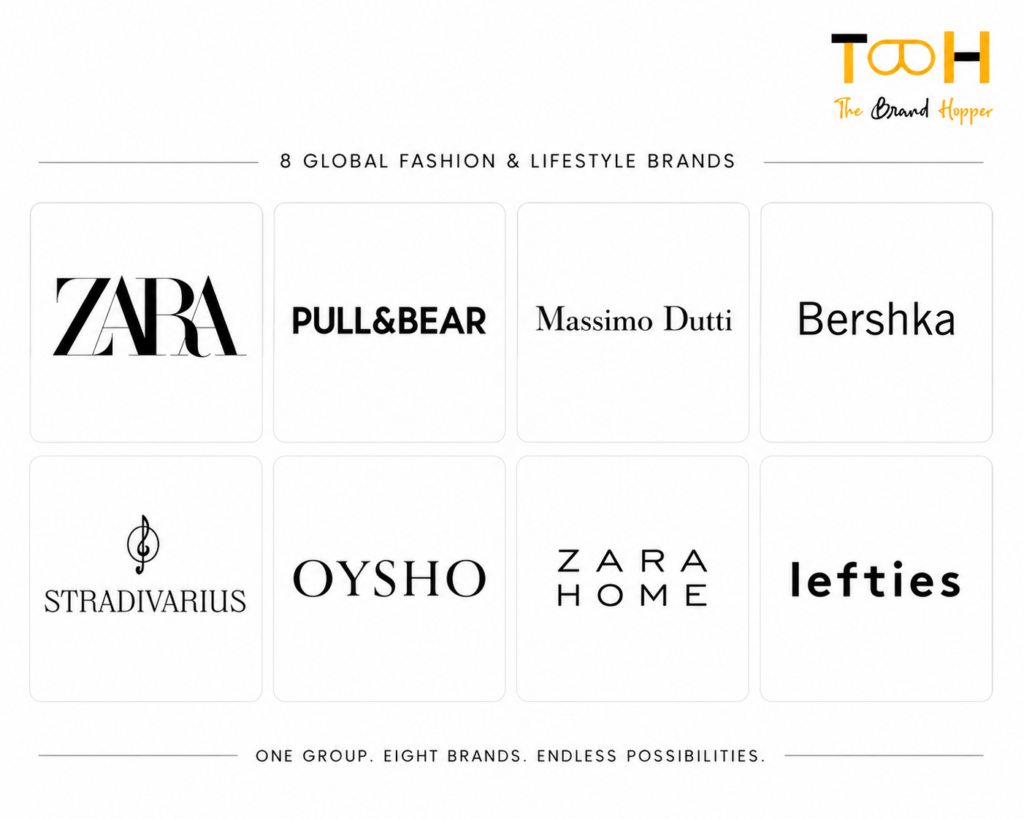
Inditex brand portfolio via The Brand Hopper
Defining Each Brand’s Portfolio Role
Once you’ve chosen a brand architecture, assign each brand its portfolio role using a Brand Portfolio Role Map. The map achieves two things:
- It shows whether the brands are genuinely differentiated or just overlapping each other;
- It gives every brand a reason to exist beyond the parent’s ambition.
Take Beaupoint, a fictional skincare company whose flagship moisturizer, Verity, targets women 35 years old and above. It wants to reach young adults and value shoppers without losing its premium identity.
Verity (flagship) and Cetra Rx (prestige) target mature adults, occupying the premium and luxury positions. Dew (entry) and Basics (fighter) split young adults by price, with Dew recruiting customers who will later graduate to Verity and Basics defending the budget flank. The map visualizes collision before it affects the bottomline.
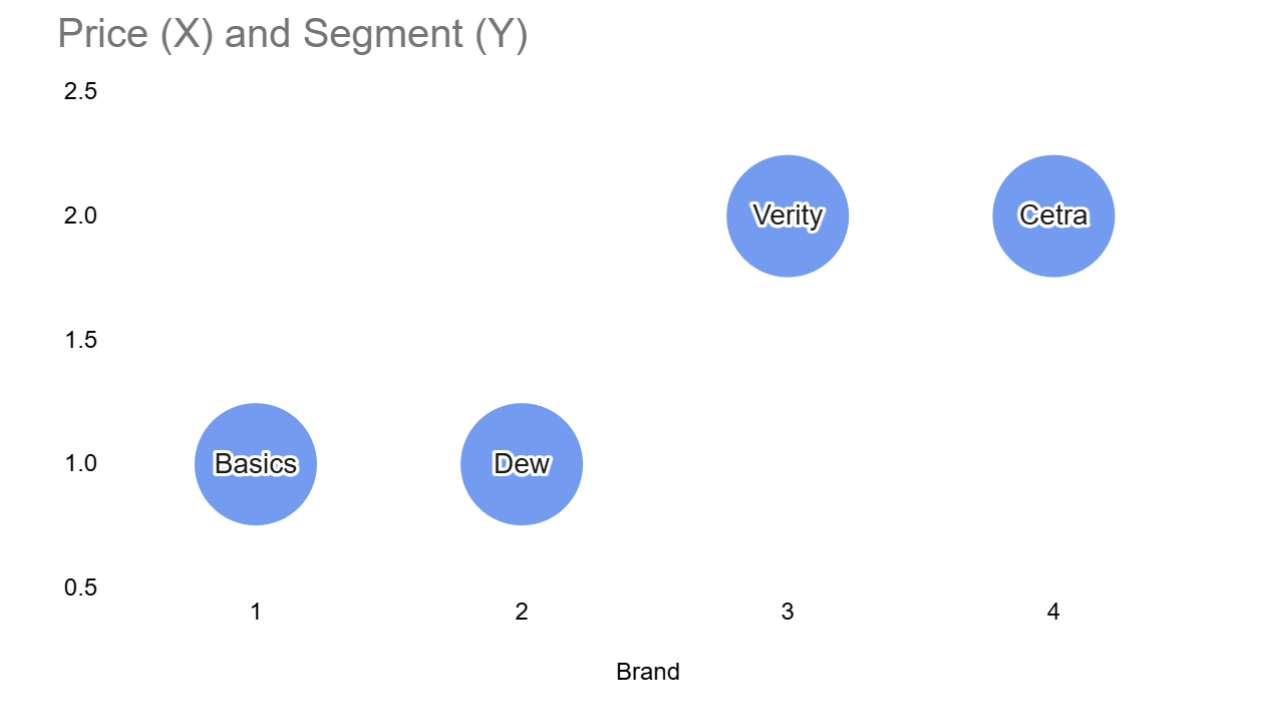
Price scale: 1= budget, 2=mid, 3=premium, 4=luxury Segment scale: 1=young adults, 2=mature adults
Say Beaupoint wants to consider moving Dew up-market to increase sales. The portfolio map may end up having two competing brands chasing the same segment. This can cost Verity sales, which can negatively impact the whole portfolio.
Preventing brand overlap and cannibalization
Overlap and cannibalization begin when two brands address the same need at the same price, and differ only in name. Sometimes, that’s deliberate, aimed at short-term goals, but it can backfire.
The Nintendo Wii U versus Wii is a classic case: the former gave existing Wii owners no reason to upgrade. The names and forms were too similar, suggesting an aesthetic, not functional, improvement. Worse, Nintendo kept Wii on sale alongside it, targeting late adopters at a lower price while the Wii U aimed at early adopters. The cheaper console outsold Wii U.
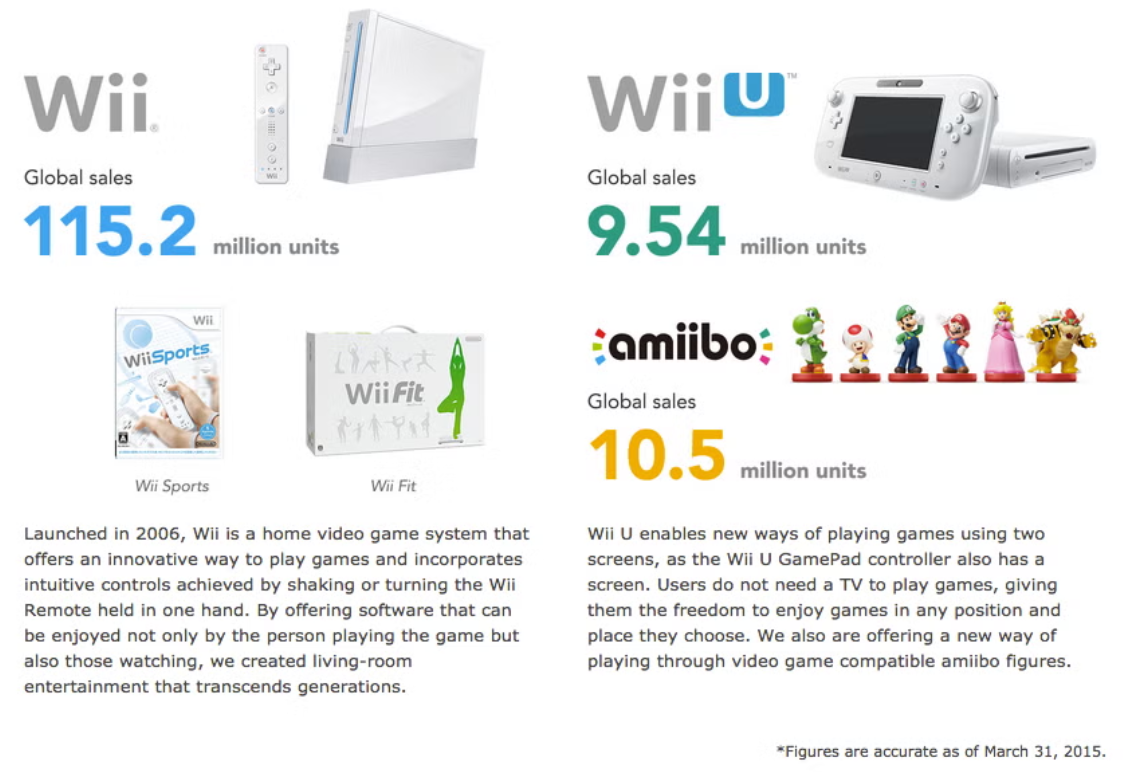
Wii vs. Wii U via Business Insider
There are four ways to prevent cannibalization from happening:
- Establish a hard price floor between brands.
- Keep the premium brand out of the value brand’s channel.
- Center each brand on its distinct promise and segment.
- Review the portfolio map quarterly for collisions.
Shared vs. Distinct Brand Capabilities
A multi-brand portfolio lets brands share the parent’s research, production, analytics, technology, and media infrastructure. Since customers don’t evaluate what stays behind the scenes, sharing costs nothing in differentiation while savings show in margin. Keep distinct what customers judge you on—materials, pack, customer experience, market positioning—because that’s what they’re actually choosing between.
But this is not set in stone. Sometimes, centralization can actually weaken differentiation. Say the shared media team buys the same channels for every brand because it’s cheaper. Not every channel will suit each brand. Over time, the premium brand feels cheap, even though its materials and packaging remain different.
Multi-Brand Portfolio Governance
Now, let’s get into the trickiest part: multi-brand portfolio governance.
Brand governance keeps quality, standards, and rules consistent across a portfolio. That task gets harder when several brands compete for the same resources and attention. A working multi-brand portfolio governance requires three things:
Someone has to own each level
Brand managers maintain positioning, execute campaigns, and monitor spend. Portfolio leadership handles shared functions, prevents overlaps, and resolves conflicts.
Allocate budget according to the role of the brand
In a multi-brand portfolio, equal budget sharing risks preventing other brands from achieving their goals. For instance, a strategic brand may need more investment ahead of its returns than a flagship brand, because it costs more to capture future buyers.
Some decisions can’t belong to the brand
New brands, repositioning, and retirement are portfolio-level calls, because brand managers have biases. No brand manager wants to shut their own brand if it starts compromising the whole portfolio. A new brand launched without portfolio approval is how overlap starts.
Multi Brand Strategy in Mergers and Acquisitions
What if you gain new brands from mergers and acquisitions?
Handling multiple brands after M&A differs from managing an organic portfolio. An acquired brand arrives with its own customers, identity, and employee culture. The decision then is whether to absorb it, keep it distinct under an endorsement, or run it independently.
- Full integration: the acquired brand is absorbed but risks losing established customer trust.
- Endorsement: the acquired brand keeps its identity, with the parent as guarantor.
- Independent: the acquired brand preserves equity and isolates risk, but adds another brand to govern.
Consider whether the acquired brand’s equity is worth preserving. If customers specifically choose it, absorbing it throws away the reason behind the purchase. That makes independence the better choice—cheaper than integration short-term, since nothing has to be migrated or rebranded. Endorsement sits in between, useful when the brand needs a boost but can stand alone.
Scoring the Launch Decision
You’ve seen the trade-offs between one brand and several. In this section, we’ll weigh these trade-offs for a hypothetical company.
Arte Atelier, a premium jewelry company, is exploring a more affordable line. Extending the parent downward is the cheapest, but asks the premium name to be credible at a budget price. A standalone brand gets full distance, but awareness must be built from zero. An endorsed brand through Arte Dos, carries the parent’s credibility without Arte Atelier having to go down-market.
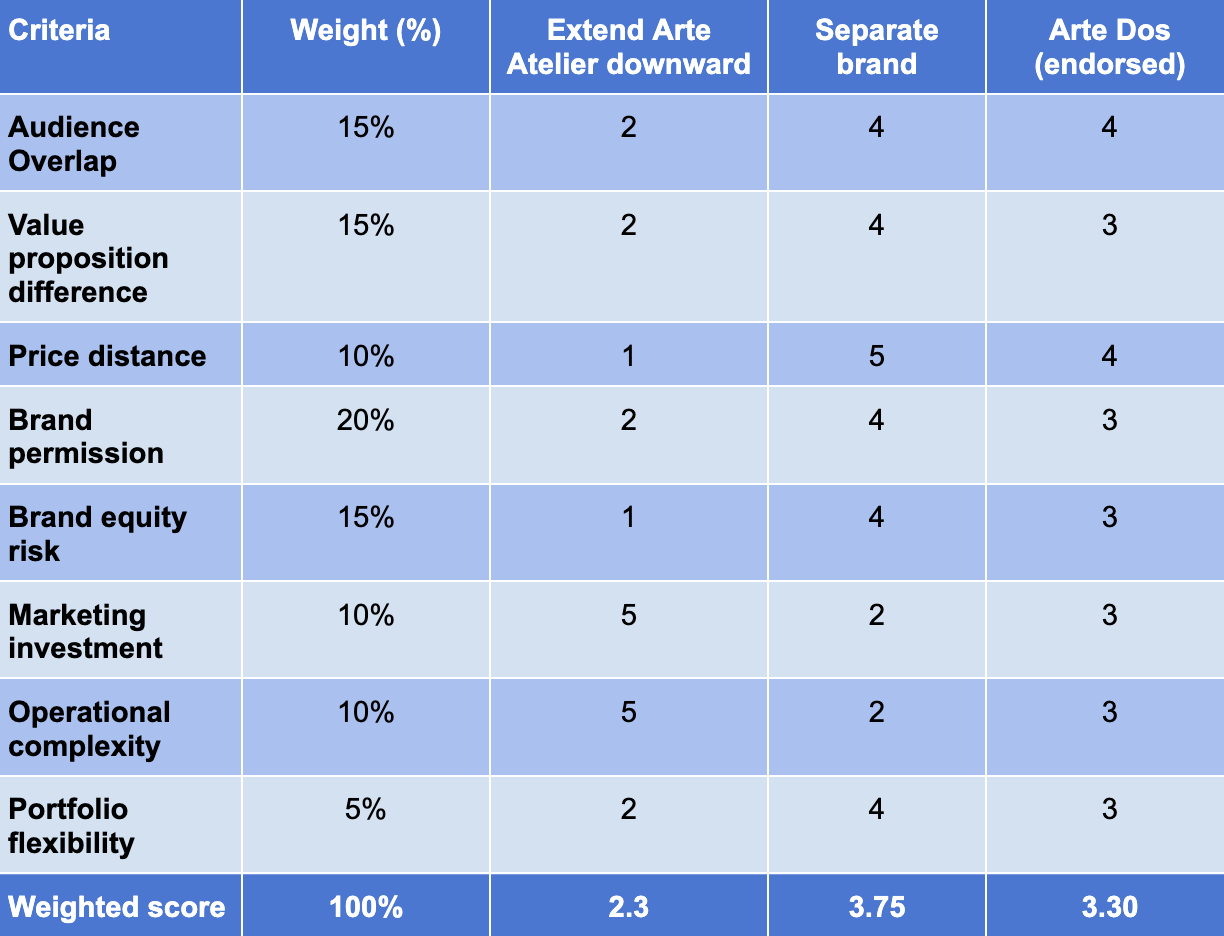
Scoring: 1= poor fit, 5 = strong fit For marketing investment and operational complexity: 5 = lowest spend and lowest complexity
The decision matrix points to launching a separate brand. Arte Atelier has no credibility at a budget price, so extending the name down would do more harm. A standalone brand costs more to build, but it keeps Arte Atelier’s positioning impact and gives the new line room to to reach buyers the parent can’t.
Measuring Multi Brand Strategy Performance
Success is measured at two levels: brand and portfolio.
Brand-level metrics track whether each brand does its job in amplifying awareness, consideration, preference, pricing power, and market penetration. It also reveals if each brand is healthy. Portfolio-level metrics track whether brands work together as an ecosystem through reach, overlap, migration, resource efficiency, and business contribution, revealing whether they boost each other or cannibalize.
Start at the brand level because a portfolio is only as healthy as its brands. Then move to the portfolio level, where numbers show whether that brand health comes from the market or another brand. The end goal is to assess whether the multi-brand portfolio is worth more than its brands would be on their own.
*Brand-level metrics to track: *
- Unaided/aided Brand Recall (survey)
- Branded Search Volume
- Share of Voice
- Website Traffic
Portfolio-level metrics to track:
- Total Portfolio Revenue and Growth Rate
- Return on Investment (ROI)
- Customer Lifetime Value
- Net Promoter Score (NPS)
- Cannibalization Rate
How to Build a Multi Brand Strategy
Keeping a multi-brand portfolio in sync is among the hardest tasks, and success hinges on how well you build the strategy. An effective multi brand strategy moves through three phases: audit, design, and operate.
Phase 1: Audit The audit gathers and assesses your business objectives, existing brands, audiences, and brand equity. This phase aims to put things in perspective so you know what’s working and what needs changing. It also covers what each brand costs to run and which shared functions already serve several of them.
Phase 2: Design Once you know which brands are worth keeping, assign each one a role through the brand portfolio role map. Decide what’s shared across brands and what stays distinct, then choose the right brand architecture.
Phase 3: Operate Positioning, budgets, decision rights, and performance measure are set here and tracked periodically. The goal is to keep the brands distinct enough to avoid overlap, while keeping them coherent enough that the portfolio still reads as one company.
Running a Cohesive Multi-Brand Strategy
A multi brand strategy only works if each brand has a role the others can’t do. Lay the foundation by defining each brand’s job, centralizing the functions they can share, and keeping separate what they do. When choosing brand architecture, make the parent as visible as the brand’s role requires, then hold the boundaries through decision rights and budget. The ultimate goal is to balance between brand differentiation and coordinated portfolio management.

Creates insightful, strategy-driven content that translates complex design and branding concepts into accessible knowledge, supporting Ramotion’s mission to elevate digital experiences.