
Did you know that PostgreSQL is currently the second most popular database system worldwide, only behind MySQL? As developers, and especially as a web app development software company, we frequently encounter this powerful database in our work, and for good reasons.
PostgreSQL, often simply referred to as "Postgres," is an open-source relational database management system that has been actively developed since its initial release in 1996. Unlike many database solutions, PostgreSQL emphasizes extensibility and SQL compliance while providing exceptional stability.
Additionally, it features ACID (atomicity, consistency, isolation, durability) properties, automatically updatable views, materialized views, triggers, foreign keys, and stored procedures. These robust features make PostgreSQL particularly well-suited for a wide range of applications.
In this comprehensive guide, we'll explore what makes PostgreSQL a top choice among developers, examine its core architecture, compare it with other popular database systems, and help you determine if it's the right solution for your next project.
Whether you're evaluating database options internally or comparing top web app agencies for your next build, understanding PostgreSQL’s strengths will help you make a more informed decision.
Core Architecture
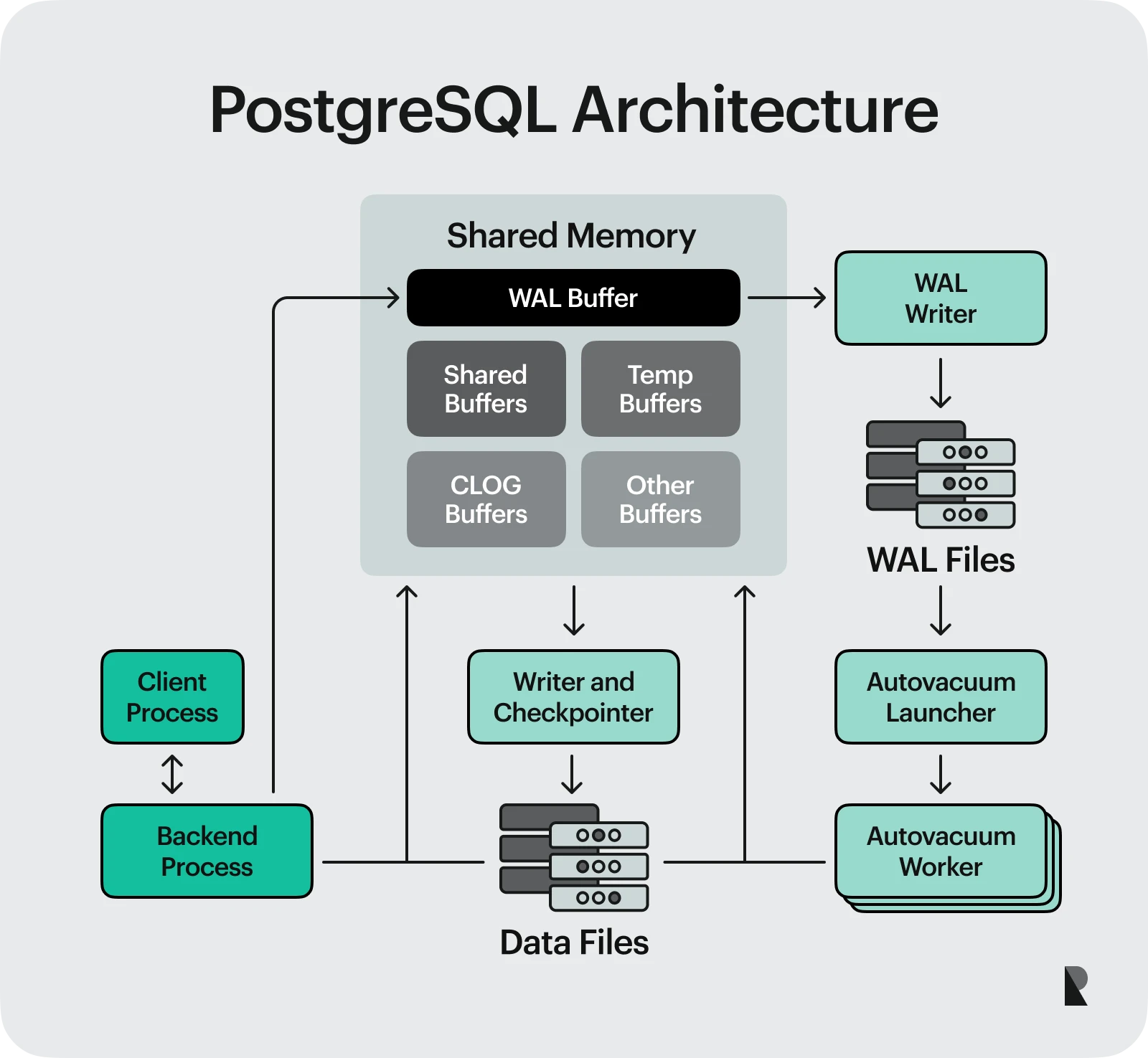
The power of PostgreSQL lies in its sophisticated architecture that enables exceptional performance, reliability, and flexibility. Let's examine the key components that make this possible.
Memory & buffers
At its core, PostgreSQL employs a dual memory architecture that utilizes both shared and local memory areas. The shared buffer cache, controlled by the shared_buffers parameter, serves as the primary caching mechanism for frequently accessed data.
For optimal performance on systems with at least 1GB of RAM, allocating 25% of system memory to shared buffers is recommended. These buffers significantly reduce disk I/O by serving data from memory rather than slower storage devices.
Additionally, PostgreSQL maintains WAL buffers that temporarily store transaction logs before they're written to disk, further enhancing performance.
Storage & WAL
Write-Ahead Logging (WAL) forms the backbone of PostgreSQL's durability guarantee. Before any changes are made to data files, PostgreSQL records them in sequential WAL (Write-Ahead Log) files, typically 16MB in size.
This approach ensures that even after a system crash, the database can recover its state by replaying these logs, a process called roll-forward recovery or redo. Moreover, WAL enables critical features like point-in-time recovery and streaming replication by providing a clean, ordered log of all database changes.
Query planner & execution
Furthermore, PostgreSQL's query planner/optimizer creates execution plans for incoming queries. When you submit a SQL query, the planner examines possible execution strategies and selects the one with the lowest estimated cost.
For complex queries involving multiple joins, PostgreSQL employs a Genetic Query Optimizer when the number of joins exceeds a configurable threshold. The execution plan includes scan methods, join techniques (such as nested loop, merge, or hash joins), and auxiliary steps like sorting or aggregation.
MVCC concurrency control
Consequently, PostgreSQL achieves high concurrency through Multi-Version Concurrency Control (MVCC). Unlike traditional locking mechanisms, MVCC creates new versions of rows during updates, allowing readers to see consistent snapshots of data without blocking writers.
This approach enables excellent performance in multi-user environments by minimizing lock contention. Each transaction operates on a snapshot of the database as it existed at the time the transaction began, ensuring consistent views regardless of concurrent modifications.
Indexing system
In addition, PostgreSQL supports various index types optimized for different workloads. Beyond the default B-tree indexes, PostgreSQL offers:
- Hash indexes for equality comparisons
- GiST (Generalized Search Tree) for complex data types
- GIN (Generalized Inverted Index) for composite data like arrays and JSON
- BRIN (Block Range Index) for large tables with naturally ordered data
Background processes
Behind the scenes, several background processes maintain database health. The postmaster process serves as the main controller, managing client connections and spawning backend processes for each connection.
Other critical workers include the background writer (flushing modified buffers to disk), the WAL writer (handling transaction logs), the autovacuum process (reclaiming storage), and the checkpointer (ensuring data consistency). These processes work together to ensure PostgreSQL's reliability even under heavy workloads.
PostgreSQL vs. Other Databases
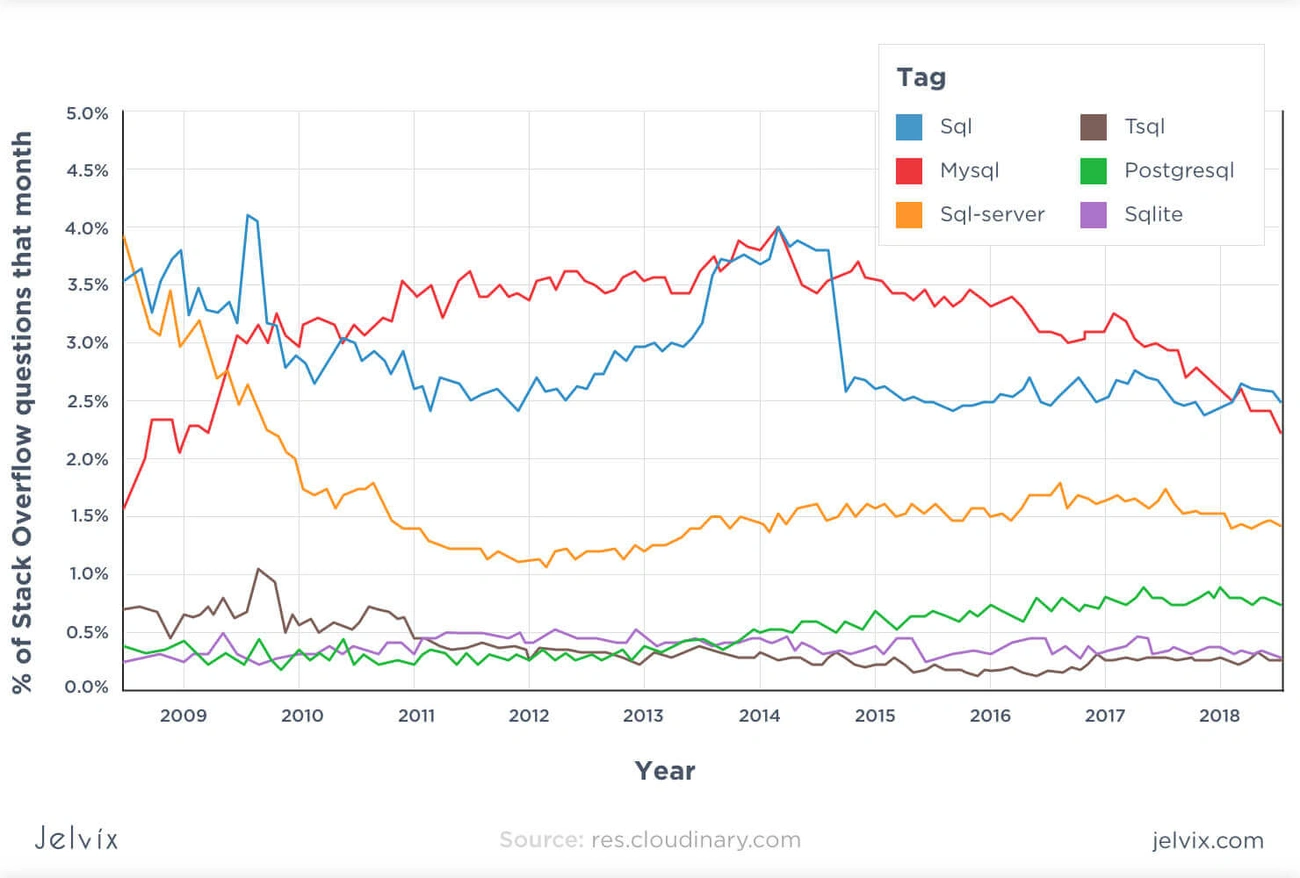
Source: Jelvix
When comparing database management systems, understanding the distinct characteristics of each option helps developers make informed decisions. Let's examine how PostgreSQL compares to other popular database systems.
PostgreSQL vs. MySQL
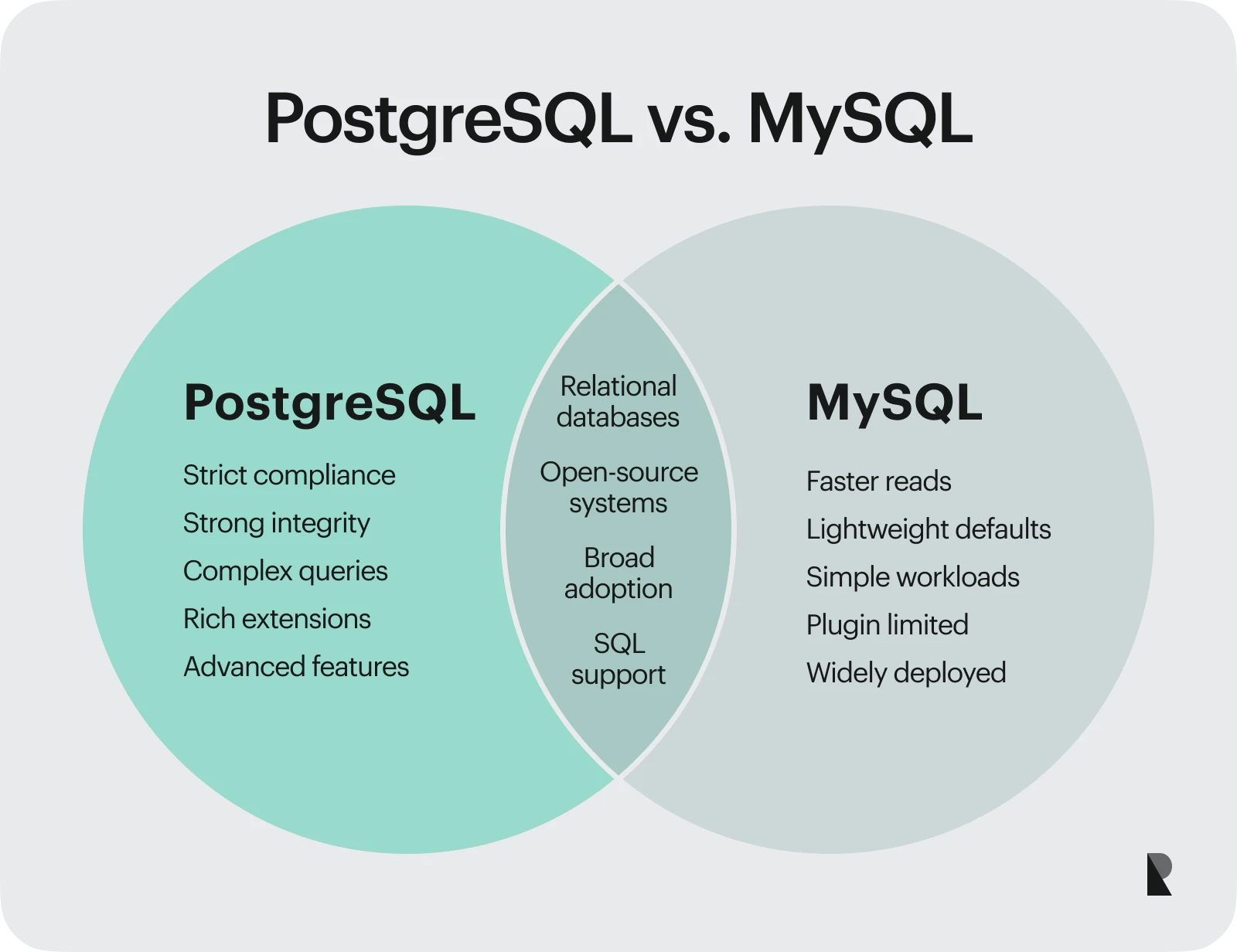
PostgreSQL and MySQL represent two of the most popular open-source relational database management systems, albeit with different design philosophies:
- Standards compliance: PostgreSQL prioritizes SQL standard compliance, whereas MySQL often implements SQL with proprietary extensions.
- Data integrity: PostgreSQL enforces strict data validation rules by default, although MySQL offers faster performance with fewer constraints in its default configuration.
- Complex queries: PostgreSQL excels at handling complex queries and joins, yet MySQL typically performs better for simple read-heavy workloads.
- Extensions: PostgreSQL offers a robust extension system that allows for custom data types and functions, whereas MySQL provides a more limited plugin architecture.
PostgreSQL vs. Oracle & SQL server
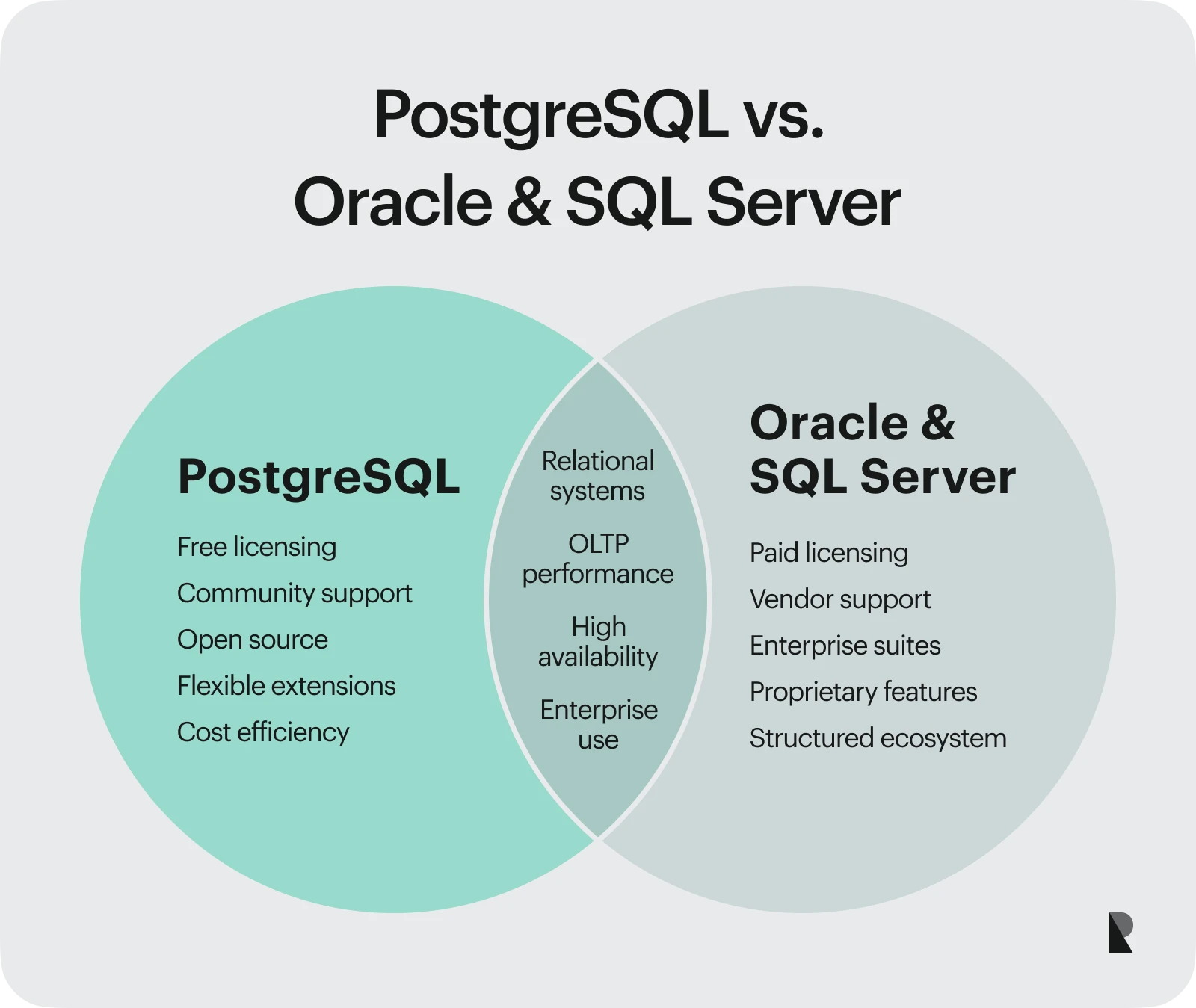
When comparing PostgreSQL to enterprise options like Oracle and SQL Server:
- Licensing: PostgreSQL uses a permissive license with no licensing costs; nonetheless, Oracle and SQL Server require substantial licensing fees for production environments.
- Enterprise features: Oracle and SQL Server have historically led in enterprise features, although this gap is narrowing as PostgreSQL now offers comparable partitioning, replication, and high availability options.
- Performance: For OLTP workloads, all three databases perform similarly on identical hardware, though each excels in specific scenarios.
- Support: Oracle and SQL Server offer vendor support options, whereas PostgreSQL relies primarily on community support and third-party service providers.
When to choose PostgreSQL
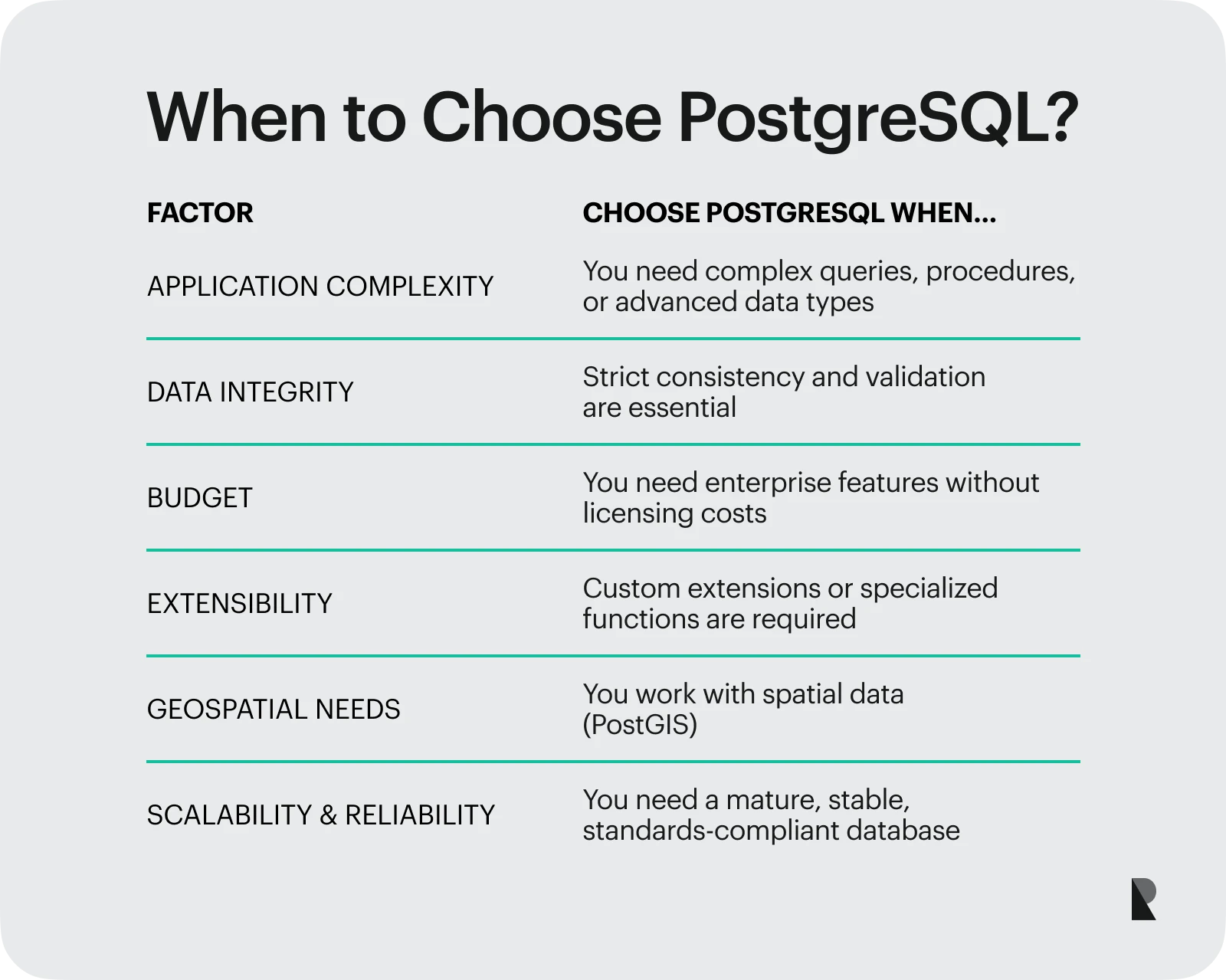
PostgreSQL becomes the ideal choice under these circumstances:
- Complex applications: When your application requires complex queries, custom procedures, or advanced data types.
- Data integrity: For systems where data consistency and validation are critical concerns.
- Cost sensitivity: When operating under budget constraints but still needing enterprise-grade features.
- Extensibility: If your project requires custom extensions or specialized functionality.
- Geographic data: For applications working with spatial data, thanks to the PostGIS extension.
Overall, PostgreSQL offers an exceptional balance between feature richness, standards compliance, and freedom from vendor lock-in. Its maturity and active development make it suitable for everything from small applications to enterprise-scale systems, especially those requiring reliability and data integrity.
Advantages & Limitations
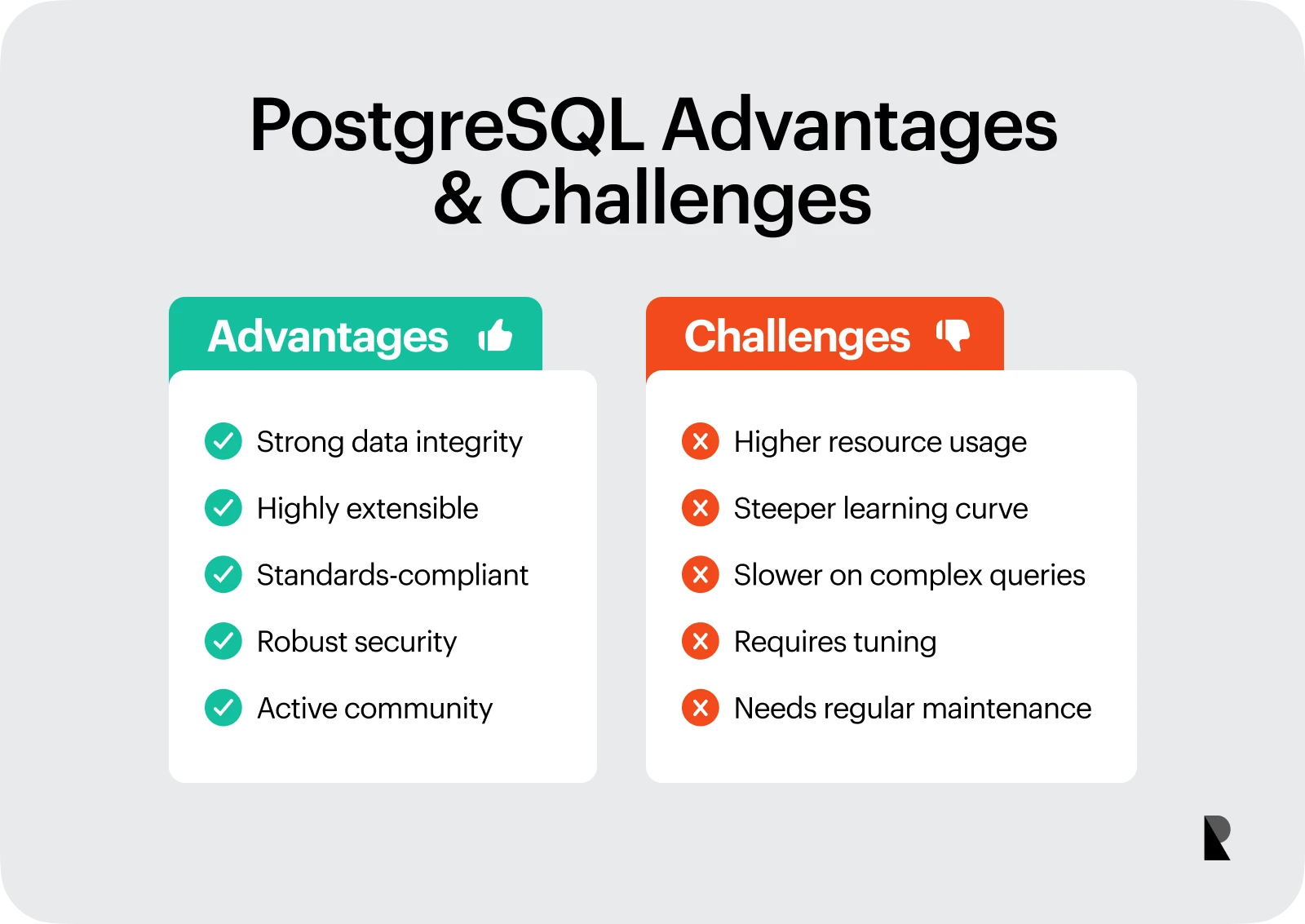
Every database system comes with its own set of strengths and weaknesses. PostgreSQL stands out for several compelling reasons, yet it also presents certain challenges.
PostgreSQL strengths
PostgreSQL excels primarily because of its strong data integrity capabilities. Unlike many competitors, it strictly enforces constraints, ensuring your data remains valid and consistent. Its extensibility is equally impressive; developers can create custom data types, functions, and procedural languages to tailor the database to specific needs.
Moreover, PostgreSQL offers exceptional standards compliance, adhering closely to SQL standards while providing advanced features like table inheritance, rule systems, and multi-version concurrency control. This makes it remarkably future-proof for complex applications.
Security-conscious developers appreciate PostgreSQL's robust permission system, SSL support, and column-level and row-level security features. The active community also ensures that bugs are promptly addressed.
Common challenges & solutions
Despite its strengths, PostgreSQL can be resource-intensive, requiring more memory than lighter alternatives. This is manageable through proper configuration; adjusting shared_buffers and work_mem parameters can optimize performance.
Also, newcomers often find PostgreSQL's strict validation rules initially frustrating. The solution lies in proper training and understanding the importance of these constraints for data integrity.
Finally, complex query performance may occasionally lag behind that of specialized databases. This challenge can be mitigated by implementing proper indexing strategies, regular VACUUM maintenance, and query optimization techniques that leverage PostgreSQL's powerful explain analyzer.
Getting Started with PostgreSQL
Setting up PostgreSQL on your development machine is straightforward and takes only minutes. The installation process varies by operating system, with all major platforms well supported. For Windows users, the installer provides a comprehensive package with pgAdmin, while Linux users typically install through package managers (apt install postgresql for Debian-based systems). Mac users often prefer Homebrew (brew install postgresql).
After installation, your first task is creating a database. From the command line, simply type:
createdb myprojectSubsequently, connect to your new database using:
psql myprojectOnce connected, you can create tables, define relationships, and begin working with data. For instance:
CREATE TABLE users (
    id SERIAL PRIMARY KEY,
    username VARCHAR(50) UNIQUE NOT NULL,
    created_at TIMESTAMP DEFAULT CURRENT_TIMESTAMP
);
pgAdmin provides a user-friendly GUI alternative for those who prefer visual interfaces. This tool simplifies database administration tasks through intuitive navigation.
For developers coming from other database systems, remember that PostgreSQL strictly follows SQL standards. Hence, practices like proper data typing and explicit relationship definitions yield long-term benefits.
Documentation at postgresql.org offers comprehensive guides, including excellent tutorials for beginners. Additionally, the active community on Stack Overflow promptly addresses specific questions as you progress from basic setup to advanced implementations.
Conclusion
PostgreSQL stands as a powerful, versatile database solution that continues to gain popularity among developers worldwide. Throughout this article, we've explored why many professionals consider it their database of choice for projects ranging from small applications to enterprise-scale systems.
The sophisticated architecture of PostgreSQL undoubtedly contributes to its exceptional performance and reliability. Components like Write-Ahead Logging, Multi-Version Concurrency Control, and the intelligent query planner work together seamlessly to create a robust foundation for data management.
These technical strengths allow PostgreSQL to handle complex workloads while maintaining data integrity.
When compared to alternatives like MySQL, Oracle, and SQL Server, PostgreSQL stands out due to its standards compliance, extensibility, and cost-effectiveness. Although each database system has specific strengths, PostgreSQL offers an impressive balance between feature richness and freedom from vendor lock-in.
This balance makes it particularly valuable for applications requiring complex queries, strong data validation, or specialized functionality through extensions.
While PostgreSQL requires proper configuration and occasionally presents a steeper learning curve than some alternatives, these challenges can be overcome through optimization and an understanding of its approach to data integrity. The benefits ultimately outweigh these initial hurdles for most use cases.
Additionally, getting started with PostgreSQL requires minimal effort thanks to straightforward installation processes across all major platforms and excellent documentation. Whether you prefer command-line interfaces or visual tools like pgAdmin, PostgreSQL effectively accommodates different working styles.
Therefore, as you consider database options for your next project, PostgreSQL deserves serious consideration. Its combination of powerful features, active community support, and commitment to data integrity makes it a reliable choice that will likely serve your needs well into the future.
Dec 3, 2025

Creates insightful, strategy-driven content that translates complex design and branding concepts into accessible knowledge, supporting Ramotion’s mission to elevate digital experiences.