
Software has become an essential part of how businesses manage operations, serve customers, and deliver specialized services. As industries become more complex, generic software does not always provide the workflows, integrations, and functionality that organizations need.
It has created growing demand for software built around the specific needs of individual industries. This is where vertical SaaS has gained attention. By focusing on a particular industry, these platforms can solve specialized problems while creating deeper value for their customers.
Businesses planning to build such products may also hire providers experienced in web application development for SaaS companies to develop scalable platforms that align with industry workflows and requirements.
In this article, we explore what vertical SaaS means, how it compares with horizontal SaaS, and where industry-specific platforms create the most value. Read along to discover real-world vertical SaaS examples, its benefits and limitations, and how businesses can evaluate or build a successful solution.
Introduction
Vertical SaaS refers to software built specifically for the workflows, data, and requirements of a particular industry. Unlike general-purpose platforms, it focuses on solving industry-specific problems and supporting the way businesses in that sector operate.
Understanding what is vertical SaaS also requires looking at how it differs from horizontal SaaS. In this article, we explore vertical software as a service, including its key benefits, potential risks, real-world examples, and the factors businesses should consider when choosing or building a vertical SaaS solution.
What Is Vertical SaaS?
Vertical SaaS is a software model designed for the specific needs of one industry or niche. Unlike general-purpose software, it is built around the workflows, terminology, data, and operational challenges that businesses in that sector regularly face.
What is vertical SaaS?
Vertical SaaS is cloud-based software designed for a specific industry, offering specialized workflows, features, integrations, and tools that address the unique needs of its target users.
Vertical software as a service (SaaS) can include industry-specific features, integrations, reporting tools, and compliance requirements. For example, healthcare software may support patient records and clinical workflows, while construction software may focus on project documents, budgets, and site management.
The key difference is depth rather than breadth. Vertical SaaS companies focus on solving a narrower set of problems in greater detail, allowing them to create a closer fit with how their target customers work. This specialized approach can make the software more useful than generic tools for businesses with complex or highly specific industry requirements.
How Vertical SaaS Works
Vertical SaaS usually follows a cloud-based subscription model. Businesses pay for access to the software instead of installing and maintaining it on their own systems. The provider manages hosting, security, maintenance, and updates, while customers access the platform through the internet.
Most platforms use a multi-tenant model, where multiple customers use the same core software infrastructure. Each customer has a separate account and data environment. This allows providers to deliver updates and improvements across the platform without requiring every customer to manage the software themselves.
Industry-specific features and configuration
Vertical SaaS is designed around the workflows of a specific industry. It may include specialized dashboards, terminology, reporting tools, and features that general-purpose software does not offer. Businesses can also configure the platform based on their operational needs.
Niche integrations
Industry-focused platforms often connect with other tools that businesses already use. These integrations can include payment systems, accounting software, scheduling platforms, hardware, or industry-specific databases. This helps businesses manage more of their workflow from one place.
Updates and support
The SaaS provider manages product updates, maintenance, and new features. Customers do not need to install updates manually. Support is also often tailored to the industry, allowing providers to address common workflows and challenges faced by their target customers.
These features help explain why vertical SaaS examples often look very different across industries.
Vertical SaaS vs. Horizontal SaaS
The main difference between Vertical SaaS and Horizontal SaaS is the market they serve. Vertical SaaS is built for a specific industry, while Horizontal SaaS provides broader tools that can serve businesses across multiple industries.
This difference affects everything from product design and integrations to sales strategy and market size. Horizontal SaaS products often prioritize flexibility and a wide range of general business functions.
In contrast, vertical SaaS focuses on deeper industry workflows, terminology, integrations, and requirements. Neither model is universally better. The right choice depends on the problem you are solving and the customers you serve.
| Factor | Vertical SaaS | Horizontal SaaS |
|---|---|---|
| Target audience | Businesses in a specific industry or niche | Businesses across multiple industries |
| Feature breadth | Narrower but highly specialized | Broader and more general-purpose |
| Industry depth | Deep understanding of specific workflows | Limited industry specialization |
| TAM | Smaller, focused market | Larger potential market |
| Sales model | Often consultative and industry-focused | More scalable and product-led |
| Customization | Designed around industry requirements | Usually more configurable across use cases |
| <>Integrations | Specialized industry integrations | Broad, general-purpose integrations |
| Compliance | Can address industry-specific requirements | Usually designed for wider use cases |
| Competition | Competes within a defined niche | Often faces broader market competition |
The Vertical vs Horizontal SaaS decision ultimately comes down to market focus and product depth. Vertical SaaS can create strong differentiation through specialized functionality, while Horizontal SaaS can reach a much broader customer base through flexible and general-purpose features.
Vertical SaaS Examples by Industry
Vertical SaaS is used across industries where businesses have specialized workflows, terminology, data, and operational requirements. Instead of offering the same features to every type of customer, these platforms are built around the needs of a particular industry vertical.
The following Vertical SaaS examples show how Vertical SaaS companies create value by solving problems within a specific industry. Each platform focuses on workflows that would be difficult to manage efficiently with only general-purpose software.
Healthcare SaaS: athenaOne
athenaOne is designed for outpatient clinics and private medical practices. It combines electronic health records (EHR), practice management, medical billing, revenue cycle management, scheduling, patient portals, and secure communication. This gives healthcare providers a connected system for managing both clinical and administrative activities.
Instead of using separate general-purpose tools for appointments, patient information, billing, and communication, practices can manage these related workflows through one healthcare-focused platform. The value comes from connecting processes that are closely linked in day-to-day medical practice.
Construction SaaS: Procore
Procore is built for contractors, subcontractors, and construction project owners. The platform supports workflows such as drawings, RFIs, submittals, daily reports, site photos, budgets, change management, and cost control.
These features help teams manage information across both construction sites and project offices. Construction projects generate large amounts of documentation and require constant coordination between different teams.
A specialized platform can connect project information, field updates, financial data, and communication in one environment. This makes it more suited to construction workflows than general project management software.
Field Service SaaS: ServiceTitan
ServiceTitan is designed for HVAC, plumbing, electrical, and other field service businesses. It supports the workflow from a customer's initial request through scheduling, dispatch, estimates, service delivery, invoicing, and payment.
This allows office teams and field technicians to work from connected information throughout the service cycle. Technicians can use mobile tools to access customer information, job details, estimates, and material costs while working in the field.
The platform is therefore built around the specific movement of work from the office to the technician and back to billing. General-purpose CRM or accounting tools may handle individual parts of this process, but they are not designed around the complete field service workflow.
Restaurant SaaS: Toast
Toast is a restaurant-focused platform that connects front-of-house and back-of-house operations. Its features include POS, order routing, online ordering, menu management, kitchen operations, payments, payroll, and time tracking.
The tools cover several connected activities that restaurants manage throughout the day. For example, an order can move from the customer or server to the POS and then into the appropriate kitchen workflow.
Payments, employee management, and other operational activities can also be managed through the same ecosystem. This restaurant-specific design makes Toast more closely aligned with food service operations than a collection of general-purpose business tools.
Hospitality SaaS: Cloudbeds
Cloudbeds is a hospitality platform centered on property and reservation management. Its tools include a property management system (PMS), booking calendar, booking engine, and channel management.
The features help accommodation providers manage reservations and distribute room availability across multiple booking channels. Keeping rates and availability synchronized is important when a property receives bookings from several platforms.
A hospitality-focused system can connect these processes and reduce the risk of conflicting inventory and overbookings. This provides a more specialized workflow than managing reservations through separate calendars and booking tools.
Retail SaaS: Lightspeed Retail
Lightspeed Retail is designed to connect physical and online retail operations. It combines POS, inventory management, ecommerce, customer data, and payments, allowing retailers to manage sales across different channels.
This is particularly useful for businesses that operate both physical stores and online shops. Real-time synchronization helps retailers keep inventory and sales information consistent as customers purchase through different channels.
A sale in a physical store can affect available inventory just as an online order does. By connecting these activities, specialized retail software can reduce manual updates and give businesses a clearer view of their operations.
Legal SaaS: Clio
Clio is structured around the matter and client workflows used by law firms. It supports matter management, documents, calendars, tasks, time tracking, billing, invoicing, payments, and client-facing tools.
These features allow legal professionals to organize information and activities around individual matters and clients. Legal work often involves connecting documents, deadlines, communications, billable time, and payments to specific matters.
A specialized platform can keep these elements connected instead of requiring lawyers and staff to move between unrelated applications. This makes the software more closely aligned with the way law firms manage client work.
Property management SaaS: AppFolio
AppFolio Property Manager is designed for property and lease operations. Its features support accounting, rent collection, maintenance requests, inspections, tenant communication, and resident portals.
These functions address both the financial and operational responsibilities involved in managing properties. Property managers need to coordinate information across owners, tenants, vendors, and internal teams.
A specialized platform can bring rent, maintenance, property records, and resident communication into connected workflows. This reduces the need to manage each activity through separate general-purpose applications.
Professional services SaaS: Deltek Vantagepoint
Deltek Vantagepoint is designed for architecture, engineering, and consulting firms. It combines CRM, project planning, talent and resource management, time and expense tracking, accounting, billing, and profitability management.
These capabilities are organized around the needs of firms that deliver work through projects and professional teams. Project-based firms need to track more than customer relationships. They also need to understand how people, hours, expenses, budgets, invoices, and project performance affect profitability.
By connecting these functions, Vantagepoint supports the full project lifecycle and gives professional services firms a more specialized industry-specific alternative to general-purpose business software.
Together, these examples show why Vertical SaaS can create value across different markets. Each platform focuses on a particular industry vertical, embeds relevant workflows, and connects functions that general-purpose software may require businesses to manage across several separate tools.
Why Choose Vertical SaaS?
Vertical SaaS is designed around the needs of a specific industry, which can create a stronger fit than general-purpose software. Its features, workflows, and terminology reflect real industry requirements. This helps businesses solve relevant problems without relying on extensive customization.
A focused product also gives providers clearer market positioning and stronger domain differentiation. Instead of competing across broad software categories, providers can build expertise within a defined industry and develop features that address its unique challenges.
Vertical SaaS can also create opportunities for long-term growth. Once a platform gains adoption within an industry, providers can expand through:
- Additional products and features
- Industry-specific services
- Premium integrations
- Payments and other embedded services
- New revenue streams built around customer needs
This allows a Vertical SaaS platform to grow alongside its customers while maintaining a clear focus on the industry it serves.
Vertical SaaS Risks and Limitations
While Vertical SaaS can provide strong industry fit, it also comes with specific risks. A focused market usually has a smaller total addressable market (TAM) than broad, horizontal software.
High industry concentration can also make the business more dependent on changes within one sector. Regulatory requirements can add further complexity, especially in highly regulated industries.
Providers may also face costly integrations with existing industry systems, while specialized products often require longer sales cycles because customers need more evaluation and implementation support.
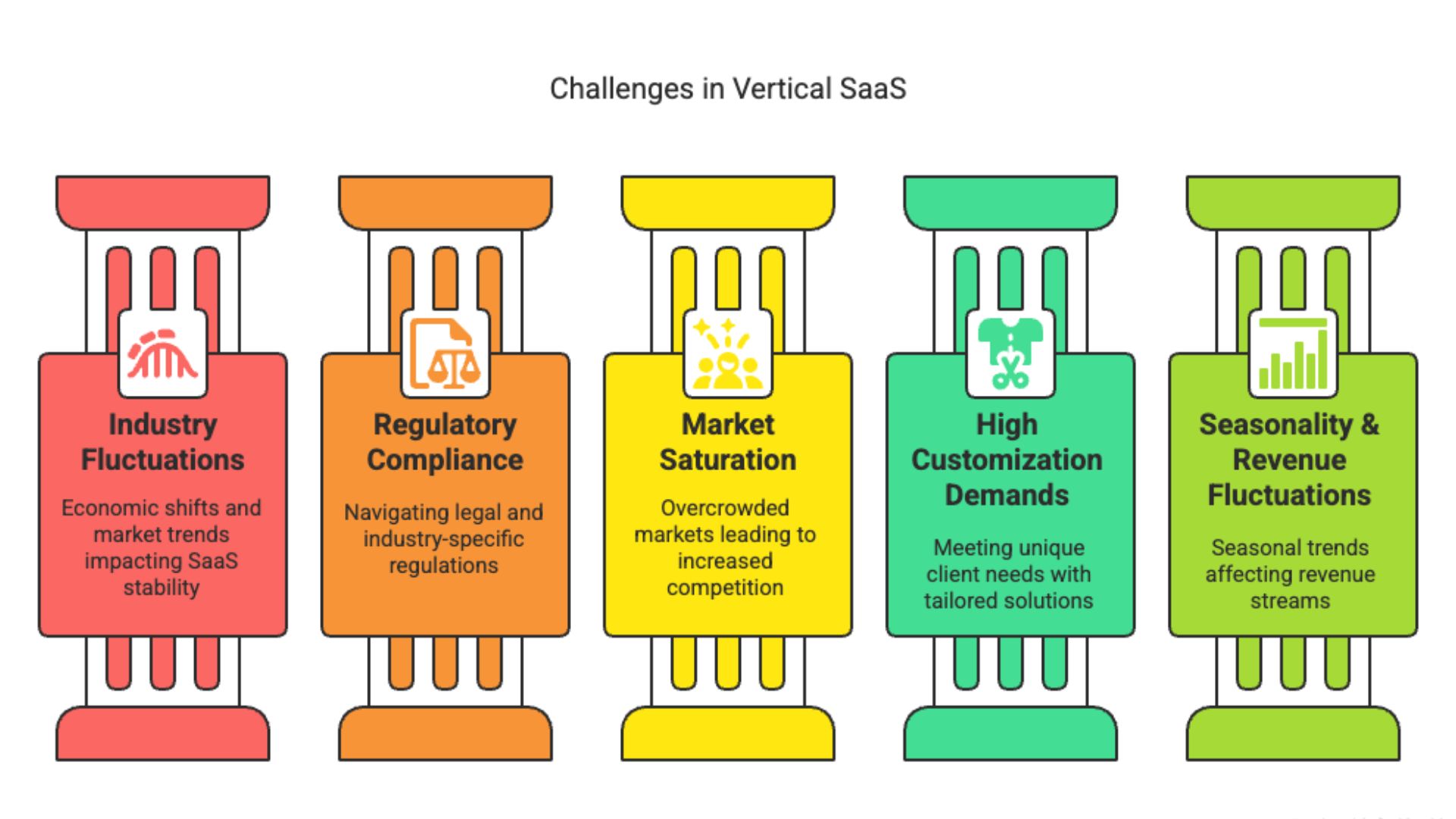
Some challenges to address when working with vertical SaaS (Agami Technologies)
Another challenge is customization pressure. Customers may request features for their unique processes, but accepting too many one-off requirements can make the product harder to maintain.
Over time, the platform may become a collection of customer-specific exceptions rather than a standardized solution for the wider industry.
To manage these risks, providers should maintain a clear product scope and prioritize features that solve common industry problems. This helps Vertical SaaS companies balance customer needs with scalability, maintainability, and long-term growth.
Vertical SaaS, Embedded Finance, and AI
The SaaS business model can grow beyond software by adding services that support more parts of an industry’s workflow. Embedded finance is one example. Payments, lending, insurance, and procurement can be built directly into a Vertical SaaS platform.
It gives customers access to related services without leaving the system. This approach, linked to embedded fintech, can improve convenience while creating additional revenue opportunities. AI can further expand a platform by automating routine tasks and supporting faster decisions.
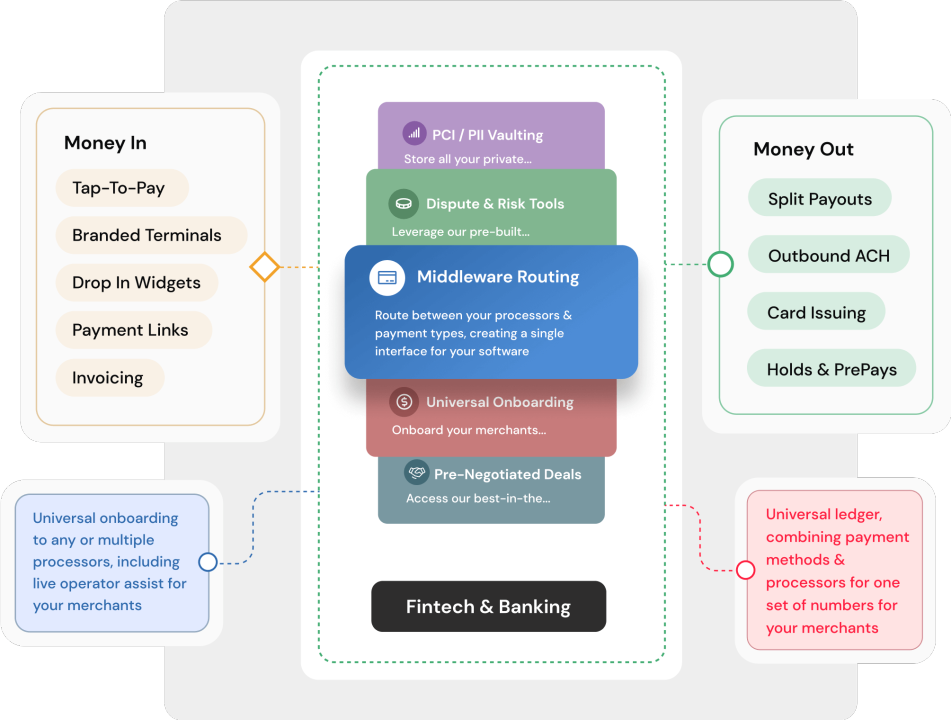
An example of vertical SaaS implementation in fintech and banking (LinkedIn)
For example, AI can help analyze industry data, generate documents, identify trends, or provide recommendations based on specific workflows. The goal should be to solve a clear industry problem and not add AI without a practical use case.
These features depend on reliable data and strong governance. Platforms need accurate data, clear rules for data collection and use, and strong security controls to protect sensitive information. Financial and AI features should provide clear industry-specific utility and fit naturally into the customer’s existing workflow.
When Vertical SaaS Makes Sense
Vertical SaaS makes sense when a specific industry has a recurring and costly problem that general-purpose software does not solve well. The opportunity is stronger when the problem affects daily workflows and creates clear costs in time, resources, errors, or lost revenue.
Before building a solution, teams should validate a few key factors:
- Market size: Is the target industry large enough to support sustainable growth?
- Willingness to pay: Do customers see enough value to invest in a specialized solution?
- Domain expertise: Does the team understand the industry’s workflows, terminology, and challenges?
- Standardization: Can the solution address common needs without excessive customization?
The product should also have room to expand through additional features, workflows, or services.
If growth depends on building unique solutions for every customer, the platform can become difficult to maintain and scale. A strong Vertical SaaS opportunity combines clear industry demand with a repeatable product that can grow across similar businesses.
How to Build Vertical SaaS
Building Vertical SaaS starts with a clear understanding of a specific industry and its most important problems. Begin with a narrow, high-value workflow and research how businesses currently manage it.
Identify the system of record the product should own, then validate compliance, technical, and operational requirements before developing an MVP. After launch, focus on essential integrations and use customer feedback and usage data to guide further development.
The goal is to solve a core problem well before expanding into additional workflows or attempting to replace an entire software stack.
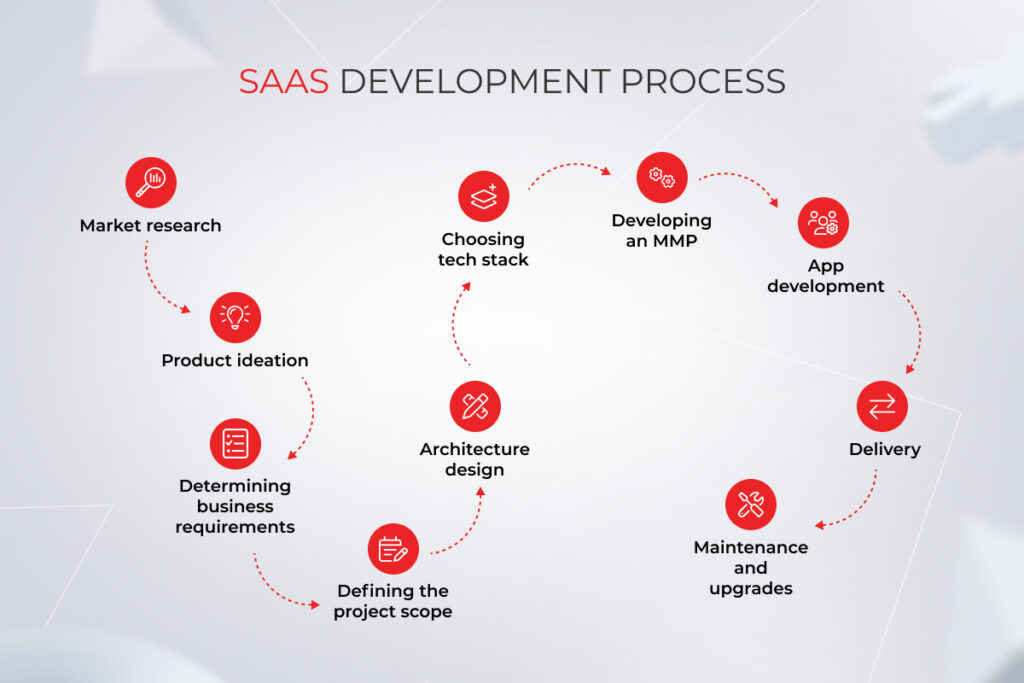
An overview of a typical SaaS development process (instinctools)
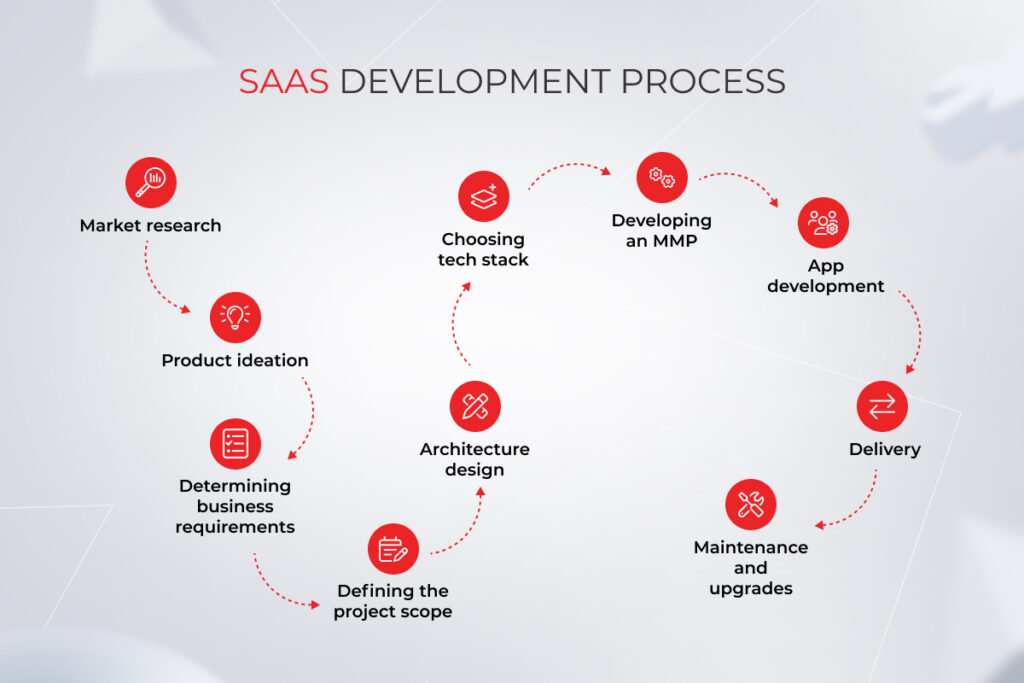
Start with a high-value workflow
Choose a recurring problem that has a clear operational or financial impact. A focused solution is easier to validate and improve than a platform that tries to solve every industry need from the start.
Solve one workflow well before adding more features. This creates a stronger foundation for future product expansion and helps prove that customers are willing to use and pay for the solution.
Build industry expertise
Strong industry knowledge is essential when building Vertical SaaS. Pilot customers and industry advisors can help validate terminology, workflows, data models, and real-world edge cases.
This knowledge should shape both the product and customer support. A deeper understanding of customer needs can also help teams make better decisions as the platform grows.
Plan vertical SaaS go-to-market
A Vertical SaaS go-to-market strategy should reflect how customers in the target industry discover and purchase software. Teams can explore industry-specific channels, partnerships, associations, and other networks while considering any implementation requirements.
Pricing and sales strategies should also match customer economics and expected sales-cycle length. This helps ensure that the business model supports sustainable growth rather than relying only on product adoption.
How to Evaluate a Vertical SaaS Market
Before entering a new market, teams need to understand whether the opportunity can support a sustainable SaaS business model. Start by assessing the number of potential customers and how concentrated the market is.
Review current software spending, market fragmentation, regulations, incumbent systems, and integration barriers. These factors can reveal both the size of the opportunity and the difficulty of entering it.
Also assess how customers behave over time. Look at retention potential, willingness to switch from existing tools, and opportunities for expansion revenue. A strong market should offer a clear problem to solve, customers who value a specialized solution, and enough room for long-term growth.
Vertical SaaS Opportunity Checklist
Before investing in the market, ask the following questions:
- Market: Is the customer base large and accessible?
- Demand: Is there a recurring problem worth paying to solve?
- Competition: Are existing solutions leaving important gaps?
- Switching: Are customers willing to change their current systems?
- Economics: Can pricing support healthy margins and sustainable growth?
- Retention: Is the product likely to become part of an ongoing workflow?
- Expansion: Can revenue grow through additional features, services, or users?
- Scalability: Can the solution grow without excessive customization?
A strong opportunity combines clear customer demand with attractive long-term economics. Teams should validate these factors before committing significant resources to product development or market expansion.
Conclusion
Vertical SaaS succeeds by solving industry-specific problems with greater depth and precision than general-purpose tools. Its value comes from understanding real workflows, supporting specialized requirements, and fitting naturally into how businesses operate.
Horizontal SaaS serves a broader audience but may not address the unique needs of a specific industry. In comparison, building a successful Vertical SaaS product requires more than industry specialization.
Teams need attractive niche economics, strong domain expertise, and disciplined customization. By balancing specialized value with scalability and sustainable growth, businesses can build software that delivers lasting value without becoming overly complex.
Tags:

Creates insightful, strategy-driven content that translates complex design and branding concepts into accessible knowledge, supporting Ramotion’s mission to elevate digital experiences.