
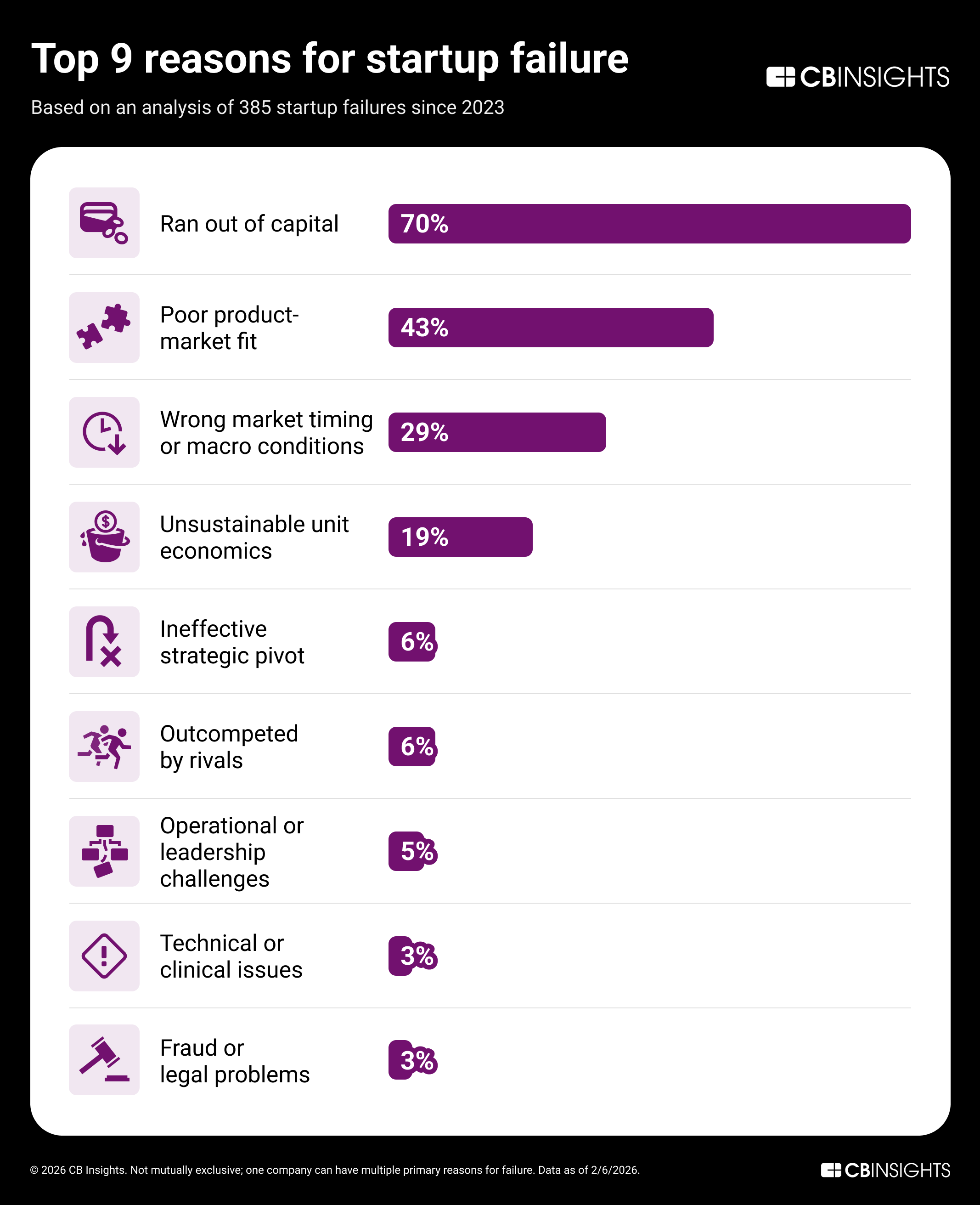
A CB Insights study identifies “poor product-market fit” as a leading cause of business failure, affecting both early- and late-stage companies. The remedy is conducting research before, during, and after building a product. Given its scope, research splits into two complementary disciplines: market research and UX research. Market research came first, answering questions about demand, size, price, and competition. UX research arrived later, once software made it obvious that a product could sell perfectly well and still frustrate users.
Understanding where they overlap and differ in methods, timing, and targets helps avoid costly mistakes and improve long-term product success.
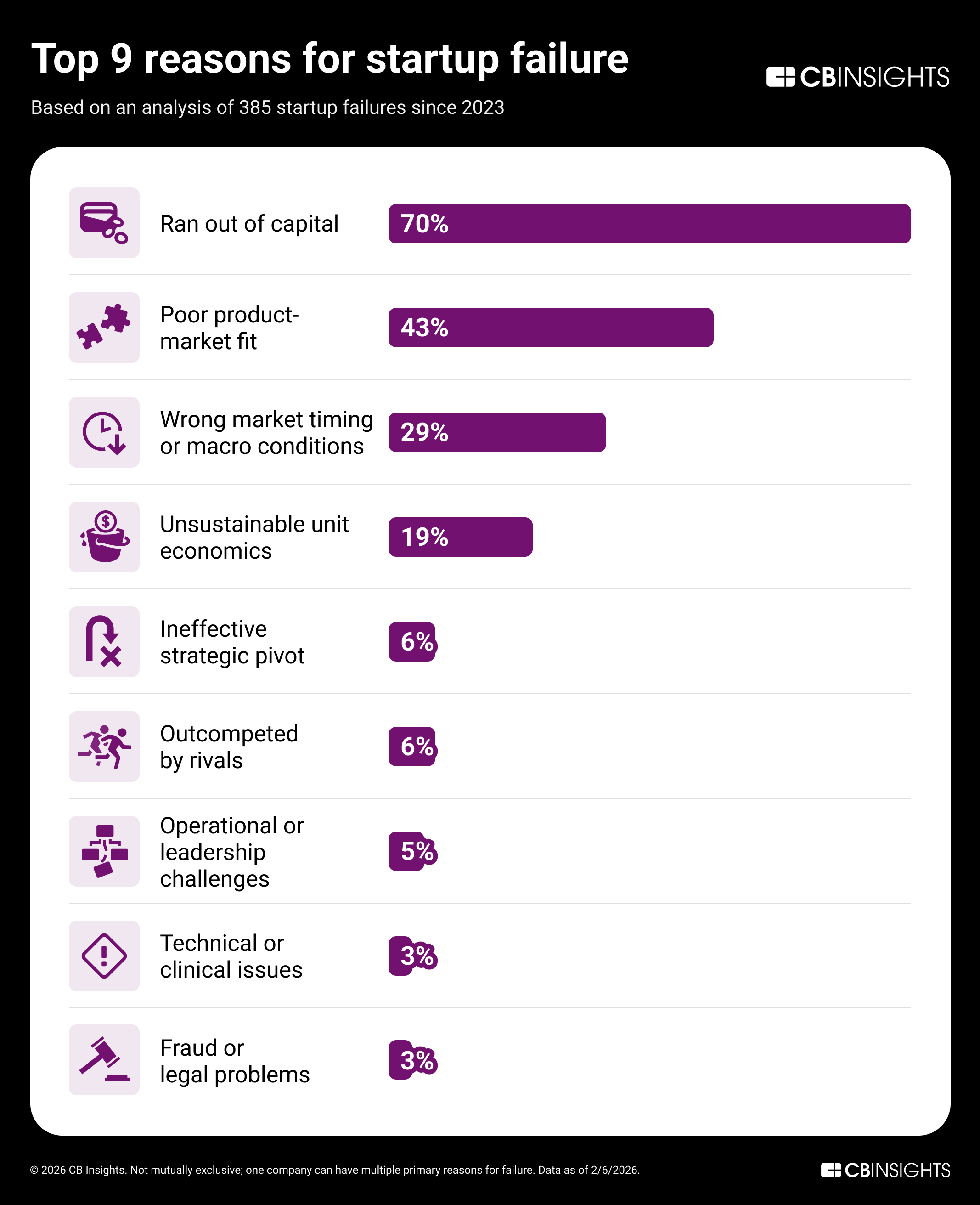
Why startups fail via CB Insights
Market Research vs. UX Research: How Do They Differ?
One is not inherently better than the other. In fact, integrating both covers the full arc in creating a successful product and meaningful customer journey. Below is an overview of the two and the different types of qualitative research and quantitative research conducted.
| Key aspects | Market research | UX research |
|---|---|---|
| Core question | Should we build this? | Does it work for users? |
| When to implement | Before building a product | Before, during, and after building a product |
| Primary methods | Surveys, interviews, competitor and pricing analysis | Usability testing, user interviews, analytics |
| Stakeholders/Who uses it | Executives, product strategy, marketing, sales | Designers, product managers, engineers |
What Market Research Is For
Market research is essentially a feasibility test you run before you commit a single centavo, determining whether there is demand, who has it, and which companies are already serving them.
Typical market research questions
The question clusters into three concerns: demand and opportunity, audience and segmentation, and competition and positioning.
Demand and opportunity questions center on whether the market exists at all: how many people share this problem and whether the market is growing or sinking. Audience and market segmentation questions focus on your actual buyers. In B2B product research, these are frequently different people, which will be discussed later. The third is competition and positioning questions that help discover the market you’re entering and which space you can occupy.
Sample questions include:
- What are people using today to solve the problem?
- What do all the audience segments have in common—demographics, behavior, budget?
- Who makes the buying decision?
- Who are your direct and indirect competitors?
- Are there any gaps you can fill, and where do users complain?
- What price would the market bear?
Common market research outputs
Market research confirms if your idea can be realized, who to aim it at, and how to best position yourself in the market. Five deliverables emerge from this work.
- Market Sizing tells you the slice you can realistically serve and growth projections.
- Market segmentation breaks buyers into demographic and psychographic groups. Sometimes, this is paired with personas—turning a segment into a recognizable character with a name, job, age, personality traits, daily life, problems, etc.
- Competitive analysis maps every direct and indirect alternative your buyer could choose, each with pricing, positioning, strengths, weaknesses, and user complaints.
- Pricing data establishes the range the market will tolerate.
- Positioning statement explicitly claims the space you can own, which becomes the foundation of your marketing and branding.
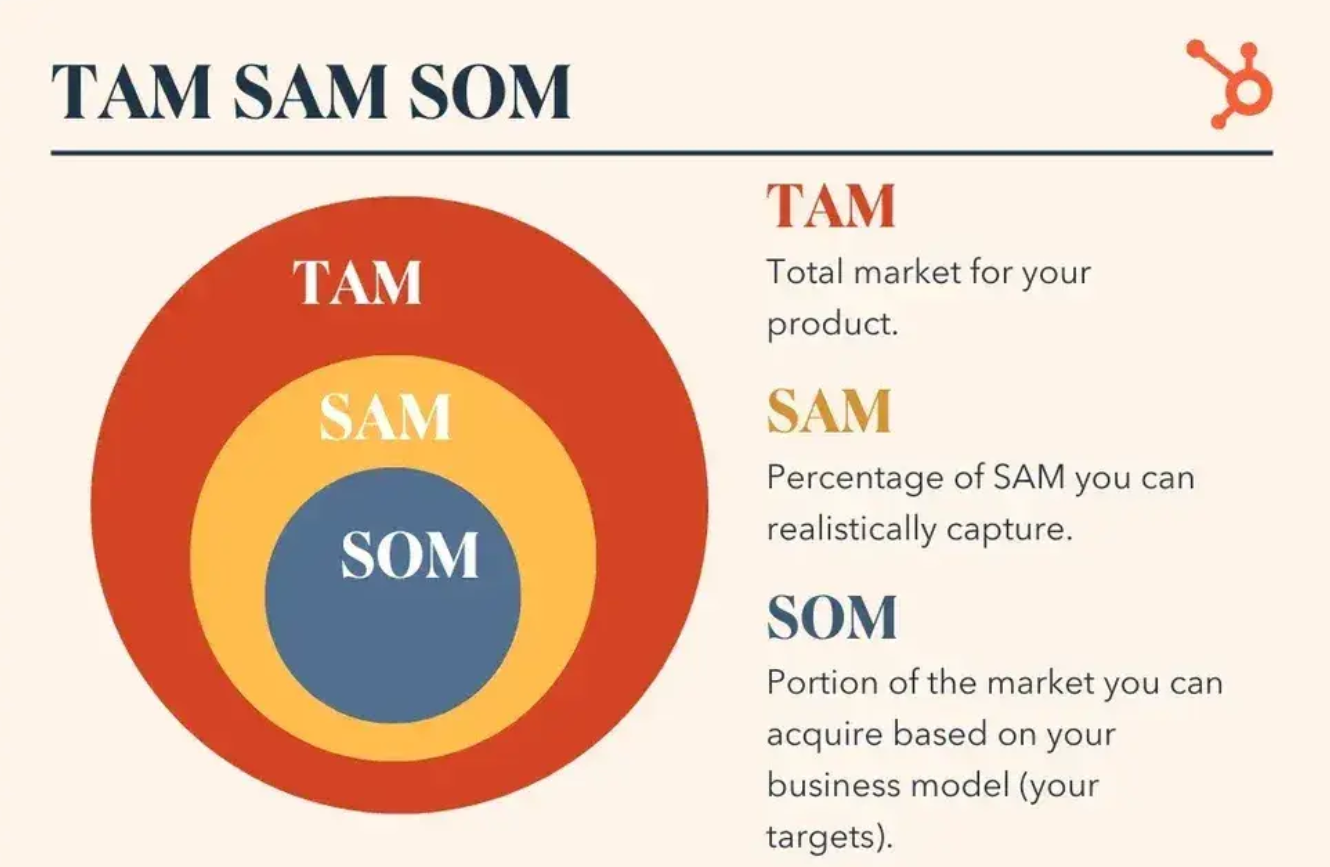
Market sizing via HubSpot
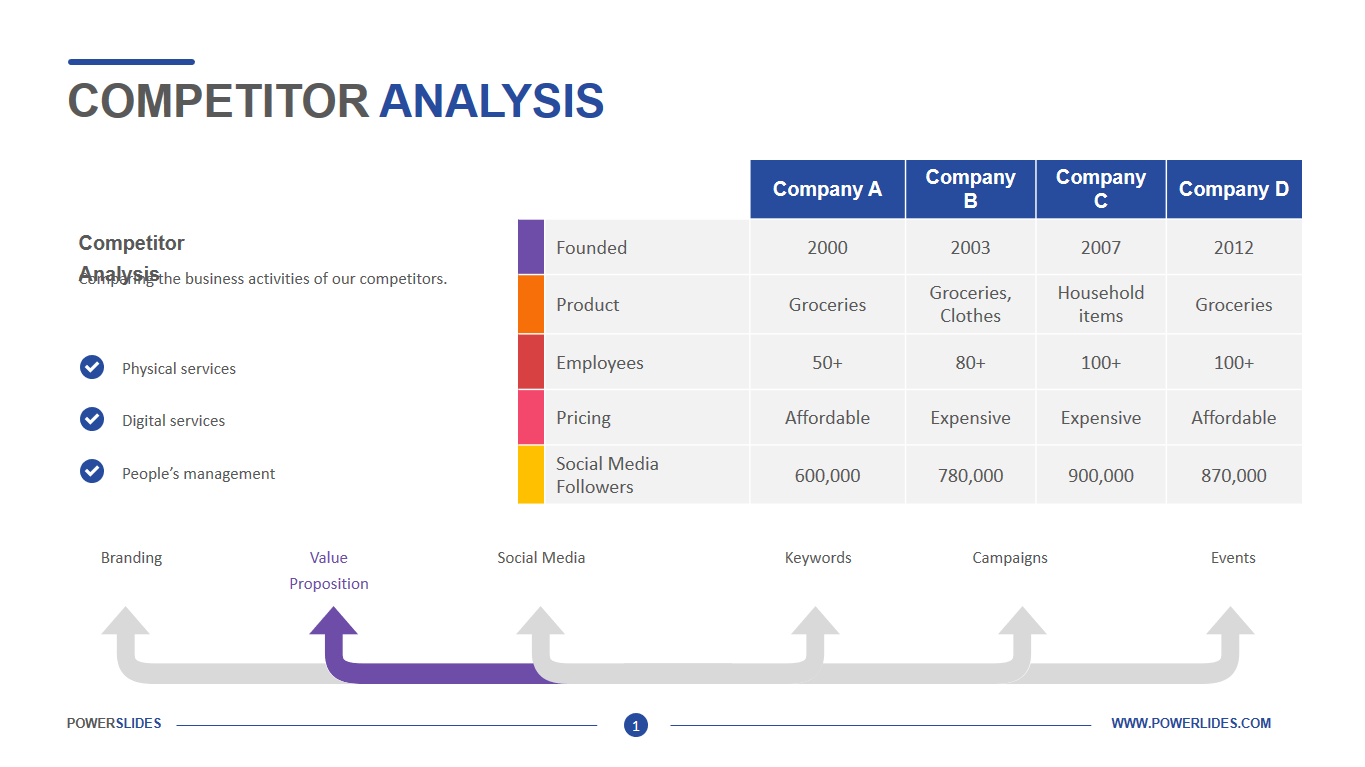
Competitive analysis template via PowerSlides
Benefits and limitations
Market research helps in reducing uncertainty before building anything by exposing blind spots. Its limitations, however, are real. It can become expensive, it captures only present data, and it can be unreliable, since respondents often say one thing on paper and do another. It is therefore best understood as a confirmatory tool that provides enough evidence to move forward with confidence.
What UX Research Is For
UX (User Experience) research studies the person who actually uses the product. It confirms whether the product works as intended and explores its future potential for a better experience.
UX research has two types: generative and evaluative.
Generative vs. evaluative UX research
Generative UX research allows you to explore what users need before you build anything, and is often used in the early phase. It dives into the potential interaction of the user with the product in relation to the problems they want solved.
Evaluative UX research is what happens after the design has been made. It dissects which parts of the experience or the product itself find users frustrating and confusing, and whether they can complete the tasks. Use evaluative user research to confirm what works, so you iterate only what’s necessary.
While generative UX research points you toward what exactly to build, evaluative UX research confirms if you did the right thing.
Common UX research outputs
Generative UX research lets you walk away with the following outputs:
- User personas built from real interviews.
- User journey maps with friction points marked.
- Problem statements based on observed user behavior.
Meanwhile, evaluative UX research brings you:
- Usability findings based on user experience issues—what, when, and where they happened.
- Severity ratings that classify user issues into critical and non-critical.
- Task success metrics like completion rates, time on task, and error rates.
- Revised prototypes according to findings.
Benefits and limitations
UX research builds empathy across the team as they understand the psyche and emotions of users. This allows them to spot friction points better and improve on them, which keeps users coming back. However, UX research only limits itself to validation. It can’t generate new ideas for you, and it also can take a long time to complete, as it is more complex to execute than market research. So, use UX research to test and refine, not to decide what to build in the first place.
Work with one of the best UX design agencies to help run a full market and UX research for your business.
Where Market Research and UX Research Overlap
Market research and UX research pull from the same two kinds of data: attitudinal (what people say) and behavioral (what people do). But they weigh these sources differently, leading to different stories about the same person.
Attitudinal vs. behavioral research
Attitudinal customer research captures opinions, emotions, and preferences gathered through interviews, focus groups, concept testing, and diary studies. It explains why markets behave a certain way and gives you the language to speak to them. But attitudinal data can be unreliable as people may misremember details, rationalize, or say what they think you want to hear.
Behavioral research records actual actions, like clicks, mouse movements, scroll depth, and where the eyes focus. It reveals where users succeed or fail in real contexts, making it more accurate for diagnosing product interaction problems. Attitudinal methods are used afterward to help explain observed behaviors.
Market research generally favors attitudinal data because strategic choices depend on stated preference and intentions. User research prioritizes behavioral data to uncover usability issues and workflow breakdowns that people rarely articulate in customer research interviews.
This difference becomes more evident in B2B content where the customer, user, buyer, and decision-makers are often different people.
Customer, user, buyer, and decision-maker
Market research focuses on buyers (who handle procurement) and decision-makers (who give spending approval). It asks what moves them, like cost, risk, comparison to competitors, etc. The user barely registers here.
UX research concentrates on the end-user or the person who interacts with the product daily. Does it work for them? Where do users struggle? Would they still keep using the product despite having other options? The buyer is out of the picture once purchase is made, and only pops back when it’s time to renew or cancel.
But what about the customer? Who is the customer?
The customer is the one in an ongoing relationship, which is the entire organization. Market research tracks the customer through retention and churn. UX research tracks it through continued use and satisfaction. Together, attitudinal and behavioral methods give a fuller picture of both market opportunity and product impact.
When to Use Market Research, UX Research, or Both
Every product goes through the following stages: ideation, prototype, testing, product launch, and then it either grows, stalls, or totally fails. Implementing the right research at each stage gives you the signals to decide, build, and iterate.
Early opportunity and product strategy
At this stage, there’s no product, just an idea. The goal is to validate market demand, identify who experiences the problem, and decide whether the opportunity justifies the risk and resources.
*Research to conduct: Market Research * Best for demand and opportunity questions, competitive landscape, and early price signals.
Recommended research methods: Market sizing, competitor research
Concept and product development
The idea has solidified into something executable. Now, it’s a concept that can turn into a prototype and, eventually, a real product you can present to the public. At this stage of product research, assumptions about users get tested and corrected, and trial and error is optimized. Mistakes are fixable if you catch them early.
*Research to conduct: Market research, supported by UX research * Market research continues to refine final positioning, pricing, and segmentation. But as real design emerges, user research takes over, getting into the specifics of the cognitive journey users go through.
Recommended research methods: Concept testing, usability testing
Post-launch growth and optimization
The final stage is when the product is already in the hands of end-users. Now, the research shifts its focus to who’s adopting or dropping off and where the funnel leaks. It’s about assessing what to fix and where to grow.
Research to conduct: UX research, supported by market research Evaluative UX research tracks obstacles, drop-offs, and failures based on actual user behavior. Market research picks back up for expansion opportunities, like a new market, segments, pricing tiers, or competitive shifts.
Recommended research methods: Analytics, session recordings, market sizing
B2B SaaS Approval Workflow Example
Let’s look into LedgerFlow, a fictional SaaS company building an expense-approval tool for mid-sized finance teams. Typically, when employees submit expenses, the system routes them to the right approver based on the amount, department, and policy. Before building the product, LedgerFlow needs to have evidence of real demand and a clear picture of how finance teams run approvals.
Market research questions to ask:
- How many mid-sized companies still handle approvals manually?
- How urgent is this fix, and where does it rank against other priorities?
- Who signs off on the purchase, and what do they need to see?
- What are they using today, and what would make them switch to LedgerFlow?
UX research questions to ask:
- Show me the step-by-step of the last expense you submitted.
- Who takes over after submission, and what does each person do?
- What happens when an issue comes up, like a split cost or a missing receipt?
- Where does the process break down, and how do you recover?
Market research vs. user research: Market answers tell LedgerFlow whether to build, while UX answers tell it what to build.
Now, the findings may conflict with each other. In this case, LedgerFlow can use the following framework to weight their options.
| Research outcomes | Demand is real | Demand isn’t real |
|---|---|---|
| Experience works | Build it. | Users like it, but not enough to buy it. Look into other factors, like pricing, positioning, and target audience. |
| Experience fails | Redesign the product before launch. Buyers exist, but the product fails to meet the needs. | Kill it or reframe the problem. |
Research Quality, Ethics, and Privacy Concerns
Lack of informed consent
Many research platforms treat a participant’s blanket agreement to terms of service (something that not everyone reads in detail) as sufficient consent for any study. But this is unethical, taking advantage of a person’s vulnerability. It is best to be transparent about a study’s goals, risks, and outcomes before obtaining consent.
TIP: Laymanize your consent form, clearly defining the study’s purpose, how data is collected and stored, and how participants can withdraw consent at any point.
Inadequate security practices if third-party research vendors
The data from a focus group recording can be just as sensitive as survey responses, especially if they are collected by a third-party research vendor/platform. These platforms may lack the necessary data retention policies to protect participant information.
TIP: Vet your third-party research vendors and check if they have the necessary certificates, like ISO 27001 or SOC 2.
Dark patterns in research recruitment
Recruiting voluntary participants is difficult, which creates pressure to tip the scales. Some companies respond by overemphasizing compensation or understating risks—techniques that risk undue influence. These undermine a participant’s ability to make a genuinely free and informed choice, and can also affect responses.
TIP: Avoid urgency or social pressure when writing recruitment messages targeted towards potential participants. You can also ask a colleague outside the project to review recruitment materials to ensure a neutral and not a coercive tone is used.
UX Research vs. Market Research: The Bottom Line
Research is essential in every business aspect, especially in product development. Market research confirms if there is real demand for a certain product, market sizing, pricing, and positioning, while UX research verifies product usability and its capability to retain users. Used strategically, both research types reduce unnecessary risks and improve outcomes.
So, before you rush into building something, identify strategic questions you want answers to. If it’s whether a product works or not, run UX research. If it’s whether to build, go for market research. And when the two sets of findings disagree, build on market evidence, then launch only when the user experience holds up.

Creates insightful, strategy-driven content that translates complex design and branding concepts into accessible knowledge, supporting Ramotion’s mission to elevate digital experiences.