
You can publish constantly, but only relevant content drives growth. Use a content audit to highlight pieces worth amplifying, remove redundancy, and reallocate resources to pieces that convert. Learn more about what a content audit is, content actions, strategies, tools, and how to measure success.
What is a Content Audit?
A content audit is a periodic process that thoroughly sifts through existing content across multiple platforms with a fine-tooth comb. It spots what works, what doesn’t, and how content marketing can be improved. It assesses the quality and performance of each piece. With a clearer picture, an audit helps brands uncover pain points and opportunities to create fresh, relevant, and impactful content.
Why Run a Website Content Audit?
Running a content audit is necessary to bridge the gap between what your content currently communicates and what your audience actually needs to make informed decisions. It exposes issues like content redundancy, decay, cannibalization, and outdated information.
1. To reduce redundancy
Multiple posts on the same topic dilute authority. An audit identifies overlaps so you can consolidate them into a single, stronger resource.
2. To prevent content cannibalization
When several pages chase the same keyword cluster, they compete in search results. A content audit reveals competing pages so you can merge or refocus them and clarify which page should rank.
3. To remove outdated information
Not all content is evergreen. Regular audits flag obsolete facts, broken links, or irrelevant offers so you can update or remove content.
Content Audit vs. Other Related Audits
Content gap analysis, SEO, and brand consistency audits all examine web content but differ in scope, data collection, and expected outcome.
Content gap analysis
A website content audit inventories existing pages; a content gap analysis finds what’s missing. It compares your site to competitors and search demand to reveal untapped topics and keyword opportunities.
SEO audit
An SEO audit evaluates technical and ranking factors, like site speed, crawlability, indexation, site architecture, and on-page and off-page issues. It defines barriers to visibility so you can fix technical or optimization problems affecting content performance.
Brand consistency audit
This audit checks whether visual identity, messaging, and content across channels align with brand strategy. It draws on market research, reviews, social listening, and competitor benchmarking to spot inconsistencies and recommend corrective actions and prioritize fixes.
| Key aspects | Content audit | Content gap analysis | SEO audit | Brand consistency audit |
|---|---|---|---|---|
| Scope | All existing content | Comparing existing content against competitors, search demand, and audience needs | Website infrastructure, on-page, and off-page elements | Brand performance across touchpoints to ensure it remains competitive and consistent |
| Data collection analyzed | Traffic, engagement rates, conversion data, audience relevance, and content quality | Keyword rankings, search volume, missing topics and queries | Internal links, analytics data, and technical crawl data | Visual identity elements, messaging, tone of voice, marketing materials, digital presence, internal communications, and customer feedback |
| Outcome | Content inventory complete with assessment and actionable recommendations | A list of unexplored topics to inform content strategy | A list of fixes to improve search visibility and page ranking | Assessment of brand identity alignment and an action plan to strengthen consistency |
When to Audit Content
Traffic decline
If you’re noticing a significant drop in your web traffic over a few weeks to a month, low click-through rates, and conversion rates, then you’re due for a website content audit. This could mean the content is not as relevant as you thought, poor SEO, technical issues, or a shift in consumer behavior.
Content backlog
It’s often wise to plan and create content months in advance. But sometimes this results in a backlog, with tons of content waiting to be published. They grow stale before they even go live, often due to changes in information, search trends, and consumer interest.
A content audit reviews your backlog against current performance data to determine which ideas are still worth pursuing.
Rebrand
A shift in brand goals, positioning, or messaging calls for a rebrand. New products are launched, the brand may change its name, and the target audience needs reevaluating—all of which requires a content audit.
Old content speaks in a voice that no longer represents the new brand, visual discrepancies arise, and links may still direct to old URLs. A content audit identifies all these content gaps so they can be rewritten or scrapped to reflect the new brand.
Hire one of the top full-service website development companies for your next content audit and proceed worry-free.
Content Action Framework
The foundational content action framework helps brands decide whether to update, keep, merge, redirect, or delete. They are evaluated in relation to content performance and quality—where performance measures visibility, traffic, engagement, and conversions, while quality assesses accuracy, readability, and brand alignment.
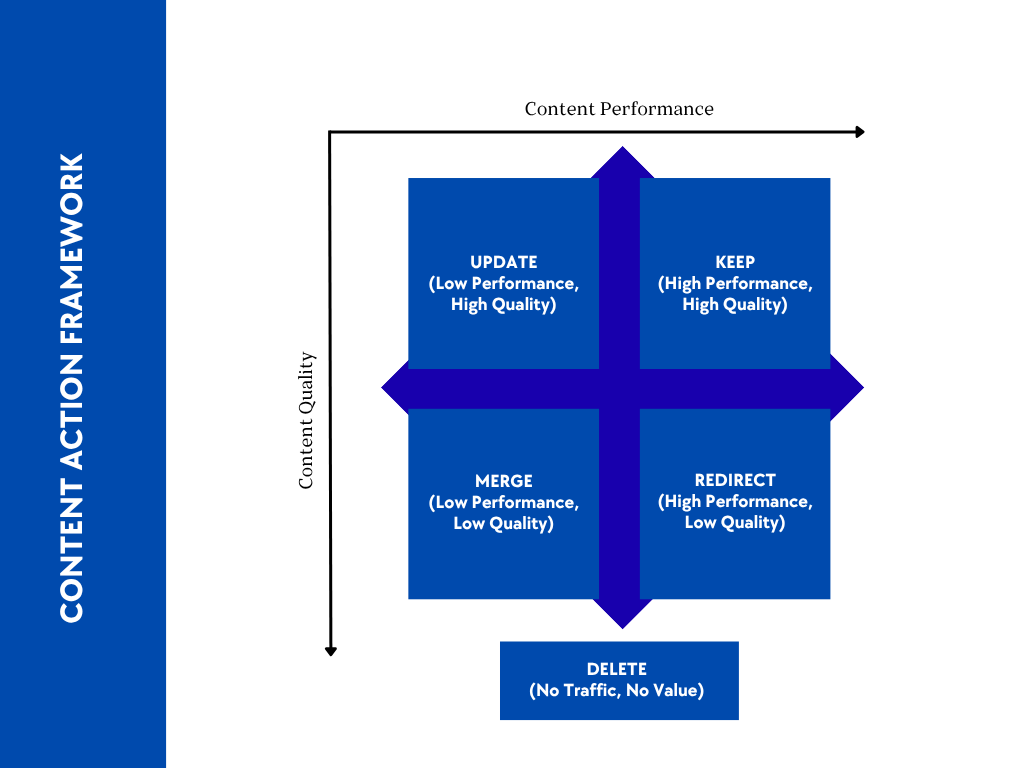
While this framework serves as a guide, not all content can be defined according to performance and quality only. For example, an evergreen article may have lower monthly traffic, but still drives higher value annually than other articles.
A good workaround is to use the framework for specific purposes. You can use the above framework for content with SEO purposes, but not for legal purposes.
How-to Steps: A Content Audit Checklist
Running a content audit doesn’t have to be overwhelming. Here’s a content audit checklist to guide you along the way.
Step 1: Set your content strategy goals and boundaries
The audit goals help set what you want to achieve within your constraints. It creates a clear picture for processing, optimizing, and calibrating content marketing strategy.
For instance, a coffee brand continues to suffer from low web traffic despite publishing hundreds of articles. A viable goal is to double sales in six months by identifying pieces of content that drive low results, merging duplicate articles, and rewriting top-performing posts to promote new products.
Step 2: Catalog everything in an inventory
Create a spreadsheet listing everything published on your website, social channels, emails, and sponsored placements. This central list reveals what exists and supports a thorough audit.
Include these columns in your content audit spreadsheet:
- URL: Direct link for quick access
- Title: Official headline
- Content Type: Article, image, video, podcast, infographic, email, etc.
- Topic: Theme or category, like FAQs, trends, case studies, and behind-the-scenes
- Audience: Intended reader or buyer persona
- Funnel Stage: Top of the funnel (awareness), middle of the funnel (consideration, interest), and bottom of the funnel (decision or conversion).
- Owner: Content creator or copyright holder
- Dates: Content creation and last modified
Keep entries consistent and up to date so the audit can prioritize, identify content gaps, and speed implementation. Regularly review and enrich the inventory with performance tags, content scores, and cross-channel notes to streamline decision-making and track tasks over time as needed.
Step 3: Collect performance data
Collect and measure performance data to see what’s currently working and what’s missing.
- Organic Traffic Search: Visitors who find pages via unpaid search—shows relevance and discoverability.
- Click-Through Rate: The percentage who click your listing or link. A higher CTR signals stronger titles and meta descriptions.
- Bounce Rate: Share of single-page sessions. A high bounce rate means users aren’t finding what they expected.
- Time on Page: How long visitors engage with a page.
- Conversion Rate: The proportion of visitors who take desired actions—signups, purchases, or contacts—after viewing content.
- Keyword Rankings: Where pages appear in search results for target queries. Appearing on the first page generally means better visibility and optimization.
Step 4: Evaluate content quality
Good content answers questions, is accurate, and engages users. It educates about your brand, holds attention, and influences decisions. Measure quality by relevance to common audience queries:
- Does the piece answer the primary question early?
- Is the format appropriate?
Verify facts, dates, and statistics, and cite reliable sources. Assess flow and readability so users can digest content quickly. Finally, check brand tone and personality alignment.
Other technical qualities to consider are image and video quality, internal and external links, and CTAs.
Step 5: Decide what to keep, update, merge, and remove
Use the content action framework to assign an action:
- Keep: Good quality content. No revisions needed.
- Update: It needs optimization—keywords, formatting, information update, etc.
- Merge: Redundant content must be consolidated into one comprehensive resource.
- Remove: Delete irrelevant or off-strategy pages to reduce clutter.
Depending on needs, add actions like Repurpose (convert into other formats) or No-Index (retain thin pages but hide from search). Always record the rationale for each decision as this simplifies implementation, prevents errors, and creates an audit trail for future reviews.
Step 6: Prioritize, prioritize, prioritize
It can take months to complete a content audit, so it’s important to go back to your list and prioritize according to impact and urgency. A priority matrix is valuable at this stage, ranging from lowest to highest priority. Separate content actions that can be implemented in the near future from complex ones that require more time.
For instance, you can sort your content by search traffic (highest to lowest). Select the easy fixes and tackle the top 20 content first before moving to the next set.
Step 7: Implement changes, measure results, and repeat
After creating a priority list, assign tasks to individuals with a relevant set of skills and knowledge. If you want to update and edit an infographic, you can assign the task to a designer. For articles, tag your content writers. Set deadlines, schedule check-ins, and create a feedback system for efficiency.
Don’t forget to assign a leader to oversee overall task monitoring and measure results. This can be your marketing director, project manager, or, in the case of conglomerates, a dedicated content governance committee.
Post-Implementation Metrics: Did Your Content Actions Work?
Below are specific metrics to measure results after completing a content audit. Use the information gathered to strategize your content marketing campaign and iterate your next round of content audit.
SEO performance
Did the content actions improve overall search visibility and page ranking?
- Organic traffic: An increase means improved search relevance. A stagnant or decrease in numbers means missing vital keywords, broken backlinks, or a ranking penalty.
- Keyword rankings: An increase signals better search page visibility. A drop in rankings means low content relevance, over-optimization, or competitors have better content.
- Click-Through Rate (CTR): An increase means title tags and meta descriptions are convincing. A low CTR, despite high page ranking, signals the opposite.
User engagement
Is the optimized content useful, readable, and engaging once users land on the page?
- Bounce Rate: A high bounce rate stems from users not finding what they need quickly. A decreasing bounce rate means the updated content is relevant and engaging.
- Time on Page: A short time on page suggests users are just skimming and exiting too soon. Longer time on page means content has more depth, visuals, and value to users.
- Scroll Depth: If users scroll far down your page, they are consuming your full content. If they drop off sooner (20-30% scroll depth), your content wasn’t a hook.
Business impact:
How did your content efforts impact your revenue and customer acquisition?
- Conversion Rate: An increase in conversion rate means your content is effective in persuading users to take action. A decline may indicate confusing CTAs, page errors, or less compelling offers.
- Revenue Attributions: A high ROI means audit efforts increased business value. A drop in revenue may signal weakened conversion paths and CTAs.
Commonly Used Content Audit Tools
Content audit template
Having a clear and easy-to-follow content audit template makes the process of organizing and analyzing more efficient. It ensures consistency, data centralization, scalability, and accountability. Progress is trackable, allowing you to measure changes over time.
Choose a reusable template so you can run audits periodically without starting from scratch.
1. Google Sheets or Excel
It enables full control over your audit framework. You can customize categories, tags, priority scores, and annotate with ease.
Downside: Manual data entry can be time-consuming.
2. Jotform
It offers ready-to-use templates for standardized reporting across large teams, workflow automation, and consistency.
Downside: Not a comprehensive inventory for large-scale analysis.
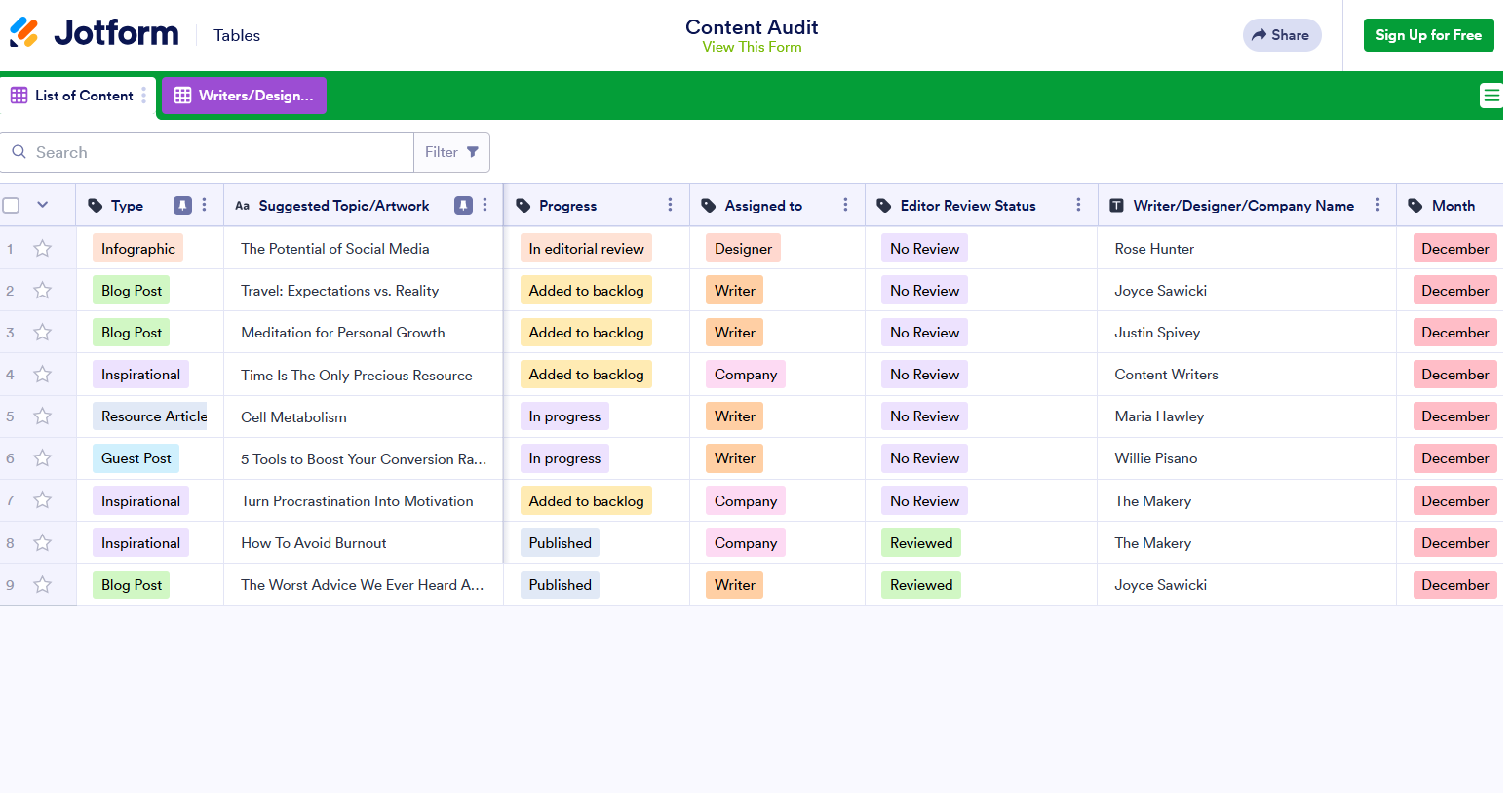
Ready-to-use content audit template via Jotform
Data collection tools
These tools crawl your website, extract metadata, and gather raw information needed for your content audit template. They provide a clear understanding of what currently exists and issues that may be present.
1. Screaming Frog
It pulls URLs, title tags, meta descriptions, and broken links from your website to create your content inventory. These results can then be imported into your template for analysis.
Downside: No cloud version for seamless team collaboration, and the interface can be too technical for beginners.
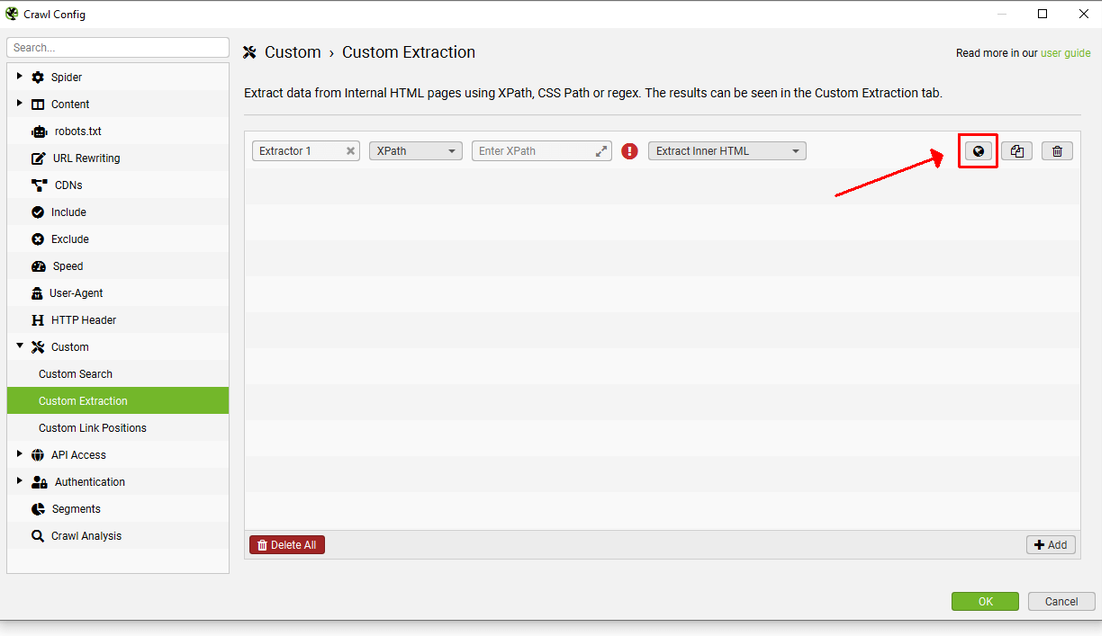
Data extraction via Screaming Frog SEO Spider
2. Supermetrics
It automates the collection of content performance data from Google Analytics, Google Ads, and social media platforms. It also feeds your content audit template with live performance data (traffic, conversions, and engagement metrics).
Downside: It requires setup and configuration for each data source.
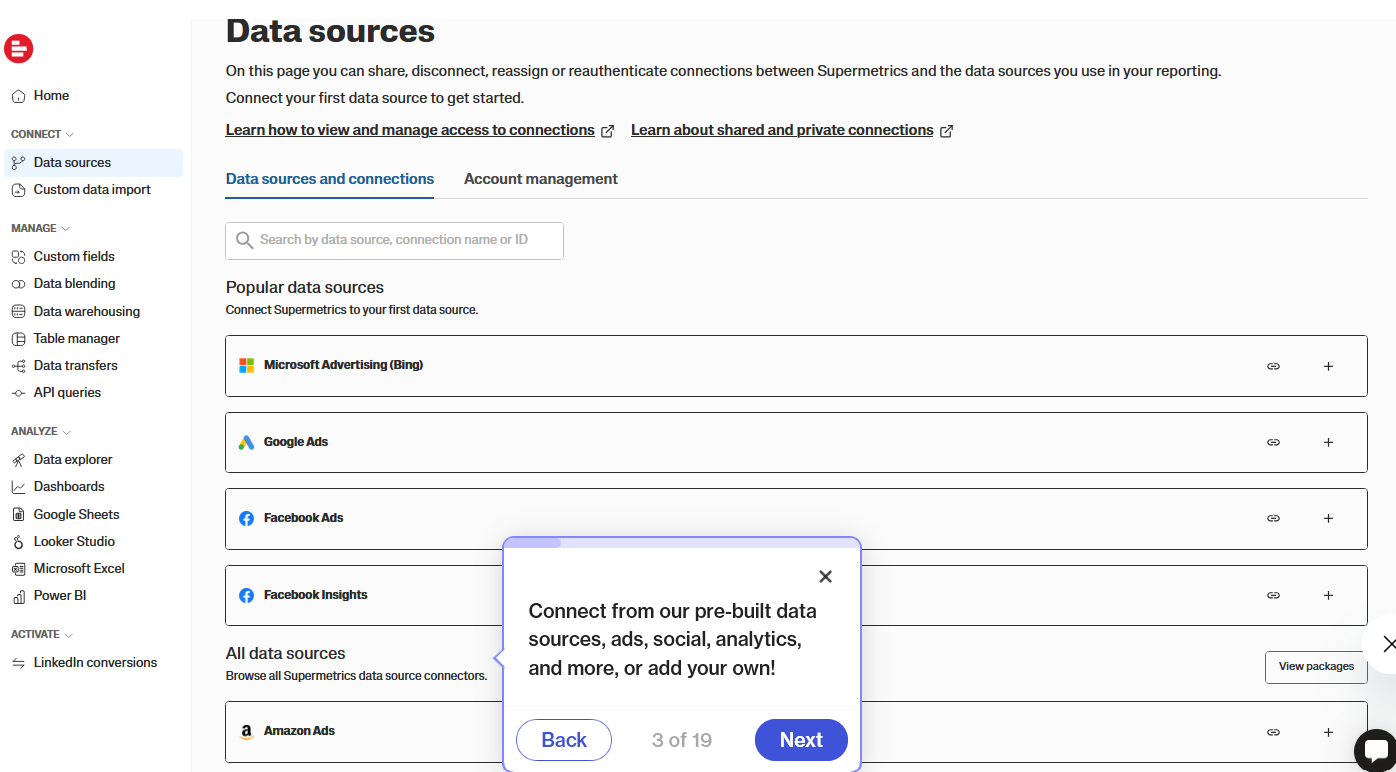
Customize data collection from multiple sources via Supermetrics.
Data analytics tools
These tools tell you how your content is actually performing, turning raw inventory into actionable insights.
1. Surfer SEO content audit
Choose this if you prioritize SEO content performance. It tracks high-traffic pages and allows auto-optimization to update content in just a few clicks. It also integrates AI-driven content optimization workflows for faster turnaround.
Downside: It requires additional tool integration to run full SEO analysis alongside content audit. It can be expensive ($99 to 299 per month) for small businesses.
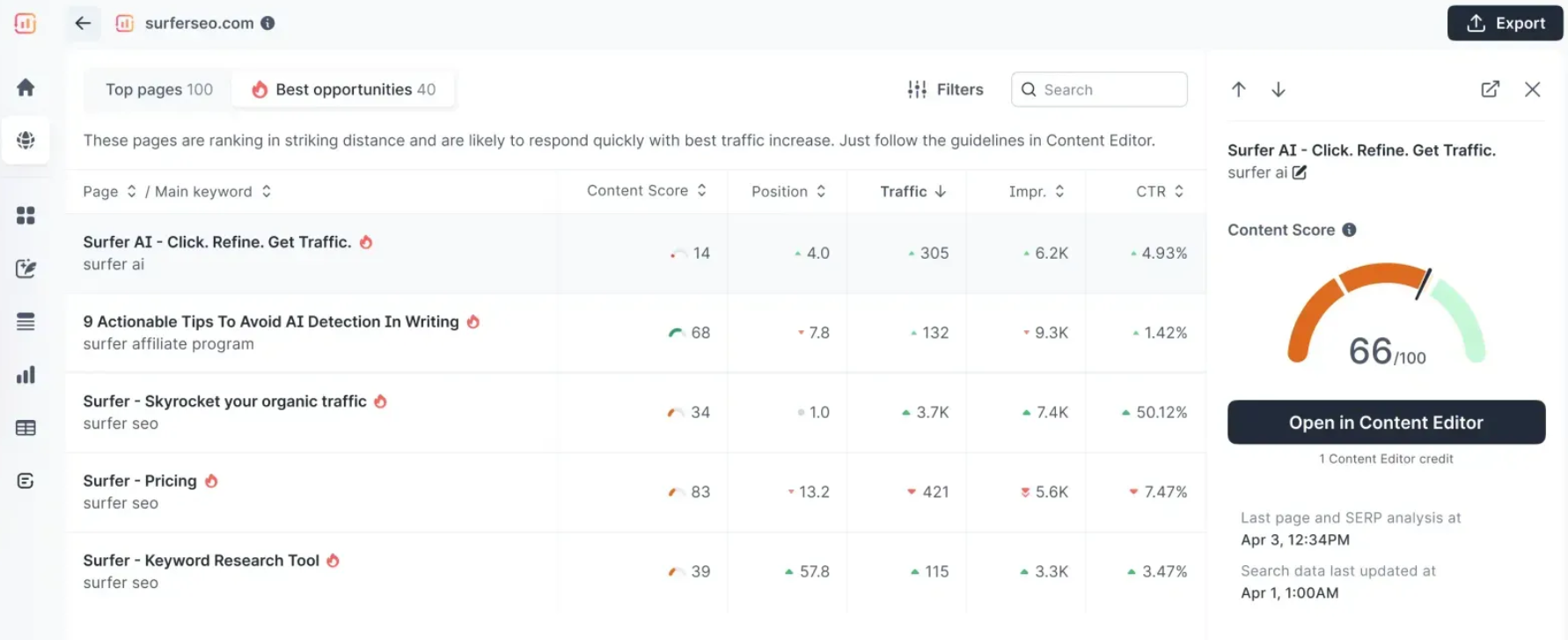
via Surfer SEO
2. Google Analytics
It tracks user behavior (page views, bounce rate, time on page, conversions, traffic sources) on your site and identifies which content drives high engagement and results. And it’s free!
Downside: It can be tricky to use for non-tech-savvy users.
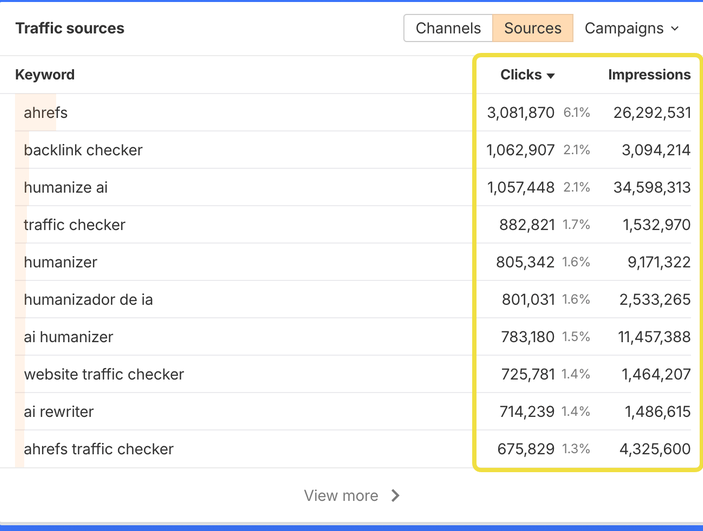
3. Ahrefs
A popular SEO tool that provides keyword rankings, backlink analysis, organic traffic estimates, and competitor insights. You can export data into your audit template.
Downside: Expensive and data freshness varies by metric.
How Often Should You Conduct a Content Audit?
At the minimum, businesses should conduct a content audit once a year. But for larger businesses with massive content libraries, quarterly audits are recommended to stay competitive. This catches the invisible decay that monitoring misses, paving the way for on-time solutions.
That said, consistently monitor performance decline signals, strategic or operational changes, and content decay indicators.
AI in Content Audit Process
More and more businesses are integrating AI into their content audit process, especially for large-scale content libraries. AI helps automate processes, enabling scalability and efficiency.
It provides consistent baseline review, useful for pattern recognition, and faster identification of quality issues. Put simply, AI frees up teams from the mundane without sacrificing content quality and precision. This allows them to focus on more important tasks than manually sourcing and analyzing information.
However, keep in mind that AI tools are not perfect. They cannot check their own work. Human judgement remains essential for assessing quality, context, and intent. While it can process at scale, it cannot determine whether text overlap is legitimate or whether content meets nuanced brand requirements.
The Payoff
Content audits often sit low on the to-do lists. This is especially true for small businesses that would rather spend time on more important and urgent matters. But a content audit is a quiet superpower that can help you as you scale.
Done right, a content audit process reveals opportunities, reduces maintenance, and sharpens messaging. It can turn neglected content into measurable growth and save you money in the long run.

Creates insightful, strategy-driven content that translates complex design and branding concepts into accessible knowledge, supporting Ramotion’s mission to elevate digital experiences.