
A website is more than just an information dump. It’s a platform where brief but powerful interactions happen, leading to an action: a signup, a purchase, or a download.
This is where a conversion-focused website matters. It captures the right leads, generates revenue, and strengthens your brand image. If you’re unsure where to begin, read on for tips and strategies to optimize website conversion.
What is Website Conversion?
Website conversion is the website working to persuade users to take action. These actions lead to results, like signing up, downloading an app, or completing a sale. Done strategically, it turns passive visitors into warm leads ready to commit.
How to Calculate and Interpret Conversion Rate
The website conversion rate formula is simple. Divide the number of conversions in a specific period by the total number of visitors or interactions, then multiply by 100. If an ice cream shop gets 2,500 visitors in a month and 100 orders, its conversion rate is (100/2500) × 100 = 4%.
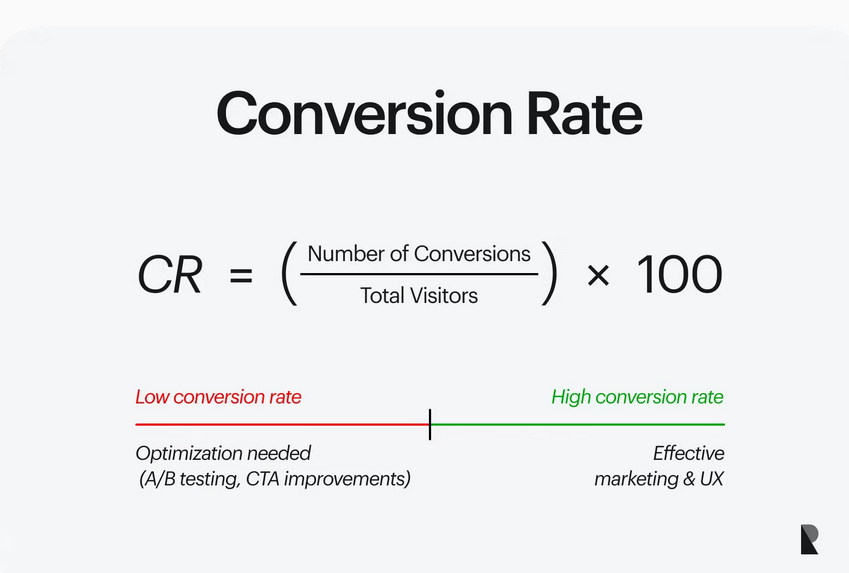
Conversion Rate Formula
What conversion rate reveals
The conversion rate acts as a thermometer. It tells you whether the people who visit your site find what they’re looking for and can take the next step. It’s an essential metric that guides how to improve marketing, product, and design best.
Industry benchmarks for conversion rates
There is no universal good conversion rate. Benchmarks vary by business model, industry type, user intent, and how you define conversion. Here are a few cited average conversion rates to guide you.
- eCommerce: Shopify reports an average site conversion rate of around 1.7%.
- SaaS: Conversion rates vary by stage. The visitor-to-lead-generation rate is at 7%, lead-to-opportunity conversion rate at 36%, and opportunity-to-sale conversion rate at 27%
- Professional Services, Finance, and Real Estate: Data from Ruler Analytics shows average conversion rates of 3.1%, 4.6%, and 2.4%, respectively.
Why Conversion Rate Matters for Marketing Performance
Understanding how conversion rates fluctuate across factors helps set realistic goals and compare them to relevant industry standards. High conversion rates indicate that your marketing strategies are effective, while low conversion rates signal a need for improvement.
Here’s how conversion rate boosts marketing performance:
- It demonstrates the effectiveness of a marketing campaign in converting visitors into leads or customers.
- It exposes weak points and opportunities for growth.
- It tells you where to funnel your budget, focusing on strategies that deliver better results.
- It reduces guesswork, allowing marketers to make informed decisions.
You can hire a marketing website development agency to create a strategy that effectively meets your goals.
Core Factors That Move Website Conversion Rate
Conversion is a compound result. Improving it means addressing several elements: UX, UI, page performance, CTAs, and traffic quality.
1. UX
Good UX anticipates needs by providing a clear structure, a smooth flow, and minimal decision friction. Common barriers include confusing information architecture, long contact forms, inconsistent messaging, and inaccessible design. Addressing these issues, such as clarifying headings, streamlining forms, and enhancing error messages, can yield substantial benefits by eliminating confusion.
A website’s UX must be grounded in understanding user behavior, needs, and pain points. This leads to longer site visits and higher engagement, which are strong indicators of website conversion success.
2. UI design
Your website must clearly communicate and establish trust. While clean typography, coherent spacing, and on-brand imagery catch attention, aesthetics are only helpful when they are also functional. Aim for a visual hierarchy that directs the viewer's eye to the most important information and actions.
3. Page speed
People are impatient. A study by Portent found that an e-commerce site that loads in 1 second is more likely to double its earnings than one that takes 5 seconds to load.
Optimize for speed without sacrificing the web experience. Prioritize reducing initial load, optimizing images, using a CDN, and limiting third-party widgets.
4. CTAs
Call-to-Actions (CTAs) prompt users to act. Without them, users may remain passive, resulting in lost opportunities. But it’s not as simple as randomly adding a button to your webpage.
CTAs must be strategically placed to deliver results. They should be clear, use action-oriented language, and create urgency by defining a benefit to users.

Strong CTAs via Hello Fresh
5. Traffic quality
Large traffic numbers are flattering, sure, but meaningless unless the visitors are relevant. The quality of your website visitors matters. You want engaged visitors with a strong intent to buy for better conversion rates. Targeting, messaging, and channel choice determine the quality of traffic.
How Conversions Impact ROI
Optimizing for website conversion makes investments worth every penny. With a higher conversion rate, your budget is allocated effectively by acquiring customers at a low cost.
Tips on how to increase your website conversion rate
1. Set clear and measurable website conversion goals
Defining exactly what you want to improve and achieve can lead to higher conversion success. You know how to allocate your time and resources effectively to achieve realistic results.
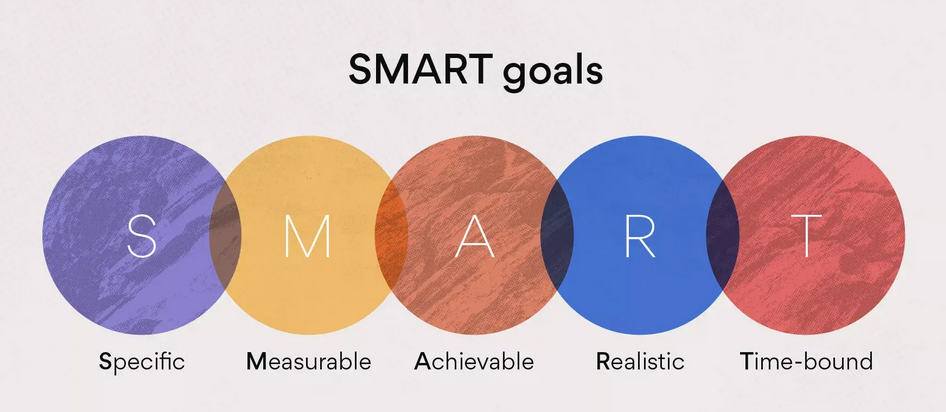
SMART framework via Asana
Conversion goals must adhere to the SMART framework, where each goal is specific, measurable, achievable, relevant, and time-bound. For instance, SMART website conversion goals can look like the following:
- Boost product purchase conversion rate from 2% to 3.5% in three months.
- Increase memberships by 10% within six weeks.
- Reduce the shopping cart abandonment rate by 20% in 90 days.
Conversion optimization is not a one-time fix. So, start small and remember that incremental changes can compound over time for sustained growth.
2. Analyze user behavior with heatmaps and analytics
Understanding how users behave provides valuable insights into how to optimize your website for better conversions. Think of it as a diagnostic phase, leveraging both qualitative and quantitative data to gain a comprehensive understanding of how your website performs and its areas for improvement.
Analytics tools, such as Google Analytics, Hotjar, Crazy Egg, and Adobe Analytics, reveal the what and why of every interaction. They identify friction points, confirm whether the current web design works as intended, and uncover opportunities for an improved page experience.
Meanwhile, heatmaps take a closer look at every page interaction with your users.
- Click heatmaps reveal whether your primary buttons are effective or not.
- Scroll maps reveal exactly where on the page users lose interest.
- Move maps identify reading patterns and spot fields where movement becomes inconsistent.
3. Research competitor strategies
Identify gaps and opportunities by knowing your competitors. Check their key conversion paths, such as the checkout page and subscription page, as a customer, and assess which strategies work and which create existing friction.
Look into their CTAs, headlines, subheadlines, and other navigational elements to identify key strategies. Analyze prices, lead magnets, and special offers. You can also source insights from customer reviews on third-party sites and their responses.
Deconstructing your competitors’ strategies can be valuable for creating a better, working conversion funnel.
4. Simplify navigation to reduce friction
A clear and seamless navigation experience begins with the right content structure. The users must intuitively understand where they are, what the website offers, and where to go next without exerting too much effort.
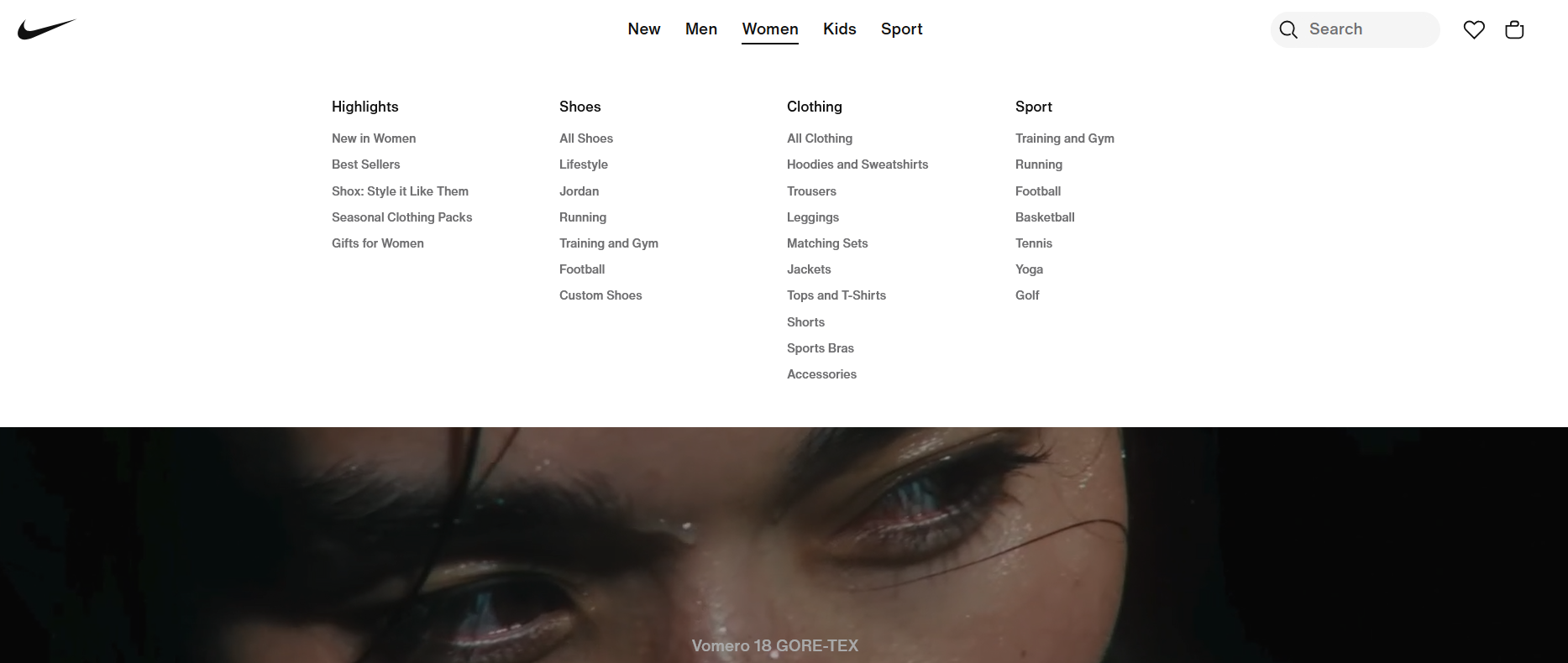
Product Navigation Menu via Nike
Start by using logical sub-categories for your products that mirror how actual users shop in a store. If a female customer is searching for a skirt, the subcategory breakdown should be: Women → Bottoms → Skirts.
Implement a simple menu with a few primary links to reduce cognitive overload. And maintain consistent navigational elements, such as hamburger menus, dropdown menus, footer navigation, and a search box. Doing so creates a predictable interaction pattern that reduces user effort and anxiety.
5. Create clear, action-driven CTAs
A website CTA that is vague, boring, and inconsistent confuses visitors and overwhelms them. While you want to push for action, the words you use, placement, and the number of CTA buttons matter.
Be clear and keep your CTAs simple. Instead of saying “Click Here,” use a CTA that explains what happens or what they will gain when they click the button. For instance, use phrases like “Get Your Discount” or “Complete Purchase.”
Be visually strategic by placing your CTA buttons where visitors can easily notice them. Choose contrasting colors to make them stand out, and place them near the important content.
6. Add social proof and testimonials
Here’s the truth: people are more likely to trust people instead of businesses. They seek recommendations from friends and family and read customer reviews before making a purchase. Social proof and customer testimonials are powerful tools for building trust and relationships.
Utilize your existing customer base and solicit feedback. You can dedicate a testimonial page, add a reviews feature on your product page, or cross-post comments and feedback from your social media pages.
Adding social proof to your website signals transparency and confidence in your brand. It is equally important to acknowledge and address both positive and negative feedback. This helps improve your products and services, increasing customer satisfaction.
7. Ensure mobile-friendly, responsive design
Data shows that roughly half of web browsing is done on mobile devices. Therefore, mobile-specific decisions matter more than trying to squeeze desktop-designed websites onto a small screen.
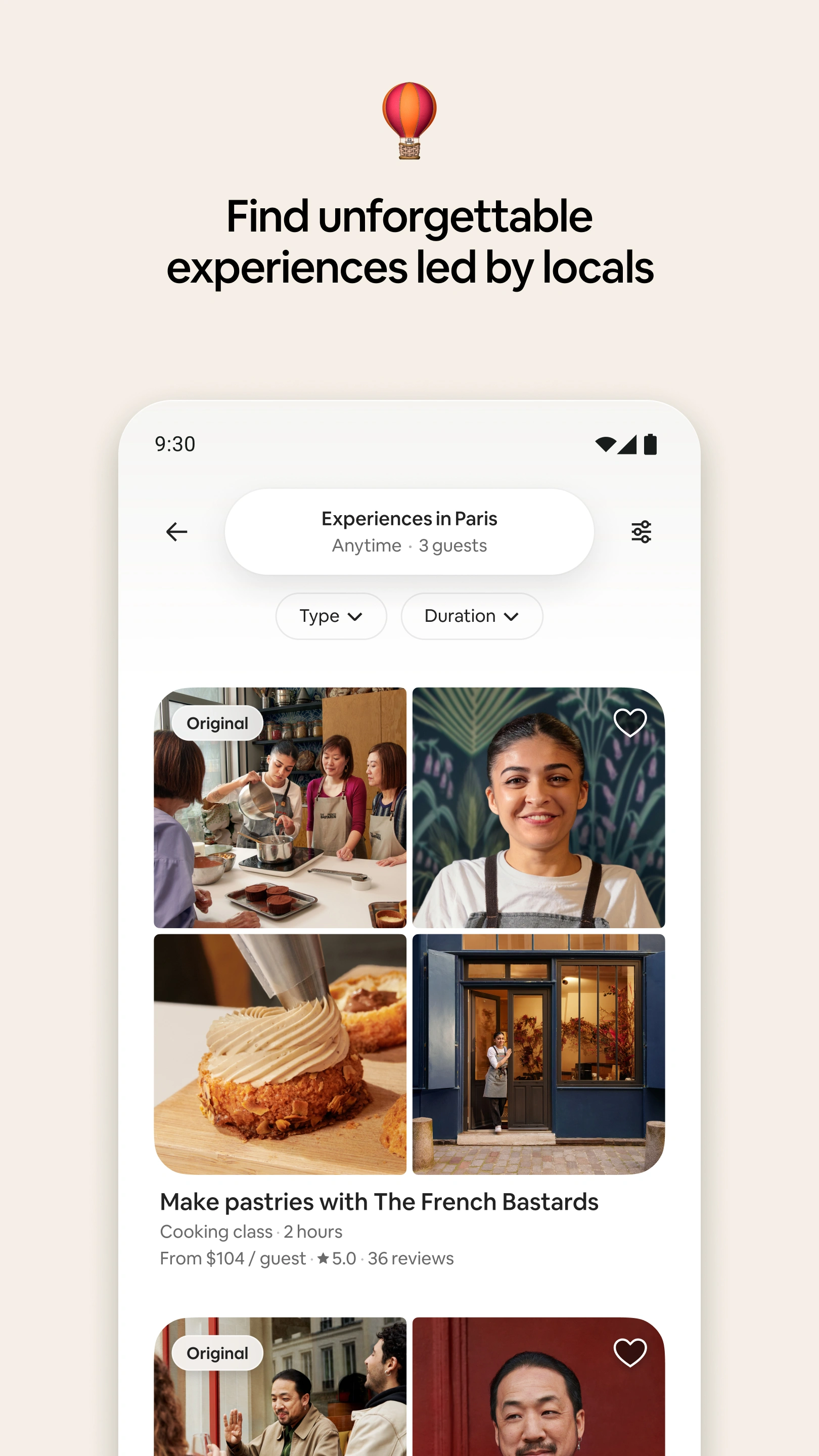
Mobile-friendly design of Airbnb via Google Play
Here are ways to create a seamless mobile website experience.
- Load the most critical parts of your page first, so users see what matters right away, even on slow internet connections.
- Keep forms short and mobile-friendly.
- Use large buttons so visitors can easily tap them.
- Leverage mobile-specific Call-to-Actions that use strong verbs and clear value, like “Shop Now,” “Get a Free Quote,” and “Claim Your Offer”.
8. Improve page load speed
Visitors usually take less than a minute to decide whether a website addresses their needs. You can optimize your website for speed by compressing media files without compromising quality, utilizing a Content Delivery Network (CDN) to enable visitors to load the site from the closest server, and minimizing third-party plugins to only the essentials.
9. Fix technical issues blocking website conversions
A broken link, a long form, slow page load times, and a non-responsive design—these are just a few technical problems that may leave your visitors frustrated. Fortunately, there are tools available to help you identify these issues before they become a significant turnoff.
Use keyword research tools like SEMrush and Ahrefs to determine whether your site aligns with the top search engine queries. Analytics tools, like Google Analytics, help identify barriers through behavior flow analysis, page load time monitoring, and bounce rate testing.
10. Reduce cognitive load
Ask only for what you need. Shorter forms, progressive disclosure that show essentials first, and clear inline help reduce abandonment. For purchases, offer guest checkout so they don’t have to create a new account and minimize steps.
11. Run regular A/B and multivariate tests
A/B testing isolates the effect of a single change. Multivariate tests examine combinations but need more traffic. However, it’s essential to know which one to use and when.
If you are testing a completely new change on your website, you can use an A/B test. It is simple and requires less traffic than a multivariate test. However, if you are testing multiple minor changes—such as button combinations, headlines, and CTAs —multivariate testing is best. It shows how different elements interact.
Let tests run long enough to achieve statistical confidence and avoid overlapping experiments that can muddy the results. You can also work with one of the top website design firms to optimize your website for maximum conversion.
Example of a Website Conversion Optimization Checklist
A conversion optimization checklist provides a step-by-step guide to ensuring your website drives results. It includes tasks, features, and tips for effective implementation. It’s also ideal to track key metrics that measure progress and the impact of each checkpoint, such as conversion lift.
The conversion optimization checklist may vary depending on goals and priorities. You may want to focus solely on macro-conversions or incorporate micro-conversions to enhance the journey.
For example, an online floral shop would have something like this:
| Website conversion optimization checkpoint | Description | Impact focus | Tools | Conversion Lift |
|---|---|---|---|---|
| Mobile-first design | Ensure the website loads under 2 seconds on mobile | User experience, speed | BrowserStack, Google Lighthouse | 3-7% |
| Clear Category architecture | Organize products by occasion, color palette, and price tier, with smart search to find them in 3 clicks. | Navigation | Google analytics | 10-12% |
| Urgency cues | Use messages like “Order by 2 PM for same-day delivery” to encourage faster purchases | Website conversion rate boost | Hotjar, Crazy Egg, Sumo | 23-35% |
| Live chat & chatbots | Provide 24/7 support to answer questions | Engagement, conversion | 8-12% | |
| Customer reviews, UGCs, & testimonials | Highlight positive feedback to build credibility | Social proof,brand trust | Trustpilot | 15-20% |
Grow Your Website Conversion Today
Improving website conversion is rarely a single execution of a brilliant strategy. It is a continuous process of understanding and listening to visitors, making incremental changes, and learning from what happens. The work is partly technical and partly understanding users' cognitive behavior, so you can effectively eliminate friction, answer questions clearly, and invite action intuitively.
If you treat your website not merely as an information board but as a communication platform where the experience you provide creates and enriches relationships with your users, conversions will follow.
Dec 29, 2025

Creates insightful, strategy-driven content that translates complex design and branding concepts into accessible knowledge, supporting Ramotion’s mission to elevate digital experiences.